
Related videos:
The State Department has begun to assign personnel to the U.S. Southern Command (SOUTHCOM) in Miami, in anticipation of possible hostilities with Cuba, as revealed this Thursday by Axios in reporting on the new sanctions announced by Secretary of State Marco Rubio.
The movement is happening in parallel with the tightening of measures by Washington against the Cuban regime. This Thursday, Rubio announced sanctions against the military conglomerate GAESA, its director Ania Guillermina Lastres Morera, and the mining company Moa Nickel S.A., under the executive order signed by Donald Trump on May 1, aimed at punishing those deemed responsible for repression in Cuba and threats to U.S. national security.
Alongside the relocation of personnel, the State Department is also strengthening its disaster preparedness supply center in South Florida. The initiative includes the integration of civilian advisors at SOUTHCOM facilities, which officials describe as part of a new humanitarian and contingency strategy.
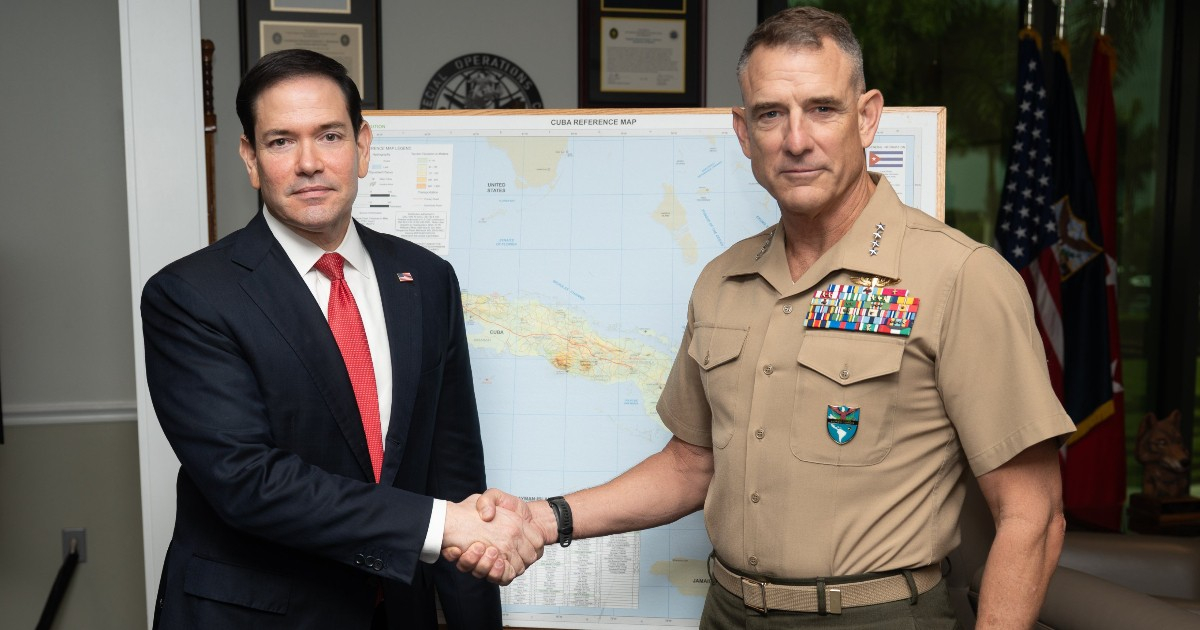
The signs of a possible escalation are not limited to these measures. Last Tuesday, Rubio chaired the 2026 Heads of Mission Conference at SOUTHCOM headquarters in Doral, Florida. During the meeting, Southern Command released an image of the Secretary of State shaking hands with General Francis L. Donovan in front of a prominent map of Cuba, while the slogan "Peace through Strength!" was projected on a screen.
One day later, during a press briefing at the White House, Rubio acknowledged that the meeting with Southern Command "had something to do with Cuba", although he refrained from providing details about the discussion.
Within the same conference, the head of the U.S. mission in Cuba, Mike Hammer, also held a meeting with Admiral Adam Chamie, commander of the Southeastern District of the Coast Guard.
Regarding the new sanctions, Rubio described GAESA as "the heart of Cuba's kleptocratic communist system," asserting that it controls between 40% and 70% of the island's formal economy, including hotels, ports, remittances, and foreign trade.
Regarding Moa Nickel S.A., it was stated that the company "has exploited Cuba's natural resources to benefit the regime at the expense of the Cuban people" and that "it profits from assets originally expropriated by the Cuban regime from American citizens and corporations."
The impact of the measures was almost immediate. The Canadian company Sherritt International, partner of Moa Nickel S.A., announced this Thursday the suspension of all its operations in Cuba and the repatriation of its expatriate personnel. This decision deprives the regime of its primary foreign mining partner and could affect between 10% and 15% of the island's electricity generation capacity.
Rubio framed the sanctions within a broader offensive against Havana. "Just 90 miles from U.S. territory, the Cuban regime has driven the island to ruin and has auctioned it off as a platform for foreign intelligence, military, and terrorist operations," he stated.
Neither Trump nor Rubio have ruled out the possibility of military action. The president threatened last Monday to send the USS Abraham Lincoln aircraft carrier to the shores of Cuba and reiterated the warning the following day in a television interview.
Since January 2026, Washington has imposed over 240 sanctions against the Cuban regime and has intercepted at least seven tankers linked to the island's energy supply, reducing fuel imports by between 80% and 90%, according to figures cited by the U.S. administration.
Rubio indicated that the pressure will continue to increase. "Additional appointments can be expected in the coming days and weeks," he warned.
Filed under: