
Related videos:
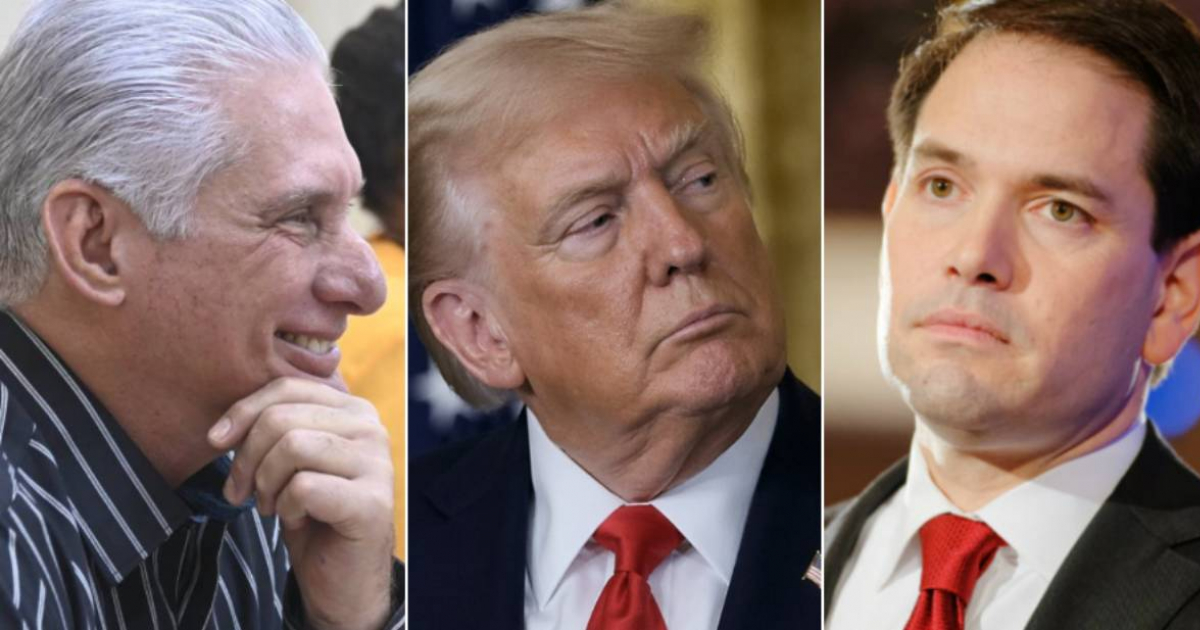
Miguel Díaz-Canel responded to Marco Rubio following the statements made by the Secretary of State at the White House, in which he denied the existence of an oil blockade against Cuba.
The Cuban leader attempted to discredit the U.S. Secretary of State, claiming that he is unaware of the executive orders signed by Donald Trump.
In a message published on X, Díaz-Canel wrote: "It is surprising that a senior official of the U.S. government publicly claims that his government does not impose an energy blockade against Cuba, and is unaware of what is stipulated in the Executive Order of his own president from January 29."
Díaz-Canel also noted that Rubio had not heard "his president and the spokesperson for the White House address the issue," referring to previous statements that did implicitly acknowledge the energy blockade.
Rubio had declared from the podium of the White House: “There is no oil embargo against Cuba as such. Cuba used to receive free oil from Venezuela. They were given quite a bit of free oil. They would take about 60% of that oil and resell it for money. It didn’t even help the people.”
He added, "Nowadays, with oil prices, no one is giving away oil, much less to a failed regime."
He attributed the Cuban energy crisis to the collapse of Venezuelan supplies and described the island's government as a "failed state," adding: "The only thing worse than a communist is an incompetent communist. And that's what we have: incompetent communists running that country."
Díaz-Canel responded directly to that accusation: "It is equally surprising that he blames the supposed incompetence of the Cubans for the difficulties facing the economy, as it is that the U.S. government has set out and continues to set out to destroy it, investing considerable resources and political capital to achieve this."
According to Miguel Díaz-Canel, the actions of the Trump administration contradict Rubio's narrative.
On January 29, Trump signed the Executive Order 14380 against the Cuban dictatorship, which declared Cuba as an "unusual and extraordinary threat" and imposed secondary tariffs on any country or entity that supplied oil to the island, resulting in a reduction of Cuban energy imports by between 80% and 90%.
The President of the United States himself had implicitly acknowledged the blockade in early February by stating: "It doesn't have to be a humanitarian crisis. They could come to us and we would make a deal. That way, Cuba would be free again."
However, on February 20, Donald Trump signed another executive order that ends the additional tariffs imposed under the International Economic Emergency Powers Act (IEEPA), including those related to Executive Order 14380 against the Cuban government.
On March 30, there was another significant turn of events. The sanctioned Russian tanker Anatoli Kolodkin docked in Matanzas with approximately 730,000 barrels of crude oil.
It was the first major shipment of fuel to the island in over three months, and the operation was made possible because the White House chose not to block it for humanitarian reasons. "If a country wants to send some oil to Cuba, I have no problem with that," Trump stated at the time.
On May 1, Trump signed a third executive order that expanded sanctions on the energy, defense, mining, and finance sectors, including secondary sanctions on foreign banks that do business with sanctioned Cuban entities.
This Monday, the leader stated: "Cuba is completely devastated at this moment. It would be an honor to liberate it."
The Chancellor Bruno Rodríguez Parrilla had accused Rubio on Wednesday of "lying" and "contradicting the President and the White House Press Secretary," labeling him as the "architect of the blockade."
The fall of the Chavista regime had a devastating impact on the Cuban people due to the interruption of oil supplies. Cuba produces about 40,000 barrels per day domestically, while the demand is between 90,000 and 110,000.
The result is daily blackouts in more than 55% of the territory, with an energy deficit of 1,750 megawatts exacerbated by the failure of the Guiteras thermal power plant, while the Cuban economy is projected to contract by 7.2% in 2026.
Rubio concluded his remarks on Monday with a warning that captures Washington's stance: “Things are going to change”, describing Cuba as “an unacceptable situation 90 miles from our shores.”
Filed under: