
Related videos:
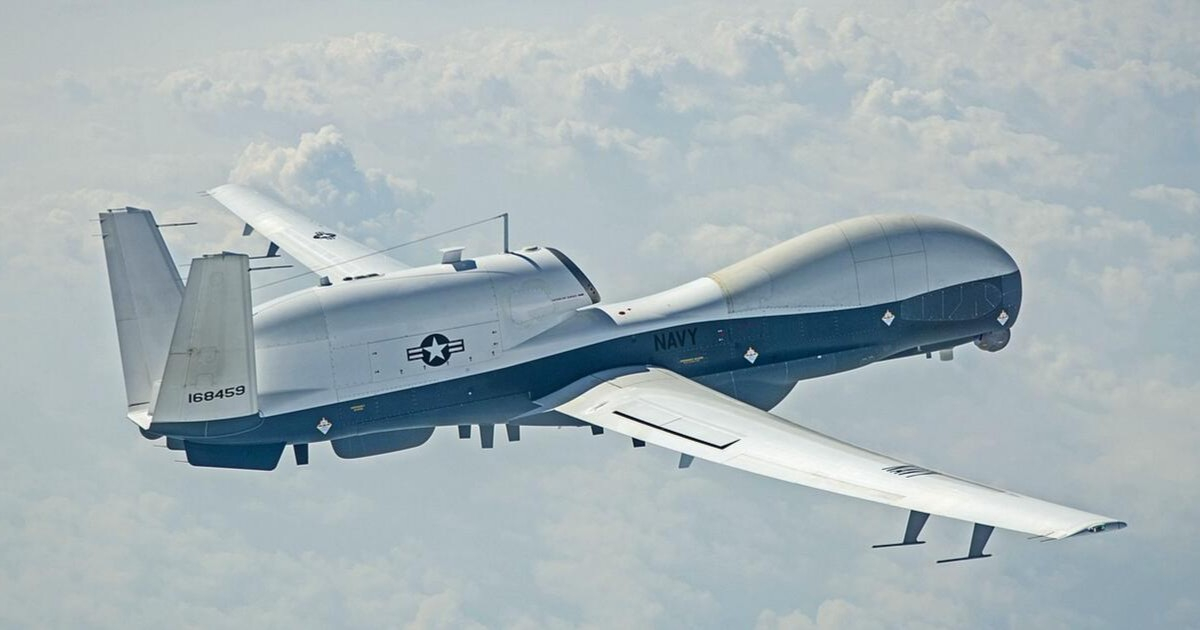
A MQ-4C Triton maritime surveillance drone from the United States Navy, identified by the call sign BLKCAT5 and the hexadecimal code AE67E8, conducted a new monitoring flight around Cuba and strategic areas of the Caribbean on Wednesday, according to records from Flightradar24 captured during the mission.
The aircraft took off from the Mayport Naval Air Station in Jacksonville, Florida, and conducted a wide-ranging flight over the Gulf of Mexico, the Yucatán Channel, and areas near the east and south of Cuba, operating at a barometric altitude of 46,950 feet (~14,300 meters) and at a speed of 580 knots for several hours.
The tracking captures show extended trajectories with orbit patterns characteristic of intelligence, surveillance, and reconnaissance missions, commonly referred to by the acronym ISR.
This flight is not an isolated incident. It is at least the fourth documented episode of aerial surveillance by the Triton near Cuba so far in 2026, amid a sustained escalation of U.S. military presence in the region.
The same BLKCAT5 was detected on February 6 north of the Cuban archipelago, accompanied by RC-135 spy planes and two P-8A Poseidons in a joint intelligence operation.
On April 16 and 17, another Triton with the call sign BLKCAT6 conducted an extensive nighttime mission over Pinar del Río, Santiago de Cuba, and the surrounding areas of Havana. The open-source analysis account FlconEYES noted at the time that the aircraft "patrolled south of Santiago de Cuba and the entire flight was along the southern coast around the Island."
On April 21, the BLKCAT5 drone returned to operate in the Gulf of America at an altitude of 47,000 feet, as confirmed by intelligence sources from open sources.
All these flights are part of the Southern Spear Operation, launched in September 2025 under the U.S. Southern Command with an estimated cost of 3 billion dollars for military deployment in the Caribbean, described as the largest U.S. military presence in the region since the Cuban Missile Crisis of 1962.
The MQ-4C Triton is one of the most advanced drones in the U.S. Navy: manufactured by Northrop Grumman, it can operate for over 24 continuous hours, cover up to four million square nautical miles per mission, and fly at altitudes over 50,000 feet, equipped with 360-degree radar, optical and infrared sensors, and signals intelligence capabilities. Its unit cost is around $240 million.
The flight on Wednesday comes just days after the U.S. activated the FLEX2026 exercise in Key West, integrating drones, artificial intelligence, and maritime units, and after the Trump administration signed a new executive order expanding sanctions against Cuba in the energy, defense, mining, and finance sectors.
The political context in which this new flight occurs is one of maximum tension. On May 1, Donald Trump threatened at a private dinner in West Palm Beach to send the aircraft carrier USS Abraham Lincoln "one hundred meters from the Cuban shore" to force the regime's surrender.
Last Tuesday, Trump reiterated the threat to deploy the aircraft carrier off the coast of Cuba, describing the Island as "completely devastated."
On April 27, Secretary of State Marco Rubio warned that Cuba "only has two destinations: neither is good," additionally accusing the regime of harboring Chinese and Russian intelligence on its territory.
The regime, for its part, has responded with rhetoric of armed resistance. Díaz-Canel replied to Trump on May 2, stating that "no aggressor, no matter how powerful, will find surrender in Cuba." The following day, he warned of the imminent threat of military aggression and declared that "every Cuban has a rifle."
Filed under: