
Related videos:
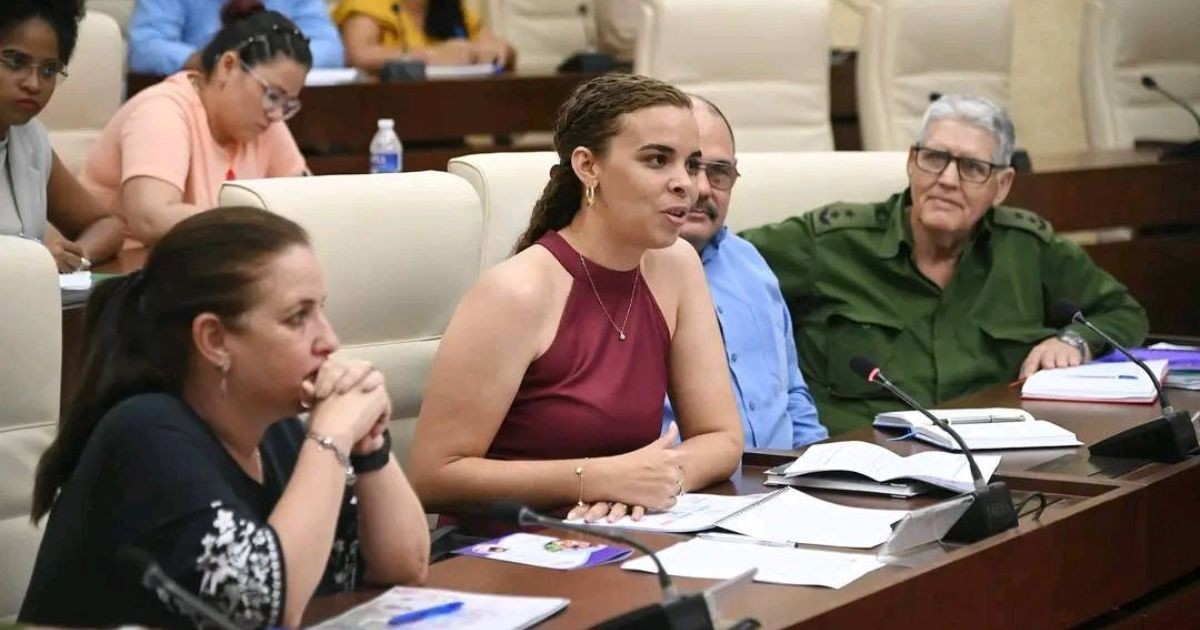
Meyvis Estévez, the first secretary of the Union of Young Communists (UJC) at the national level, posted on Facebook this Friday a glowing tribute to the Community Youth Network, one of the flagship programs of Miguel Díaz-Canel's regime, describing the initiative as "a beautiful task" and "gigantic," capable of transforming Cuban neighborhoods.
The "lyrical" enthusiasm of Estévez comes at a time when Cuba is facing a projected contraction of the GDP of -6.5% in 2026 according to CEPAL, power outages of up to 20 hours a day or more, and an average salary of only 16 dollars per month—facts that the official discreetly omits with the silent elegance of Cuban state propaganda.
"There are things that cannot be measured solely by numbers, reports, or goals. There are things that are felt," wrote Estévez, using his characteristic "poetic" prose that seems crafted precisely to sidestep the numbers, reports, and goals that outline the economic disaster of the Island.
The secretary of the UJC recounted that "a few days ago" she met with President Miguel Díaz-Canel to assess "how we are progressing in this first stage" of the Network, and she highlighted a presidential phrase that, in the current Cuban context, sounds more like a confession than inspiration: "In every place, there is something to beautify, there is some institution to improve."
Indeed. There is much to beautify: almost everything. And there are institutions to improve: practically all of them. However, the solution proposed by the regime is not to reform the system that led to the collapse, but to mobilize youth brigades to paint schools and organize game afternoons.
Officially launched on April 7, 2026, the Community Youth Network is structured around seven projects under the slogan "Innovate, Create, Lead" and operates through brigades at the levels of popular councils, municipalities, and provinces. Among its most revealing components are the so-called "digital beehives," designed to combat "fake news" on social media and transform youth communication into "a weapon for ideological battle." Painting murals and monitoring others' thoughts, all in one package.
Estévez, who on April 3 had already led the Anti-Imperialist Youth Parade "Here, with Fidel" — one of the many tributes to the former dictator — calling for "to resist, innovate, and create amidst adversity", asserts in his post that "when the Network moves, the whole neighborhood moves with it." What he does not mention is where the majority of Cubans are moving: towards the exit.
The population of Cuba has fallen to 9,748,007 inhabitants, the lowest level since 1985, following a negative net migration of 251,221 people just in 2024. More than a million Cubans have left the island between 2021 and 2025, and it is estimated that 30% of those emigrants are between 15 and 34 years old: precisely the audience that the Community Youth Network aims to "organize, engage, and fill with colors."
Díaz-Canel himself acknowledged on April 17 that the youth exodus is "a painful wound," although he blamed capitalism for "buying" the talent educated for free in Cuba. The irony was not lost on many Cubans who recalled that his stepson studies at a private university in Madrid, far from any digital beehive and any afternoons of play in the neighborhood.
In May, the Community Youth Network expanded its mission: in addition to painting schools, its brigades began distributing the "Family Guide for Civil Defense" in the neighborhoods, as part of the regime's military preparations. So, in addition to the list of "beautiful" tasks, another one must be added: preparing the population for a potential armed conflict, candles included.
Estévez concludes his post with a phrase that, when read carefully, comes off as involuntarily honest: "Because you, young people, students, neighbors, friends, are immersed in various battles. But not distant or abstract battles: these are the ones we experience in our neighborhoods, with our feet on the ground and our hearts in our hands."
Battles against hunger, darkness, and despair, yes. Those are the real battles of young Cubans in 2026, and no mural of revolutionary enthusiasm will resolve them.
Filed under: