
Related videos:
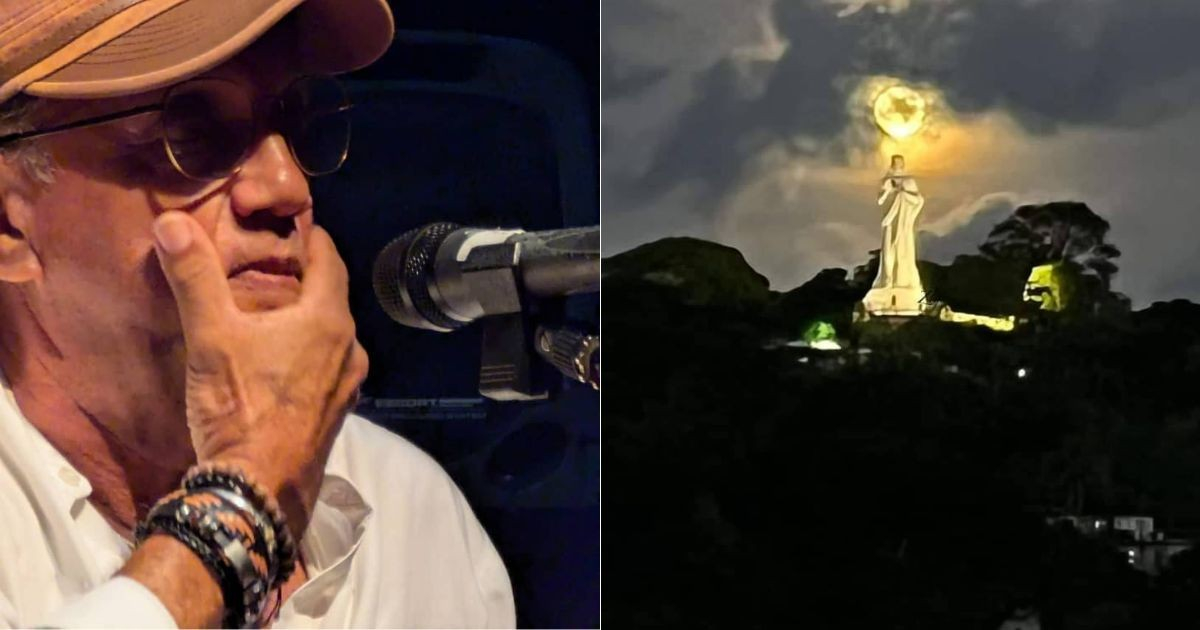
The Cuban writer and musician Frank (Francisco) Upierre Casellas published the poem "Cuando se va la luz" this Friday on his Facebook profile, a piece with a strong symbolic weight in which he transforms the chronic blackouts endured by Cuba into a metaphor for collective fear and the agony of a country that is crumbling.
The poem, closed in 2026, arrives at one of the moments of greatest energy collapse that the Island has experienced in its recent history, with daily electrical deficits this week ranging between 1,440 and 1,900 MW, blackouts exceeding 20 hours in several provinces, and entire cities without radio or television signals.
From the very first verses, Upierre Casellas names without euphemisms what Cuba experiences: "darkness arrives with its roar / with its tooth of darker shadow / to bite the humble flesh of the nation."
The darkness of the poem is not only that of a blackout: it is also that of institutionalized fear, that of a closed horizon, that of a life that unfolds amid shadows imposed by decades of dictatorship.
The author writes: "it doesn't even respect the sunny dawn / with its mantle spread over wide dimensions / it envelops and darkens the life of living," verses that depict a darkness that no longer distinguishes between day and night, between the possible and the impossible.
The harshest verses of the poem encapsulate the mood of millions of Cubans: “every day is the fear of shadows / and nights are the fear of the fear of shadows,” an image that amplifies terror to the point of becoming unbearable.
And the closing is a sentence: "the darkest part of darkness is the dark void / that makes us foresee the slow death of the country."
The poem carries special weight because its author is not a marginal or dissenting voice in exile, but rather a writer shaped within the cultural institutions of the regime: a member of the Unión de Escritores y Artistas de Cuba (UNEAC), a winner of national competitions such as the Dulce María Loynaz in 1992 and 1993, and the author of books like: The Magic Watercolor and It’s Raining in Havana.
Born in Guanabacoa, Havana, in 1956, Upierre Casellas holds a degree in History and began his connection with literature in 1978 in workshops on the Island of Youth, led by Soleida Ríos, Alberto Serret, and Chely Lima, as noted in the digital encyclopedia Ecured. Since 1990, he has also been a professional musician, first in the trio Madrigal and later in the quartet Olorun. In 1996, he wrote the lyrics for the Anthem of Guanabacoa, the source specifies.
That a voice like this, recognized and awarded by the system itself, speaks of "the slow death of the country" says as much about the state of Cuba as any statistical data.
And the data is devastating. On May 7, the maximum electrical impact reached 1,876 MW at 8:40 PM, with service interrupted for 24 consecutive hours. Matanzas accumulated over 40 continuous hours without electricity, while Santiago de Cuba lost radio and television signal due to the generation deficit.
The Antonio Guiteras power plant went out of service on May 5 due to a boiler failure, resulting in a loss of 140 MW, worsening a system that was already operating at its limit. This Saturday, the completion of repairs was announced, although the restart of Guiteras remains a promise yet to be fulfilled.
The energy collapse is just one aspect of a broader crisis. According to the Cuban Observatory of Human Rights, 89% of the Cuban population lives in extreme poverty, seven out of ten Cubans have skipped meals due to lack of food or money, and 78% intend to emigrate.
Power outages are the main concern for 72% of Cubans, followed by the food crisis (71%) and the cost of living (61%), according to the same study.
In that context of literal and metaphorical darkness, the verses of Upierre Casellas serve as testimony and as a denunciation: "it puts scales of shadows in our eyes / empty gems impossible to see the light upon the waters / and to sniff around the clear corners of the Island."
Filed under: