
Related videos:
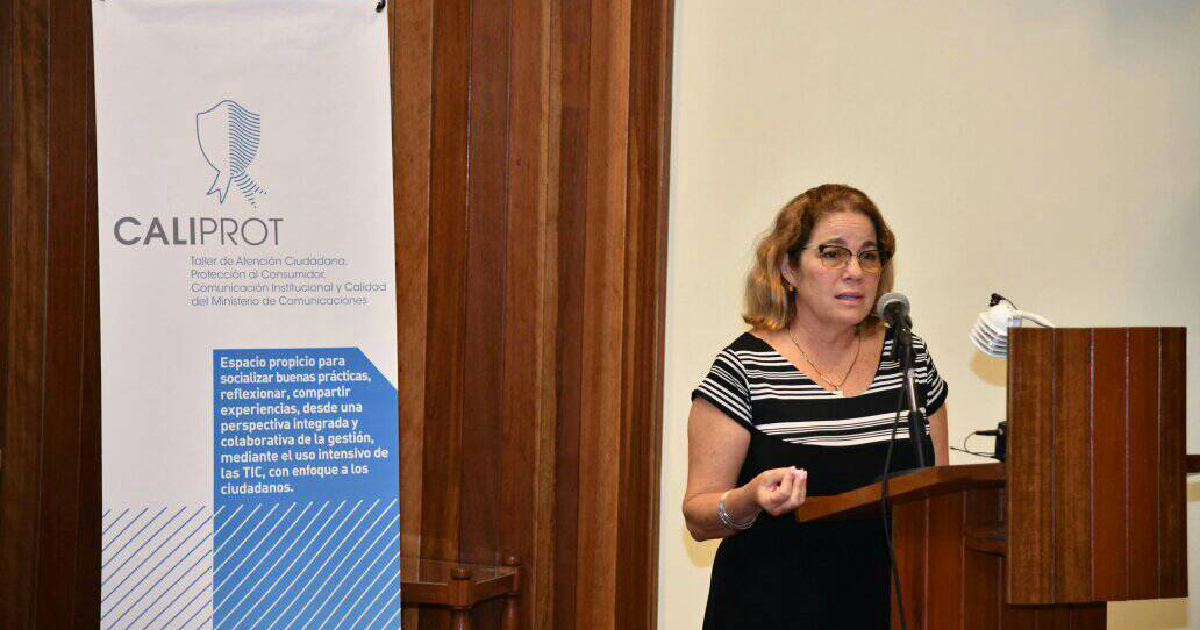
The Ministry of Communications of Cuba (Mincom) called for the Workshop on Citizen Attention, Consumer Protection, Institutional Communication, and Quality "Caliprot 2026", scheduled for May 13 and 14 at the ETECSA Theatre in the Miramar Business Center, Havana, with a video conference transmission to all provinces, reported the Cuban News Agency.
The event, under the inspiring motto "Connected to Our Own," is dedicated to the centenary of former dictator Fidel Castro and World Telecommunications Day on May 17. Because if there is one thing that defines the Cuban telecommunications sector, it is precisely that: the connection to "what is ours," meaning the slowness, the outages, and the automated responses that offer no solutions.
The call includes professionals from communication, journalism, design, and audiovisual production, along with specialists in complaint handling, consumer protection, and the quality of ICT services. Among the topics are compliance with the Transparency and Access to Information Law and the Law on the System for Addressing Complaints and Requests: laws whose actual implementation citizens themselves question daily.
The Mincom describes the event as "a space for training, reflection, and sharing experiences that will contribute to enhancing the quality of services in the ICT sector in Cuba." Strong words from an agency that in 2021 enacted the Decree-Law 35, which criminalizes the dissemination of information online, and that in 2025 declared the use of Starlink illegal in the nation.
The reality of the service that Mincom intends to "improve" is well known by any Cuban with a phone in hand. According to Ookla's Speedtest Global Index, Cuba recorded the worst internet speed in the world during the period from May 2023 to 2024: 3.77 Mbps for mobile (ranked 147 out of 147) and 2.69 Mbps for fixed broadband (ranked 181 out of 181). As of March 2026, the island remained in 153rd place out of approximately 180 countries for fixed broadband.
Adding to this situation, a 3 GB internet plan costs 3,360 Cuban pesos per month, more than 50% of the average monthly salary of 6,649 pesos. And when the connection is available, power outages—lasting up to 20 hours a day in some provinces—collapse the telecommunications infrastructure, whose backup batteries can only last a few hours.
Complaints against ETECSA are a constant that no workshop has managed to stop. "Problems and more problems... the only thing they're punctual about is collecting payment," summarized a user. When someone manages to contact *2266, the response is often terse: "It's already reported", with no follow-up action. In October 2025, the company attributed massive service interruptions to an"atmospheric duct", an explanation that generated widespread mockery.
The organization has also not hesitated to use telecommunications as a tool of repression: the systematic cuts in service to independent journalists or critical intellectual voices against the regime clearly show this. And when citizen protests occur, which are becoming increasingly frequent, the connection "mysteriously" disappears in the country. Protecting the consumer, it seems, has its ideological limits.
Previous editions of Caliprot have existed as a space for "socializing experiences" without producing noticeable improvements. The workshop starts on May 13. The connection, when it arrives, will likely take a little longer.
Filed under: