
Related videos:
The Argentine historian and journalist Pablo Stefanoni published an essay this Thursday diagnosing the terminal decline of the Cuban revolutionary model, invoking philosopher Jean Baudrillard to describe the island as part of the "repentance of history": a cycle that comes to an end when the epic that founded it can no longer find grounding in everyday reality.
The text, titled "The End of Revolutionary Cuba," originally published in Italian in the newsletter Pubblico of the Feltrinelli Foundation, was reproduced in Spanish by the Center for Studies on the Rule of Law Cuba Próxima, with introductory remarks from its director Roberto Veiga. Stefanoni, the editor of the magazine Nueva Sociedad and a researcher at the Carolina Foundation, is regarded as "one of the most insightful voices of contemporary Latin American intellectual left," noted Veiga.
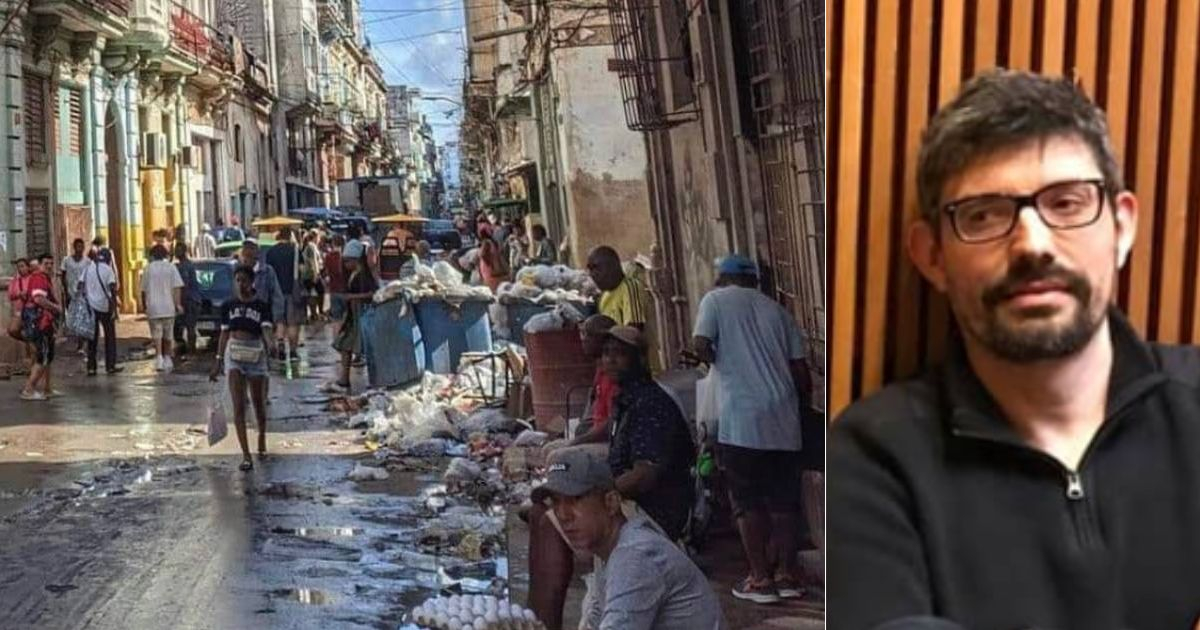
"The images of Cuba, with its crumbling buildings, the daily power outages, the crisis in hospitals, and the lack of prospects no longer hold any epic quality," writes Stefanoni, who notes that the banners proclaiming, "Imperialist gentlemen, we are not afraid of you," have faded as the political elites—especially the military—have transformed into economic elites.
As a symptom of the end of a cycle, the author mentions reports indicating that Raúl Rodríguez Castro, popularly known as "Raulito," grandson of Raúl Castro and head of his personal security, is negotiating discreetly with the United States. The question posed by Stefanoni is inevitable: if Fidel was reluctant to reform and Raúl started changes with a more realistic discourse, will his grandson be the one to negotiate the exit with Washington?
This negotiation has official confirmation: on April 20, the Trump administration confirmed a formal meeting with Rodríguez Castro in Havana, bypassing the channels of the Communist Party and President Miguel Díaz-Canel.
Stefanoni outlines a genealogy of Cuban exhaustion that begins in 1959, when the Revolution captivated the entire Latin American left with the moral strength of David against Goliath. However, under Fidel Castro's charisma, the system shifted towards a Soviet model, illustrated by the arrest of poet Heberto Padilla in 1971 and the Castro maxim: "within the Revolution, everything; outside the Revolution, nothing."
The author argues that Cuba survived symbolically thanks to a "rent of heroism" fueled by Washington's aggressive policies, which led much of the Latin American left to overlook the "internal blockade." Connectivity has broken that discursive monopoly: citing analyst Wilder Pérez Varona, Stefanoni notes that "for the first time in six decades, the State has ceased to monopolize the production and circulation of public discourse," and that the circulation of "Patria y Vida" "not only challenges a narrative, but also dismantles an emotional and moral regime that for decades sustained official legitimacy."
This symbolic break coincides with an unprecedented material crisis. In the early months of 2026, the electricity deficit has exceeded 1,900 MW, with daily blackouts lasting more than 20 hours, while the healthcare collapse leaves only 30% of essential medications available and more than 850,000 Cubans emigrated to the United States between 2021 and 2024.
The Cuban economist Ricardo Torres, cited in the essay, summarizes the structural paralysis: “No social project can be sustained indefinitely without a sufficient material base. For too long, the Cuban leadership has tried to bypass that limit.” The military's presence in the economy through GAESA —which controls between 40% and 70% of the Cuban GDP— did not alter that dynamic; therefore, the Trump administration's sanctions against GAESA target directly the heart of the regime's military-economic power.
The essay concludes with an image that captures the crossroads: "The country is trapped between a declining communist elite and new imperial forms that combine the postponed ambitions of Cold War neoconservatives and Miami Cubans with the political and emotional fluctuations of the occupant of the White House."
Roberto Veiga presented the text as an invitation to stop viewing Cuba as a "theme park of past utopias" and to see it as a real country, "with citizens who demand the right to envision a future beyond eternal resistance."
Filed under: