
Related videos:
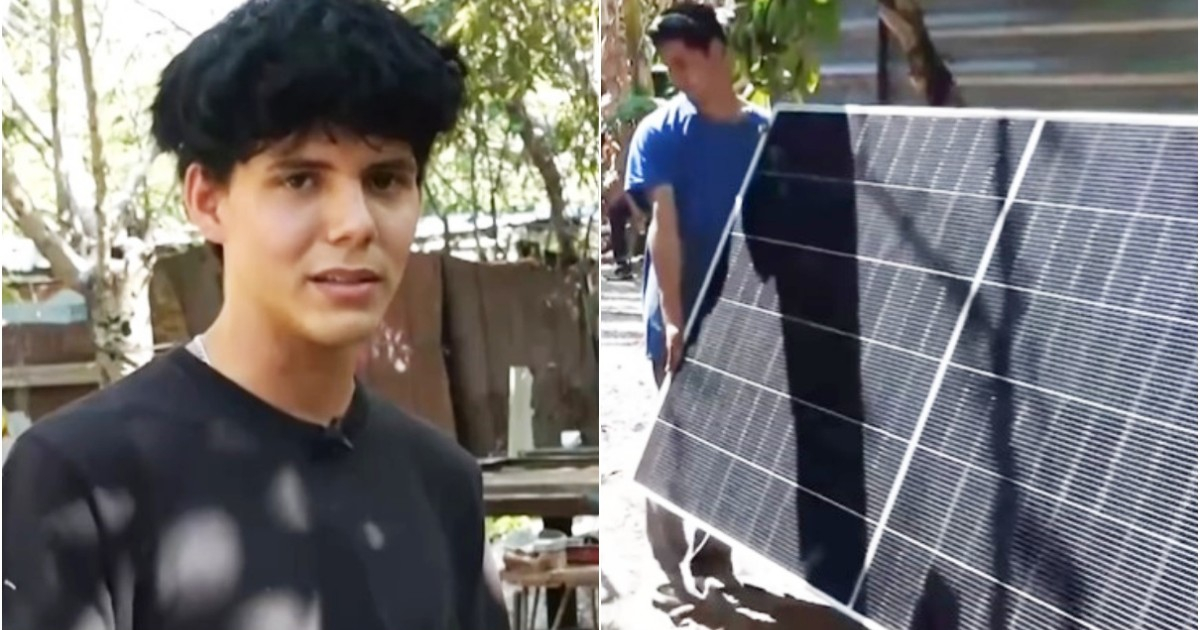
Yadán Pablo Espinosa, a 21-year-old from Havana, set up a small home factory in the municipality of Arroyo Naranjo where he installs solar panels on electric tricycles.
It is a solution that has already equipped more than 15 vehicles and is saving the livelihood of dozens of Cuban workers amid the worst energy crisis the island has seen in decades.
The project began a few weeks ago and operates without state funding, subsidies, or official technical training.
Espinosa works alongside his father, three brothers, and a friend, and together they craft iron supports that hold the panels and serve as protective covers for the conduits, as the young man detailed in an interview with the EFE agency.
The installed panels have a capacity ranging from 550 to 650 watts, and during peak solar radiation hours, they generate a power close to 2,600 watts, depending on the model.
Espinosa himself explains to EFE how the system works:
"The installation we perform allows the panel to provide constant and direct energy to the tricycle's motor while it is in motion, with the help of the battery. Once the vehicle stops, the energy received by the panel charges the battery."
The idea was born from a simple question, in his own words:
"I say, how much autonomy should a tricycle provide? And I saw that the autonomy increased significantly, since a panel gives about five hours of peak sunlight, approximately 2,600 W depending on the type of panel. The motor of a tricycle consumes many more watts, but the panel supplies a constant energy that goes directly to the motor while you are in motion."
The key to the design is that mandatory stops—whether for delivering goods or resting—automatically turn into free charging sessions, eliminating the need to search for an outlet in a city where blackouts are commonplace.
The impact on Cuban workers
For transporters who rely on their tricycles to bring food to the table, the difference between a vehicle with a panel and one without can mean preserving or losing their livelihood for the month.
Joanis Castro, a client dedicated to the transportation of goods, recounted to EFE how she received the proposal:
"Are you interested in installing a solar panel roof? And I told my husband: yes, yes, that when we have the possibility of getting more tricycles, we can come and install solar panels with them too."
Orlando Muñoz, 62, a passenger transporter at the busy corner of 100th Avenue and Boyeros in Havana, also celebrates the results: "It helps me keep the battery from dying and makes the charge last longer while I work," he explained to EFE.
Yoandis Castro, 47 years old, who transports goods for markets, is already planning to expand his fleet of electric tricycles with solar panels installed by Espinosa.
A crisis that sparked popular ingenuity
Since January 2026, Cuba has been experiencing its worst energy crisis in decades, with blackouts in some provinces exceeding 20 hours a day and gas stations that have stopped selling fuel.
The island needs about 100,000 barrels of crude oil per day and only produces around 40,000 from its national production, according to data from EFE.
The only external relief arrived on March 31 with the Russian ship Anatoli Kolodkin, carrying about 100,000 tons of crude oil, enough for barely 15 days of supply. The previous foreign tanker had docked on January 9.
The Díaz-Canel regime promoted electric tricycles as an alternative to gasoline transportation, but it created a new paradox: the national electrical grid also does not guarantee battery recharging.
The Minister of Transport, Eduardo Rodríguez, announced on March 18 that even patients undergoing hemodialysis should travel in taxis or electric tricycles.
A workshop without assistance but with a waiting list
Espinosa received no institutional support. The business operates solely through word of mouth among transporters: each time a tricycle equipped with panels passes through the street, neighbors ask who installed them.
Other Cuban self-employed workers charge up to 800 dollars for installing a solar panel on a tricycle, materials included, placing Espinosa's initiative in an emerging market with high demand.
The government approved in February Resolution 41/2026 from the Ministry of Finance, which exempts up to eight years of taxes for private investments in renewable energies and includes customs exemption for the importation of solar panels, although actual access to these materials remains limited on the island.
While the regime fails to resolve the structural crisis caused by decades of communist dictatorship, Cubans are turning to solar solutions to survive, and a 21-year-old, with handmade iron and photovoltaic panels, is achieving what official solutions have not been able to: keeping the livelihoods of his people in motion.
Filed under: