
Related videos:
Ramón Orlando Martínez, a beloved knife sharpener in the Marimón neighborhood of the José Martí District in Santiago de Cuba, died after being stabbed on Saturday night during an assault intended to steal his electric tricycle, his daughter reported.
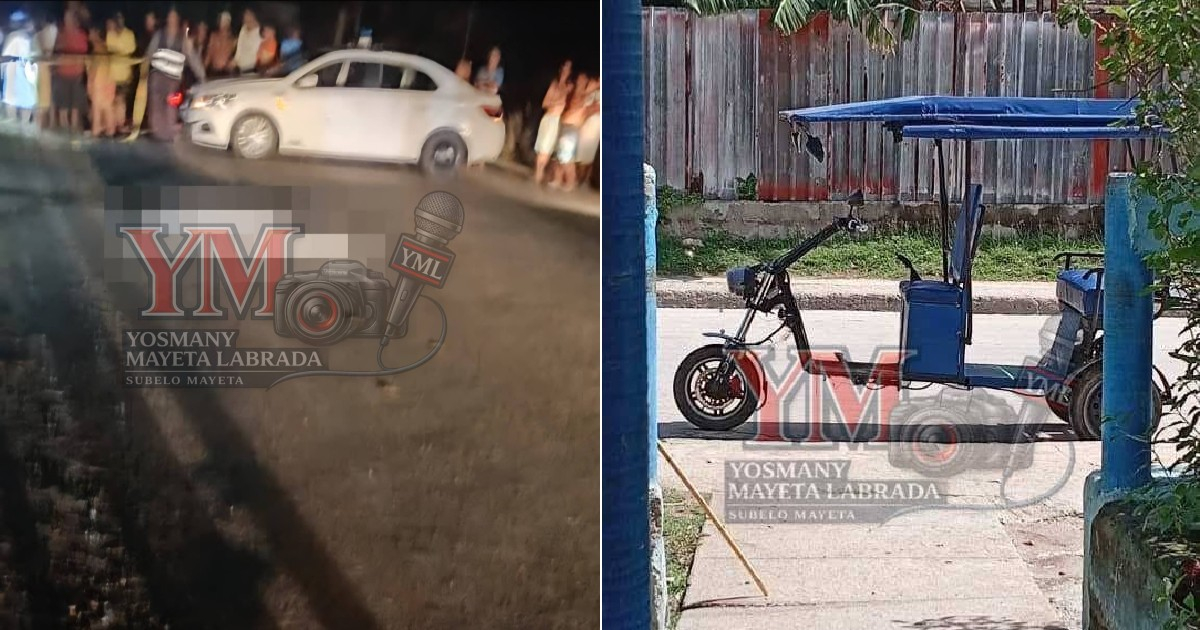
The crime occurred on Avenida Las Américas, one of the main roads in the city, where the victim lay and died "without anyone being able to save his life," due to the severity of the injuries, reported on his Facebook page the communicator Yosmany Mayeta Labrada, who was contacted by Martínez's family.
"My father was brutally stabbed, all for stealing an electric tricitaxi," wrote the daughter, who urgently requested help to locate the vehicle and identify those responsible for the incident.
"I don't have much strength to write, please help me to publish in order to catch the killer," he pleaded.
Martínez, "a well-known and beloved man in the Marimón neighborhood," would walk the streets with his tricycle, which he used as a means of transportation and to make a living sharpening knives, a trade that earned him the respect and affection of the locals for many years.
Mayeta published photos of the stolen tricycle, which is blue, with a metal structure and distinctive features that could help with its identification. Martínez's family suspects that the vehicle might be in a location nearby, the reporter indicated.
The family members have requested maximum publicity to capture the perpetrators of the murder and recover the tricycle, asking anyone who has seen the vehicle or has information about its whereabouts to report it immediately. They "believe that finding it could be crucial to clarifying this crime," added Mayeta.
"Once again, violence strikes a working family in Santiago de Cuba, leaving pain, indignation, and the demand for justice from an entire neighborhood that is now mourning one of its own," the communicator concluded.
The crime that cut short the life of Ramón Orlando Martínez, an honest and hardworking man, has plunged his family into mourning and shocked friends, neighbors, and residents of the neighborhood. Hundreds of people have reacted to the news and expressed their deep sorrow for the tragic event, as well as demanded that the authorities capture those responsible as soon as possible and deliver justice.
"Today it pains me to write these words. Ramón was not just the bicitaxi man to us... he was someone close, someone who, with his humility, nobility, and character, earned our affection and respect," expressed Ibrahin Zambrano in a poignant tribute to the memory of the deceased.
"Ramón was a humble, hardworking man, a Christian, and beloved by everyone in Marimón. He was one of those simple people who do good quietly and leave beautiful marks in the lives of others. It hurts deeply to know the cruel way in which his life was taken from him. Today, the neighborhood is sad, and those of us who had the fortune to know him feel a tremendous void," Zambrano confessed.
Like him, numerous people mourned the loss and condemned the crime, which once again raises alarms about unchecked violence in Cuba.
Unfortunately, this is not an isolated case. On April 15, Adonis Fuentes González was murdered in Cienfuegos under nearly identical circumstances: the attackers assaulted him with knives as he was about to park his electric tricycle and stole the battery and charger.
At the beginning of this month, in San Miguel del Padrón, Havana, the police arrested a suspect for the theft of another electric tricycle, recovered because the owner recognized it in a sales ad on Facebook, a pattern that repeats in this type of crime.
Violence in Santiago de Cuba has intensified in recent weeks. Previously, it was reported that a farmer was murdered in the municipality of Segundo Frente, in a robbery for his oxen; while a 23-year-old man lost his life in a knife attack in San Luis, also in the eastern province.
The theft of electric tricycles has become a widespread phenomenon throughout Cuba, driven by the severe economic and energy crisis that has skyrocketed the value of these vehicles. Their owners, mostly humble workers who rely on them for survival, have become prime targets for crime.
In a context of increasing insecurity due to rising crime and violence in Cuban towns, the families of victims systematically turn to social media to denounce crimes and seek citizens' assistance.
The Cuban government does not publish official crime statistics. The Cuban Observatory of Citizen Audit - an independent organization - recorded 2,833 verified crimes in Cuba during 2025, representing a 115% increase compared to 2024 and a 337% increase compared to 2023, with thefts being the most frequent crime: 1,536 cases, a rise of 479% since 2023.
Santiago de Cuba was the fourth province most affected, with 323 documented cases amid a wave of crimes that shows no signs of stopping.
Filed under: