
Related videos:
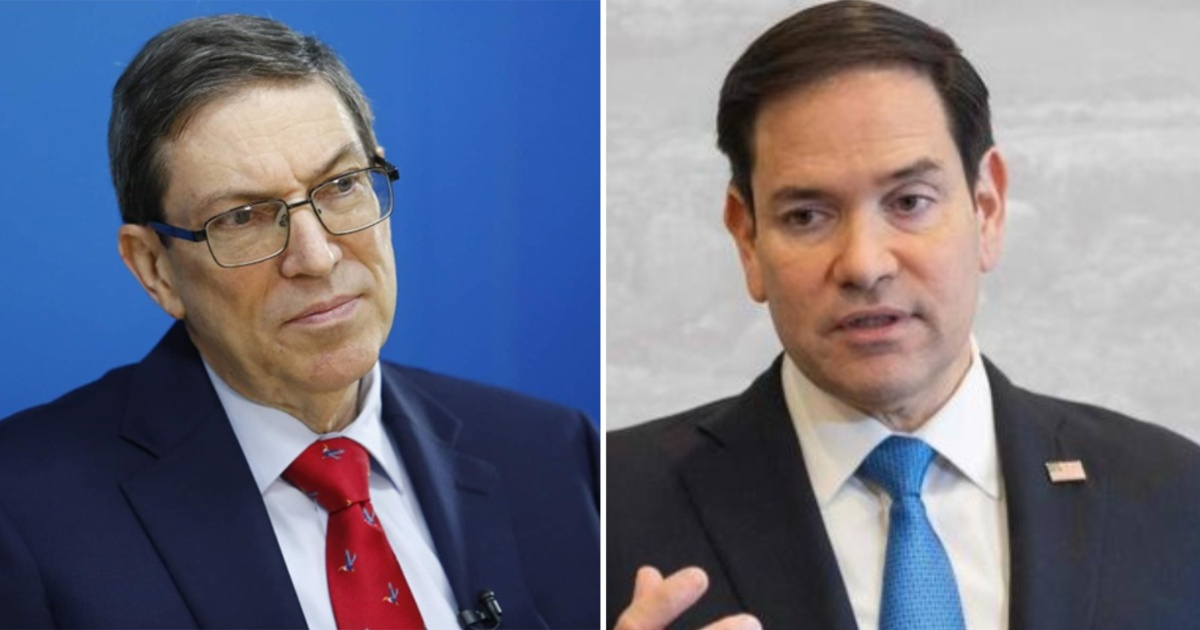
Cuban Foreign Minister Bruno Rodríguez Parrilla posted on his X account this Tuesday a message in which he denies that the regime has received any formal offer of 100 million dollars in humanitarian aid from the United States, describing the claim made by Secretary of State Marco Rubio as a "tale" and a "100 million dollar lie."
"Someone should ask the U.S. Secretary of State about the fable of the supposed offer of 100 million dollars in humanitarian aid to Cuba, which no one here knows about," wrote Rodríguez Parrilla.
The chancellor demanded clarification on who would provide the money, whether it would be given in cash or in kind, which company would supply the products, how they would be distributed in Cuba, and when it would have been officially presented to the Cuban authorities.
The denial comes four days after Rubio revealed from Rome that Washington had offered 100 million dollars in humanitarian aid to the regime, which it reportedly refused to distribute among the population.
"We have offered the regime 100 million dollars in humanitarian aid that, unfortunately, they have not yet agreed to distribute to help the people of Cuba," Rubio stated.
Rubio made those statements a day after meeting with Pope Leo XIV at the Vatican, a meeting where Cuba and the expansion of humanitarian aid were the central topics.
The channel chosen by Washington to distribute aid is the Catholic Church and Caritas, deliberately to avoid the mediation of the Cuban state, which has been the core of the diplomatic conflict.
Rubio specified that six million dollars had already been distributed through Caritas and the Catholic Church as part of the post-hurricane aid for Melissa, which impacted Cuba on October 29, 2025, as a category 3 storm and affected more than 2.2 million people in the eastern part of the island.
Cáritas Cuba reported last Thursday that it has executed 82% of the first donation of three million dollars, benefiting 8,800 families in Santiago de Cuba, Holguín, Las Tunas, Granma, and Guantánamo.
The Cuban Deputy Minister Carlos Fernández de Cossío had already referred to the offer as a "dirty political deal" last Saturday, linking it to the possibility of a military aggression, and on Sunday he labeled those participating in efforts to "normalize the threat of military aggression" from the U.S. against Cuba as "accomplices."
This Tuesday, the State Department attempted to ease tensions by stating that Trump will not allow Cuba "to deteriorate into an even greater threat to the national security of the United States."
The dispute is set against a backdrop of sustained U.S. pressure: since January 2026, the Trump administration has imposed more than 240 sanctions against Cuba, intercepted at least seven tankers, and reduced the island's energy imports by between 80% and 90%.
Rodríguez Parrilla concluded his message with a rhetorical question that summarizes the regime's stance: "Will it be a donation, a deception, or a dirty deal to undermine our independence? Wouldn't it be easier to lift the fuel blockade?"
Filed under: