
Related videos:
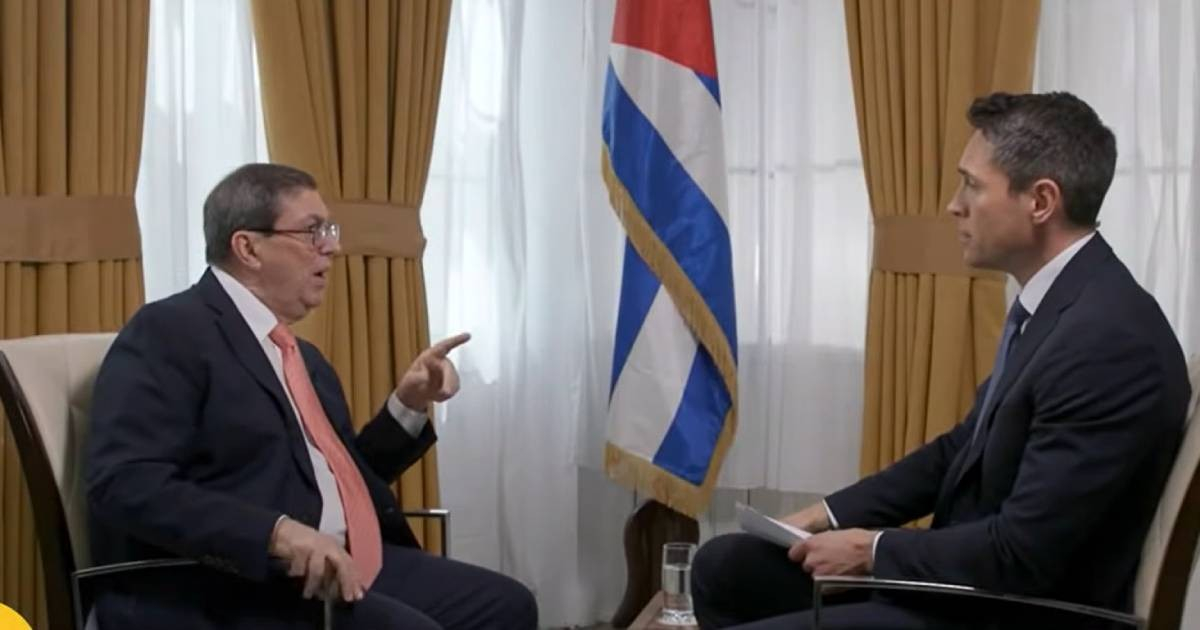
Cuban Foreign Minister Bruno Rodríguez Parrilla was put in a difficult position this Sunday during an interview aired on the program "Good Morning America" from ABC News, where reporter Whit Johnson pressed him on free elections, political prisoners, and government reforms from Havana.
When Johnson asked him what he feared would happen if Cubans could vote freely, Rodríguez replied simply, "You are presenting a bias," and didn’t say anything more. The reporter himself pointed this out bluntly on camera: "He never answered that question."
Before that moment, the chancellor had tried to dodge the issue by describing Cuba as "a different kind of democracy" and arguing that it is "a country with its own history, with its peculiarities, and we are a free and independent nation."
Johnson reminded him live that in Cuba, voters face only one candidate and one party, with no real possibility of choice, and that a socialist communist party and essentially one family have governed the island for nearly seven decades.
Rodríguez also stated emphatically, "There are no political prisoners in Cuba." Johnson countered the statement live, citing human rights organizations that estimate that hundreds of people remain detained for political reasons, including participants in the protests of July 11, 2021.
Organizations like Prisoners Defenders document up to 1,250 political prisoners in Cuba, while Justicia 11J reported 775 political prisoners as of April 17, of which 338 are directly linked to the protests of July 11.
Regarding the negotiations with Washington, Rodríguez was equally firm: there has been "no progress" in the recent contacts between the two governments.
The interview takes place in the context of an unprecedented escalation. Since January 2026, the Trump administration has imposed more than 240 sanctions against the regime, and Secretary of State Marco Rubio announced new sanctions against GAESA —the military conglomerate that controls between 40% and 70% of the formal Cuban economy— and against Moa Nickel S.A.
In the first part of the interview, broadcast a few days earlier, Rodríguez accused the United States of having a "genocidal intent" and warned that an attack could lead to a "bloodbath in Cuba."
From Havana, Johnson described a devastating reality: a carton of eggs costs more than the monthly salary of an average Cuban, a gallon of gasoline reaches 40 dollars on the black market, and gas stations remain closed because no one can afford it.
The Economic Commission for Latin America and the Caribbean (ECLAC) forecasts a contraction of the Cuban GDP by 6.5% for 2026, the worst in Latin America and the Caribbean, while economist Pedro Monreal warns that the drop could reach 15%, comparable to the worst year of the Special Period.
Cuban-American host Gio Benítez, who led the segment alongside Johnson, described the interview as "impactful" and recalled that her own family "lost everything in communist Cuba." Johnson wrapped up his report with a conclusion that sums up the situation: "There is a growing sense of despair, and many of the people we spoke with do want change."
Filed under: