
Related videos:
For decades, the conflict between the United States and Cuba was characterized by relatively stable categories: embargo, diplomatic isolation, general economic sanctions, and ideological dispute.
However, in recent years, another language has begun to emerge, one that is closer to the rhetoric used by Washington in addressing networks of international corruption, hybrid state structures, and opaque financial systems.
In social media and analytical spaces related to the Cuban exile community, a previously marginal idea is gaining traction: that pressure on the Cuban system could shift from general sanctions to a framework of legal-financial "enforcement" focused on the structures that economically sustain the State.
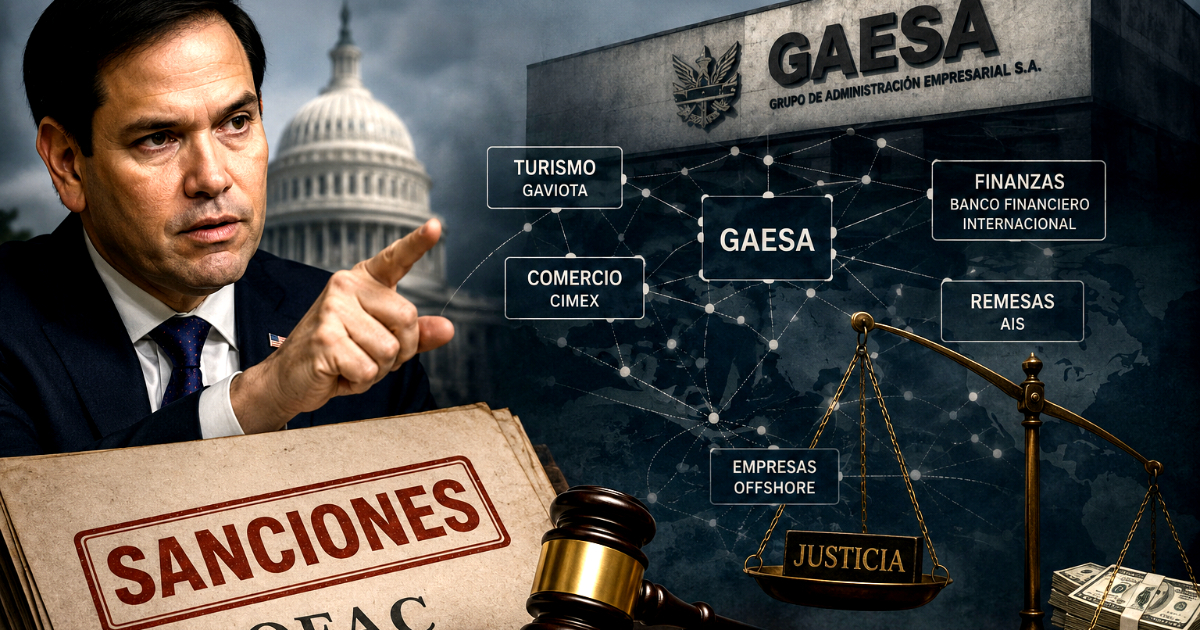
The point of convergence of that conversation has a name: GAESA.
The business conglomerate controlled by the Cuban Armed Forces has progressively become one of the primary targets of U.S. sanctions.
But perhaps the most significant change is not the tightening of the measures themselves, but rather how Washington seems to be beginning to legally conceptualize that corporate network.
GAESA as an economic center of gravity
For years, GAESA was primarily described as a large state conglomerate with a presence in tourism, commerce, remittances, logistics, and finance.
Today, the debate seems to be shifting in a different direction: to treat GAESA not only as a public enterprise but as an inseparable structure of the political and military architecture of the Cuban power.
That nuance has enormous implications.
The logic behind the new approach is based on a simple premise: if a significant portion of foreign currency revenue and the strategic sectors of the Cuban economy are concentrated in structures under military control, then financially pressuring these structures may be more effective than imposing broad economic sanctions on the country as a whole.
This strategy also aligns with recent global trends in U.S. foreign policy, which is increasingly focused on:
selective sanctions
financial flow control
tracking of beneficial owners
extraterritorial enforcement;
and pressure on international intermediaries.
The difference with the classic embargo is significant. It would no longer be solely about restricting trade or investment, but rather about increasing the legal, reputational, and financial risks of operating with certain structures associated with the Cuban state.
The weight of the precedent Bancec
Within that conversation, a key legal reference has frequently reemerged: the case First National City Bank v. Banco Para el Comercio Exterior de Cuba (Bancec, 1983), decided by the United States Supreme Court.
That precedent established that certain foreign state-owned enterprises may lose the protection derived from their separate legal personality if they operate, in practice, as the "alter ego" of the State.
In other words, if a corporation lacks real autonomy and operates as a direct instrument of political power, the courts could partially disregard the formal separation between business and state.
The doctrine does not automatically imply state responsibility nor does it authorize indiscriminate actions. Its application requires concrete evidence and specific judicial processes. However, it does introduce a relevant legal framework for future disputes related to assets, financial litigation, or sanctions.
And it is precisely there that the debate about GAESA takes on another dimension.
The close historical connection of the conglomerate with the Cuban military leadership, its strategic weight within the economy and the opacity of much of its corporate structure are elements that fuel this legal discussion.
Magnitsky, compliance and financial pressure
The recent tightening of U.S. sanctions against entities linked to GAESA also coincides with another phenomenon: the global expansion of regulatory frameworks related to money laundering, financial traceability, and human rights.
Norms such as the Global Magnitsky Act, along with international regulations regarding beneficial ownership and anti-money laundering, have broadened the tools available to sanction individuals, companies, and financial networks linked to corruption or serious abuses.
Since the protests in July 2021, Washington has used part of that legal arsenal to sanction Cuban officials and organizations related to the repression of demonstrations.
But in certain analytical circles, a broader scenario is beginning to emerge: that the future focus may not solely be on specific individuals, but on the economic structures that financially support the political system.
This would help explain why terms such as compliance, reputational risk, corporate traceability, or ultimate beneficiary are starting to appear more frequently in the public conversation about Cuba.
A less hypothetical scenario of transition?
None of this means that there is an imminent process of international judicialization against the Cuban leadership or a publicly driven transition plan from Washington.
A significant portion of the hypotheses circulating on social media and independent media mix serious legal analysis with highly speculative scenarios. However, it is also true that the current context is different from that of a decade ago.
The prolonged economic crisis in Cuba, institutional deterioration, increasing reliance on extraordinary mechanisms for foreign currency acquisition, and the gradual tightening of U.S. policy have begun to shift the debate toward questions that previously surfaced only in specialized circles:
How would certain economic structures be audited in a future opening?
What legal status would a conglomerate like GAESA have in a potential transition process?
How far could future claims for assets or international litigations go?
What risks would foreign actors involved with those structures face?
The most significant change may not be, for the time being, the increase in sanctions. It could be something deeper: the legal and financial redefinition of the economic structures that support the Cuban state.
And that discussion seems to have already started.
Filed under: