
Related videos:
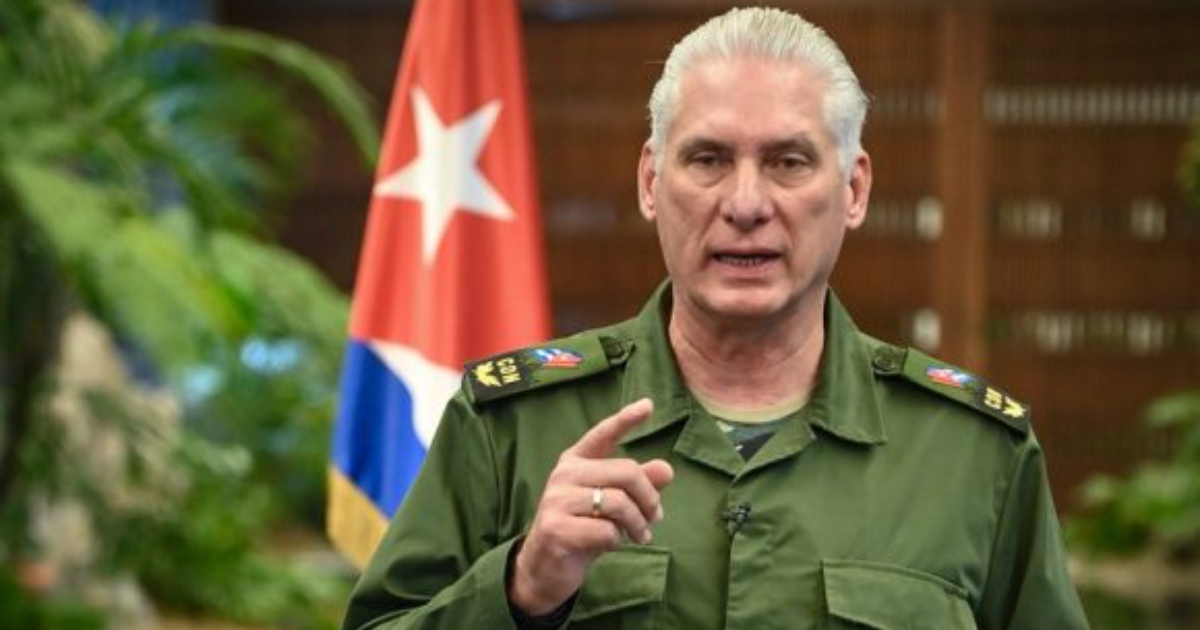
The leader Miguel Díaz-Canel published a new defiant statement on his Facebook account this Tuesday, in which he rejects the notion that Cuba poses a threat to Estados Unidos and concludes with a phrase that encapsulates the official stance of the regime: "Cuba does not threaten or challenge, but it does not fear either."
The text, titled "Cuba does not threaten; Cuba is constantly threatened," arrives a day after Secretary of Defense Pete Hegseth confirmed before Congress that the Pentagon considers the Cuban regime a threat to national security, citing its collaboration with Russia and China and the use of Cuban ports by Russian vessels.
In his post, Díaz-Canel states that "in more than six decades of socialist Revolution, just ninety miles from the U.S., not a single offensive action has ever emerged from this territory against that country's national security," and he argues that Cuba has contributed to Washington "in preserving its security in the fight against various types of transnational crimes."
The Cuban leader directly accuses the Trump administration of cynicism: "Labeling Cuba as a threat is, first and foremost, cynical," he writes, and describes the U.S. narrative as a "construction" designed to "continue suffocating the Cuban people, in addition to escalating a conflict that could have unimaginable consequences for our peoples and region."
The statement comes at a time of heightened tension between Havana and Washington since the Missile Crisis of 1962. On January 29, Trump signed the Executive Order 14380 declaring Cuba an "unusual and extraordinary threat" to national security and imposed an energy embargo that reduced oil supplies by between 80% and 90%.
On May 1, Trump expanded those sanctions with Executive Order 14404, which affects the energy, defense, mining, and finance sectors. On the same day, at a private dinner in West Palm Beach, he stated that the U.S. would "take Cuba almost immediately" after completing operations in Iran.
Between May 5 and May 11, Trump repeatedly reiterated the threat of deploying the aircraft carrier USS Abraham Lincoln off the coast of Cuba, even suggesting bringing it "within about 100 meters of the shore."
The Secretary of State Marco Rubio announced last Thursday sanctions against GAESA —the military conglomerate that controls between 40% and 70% of the Cuban economy— and 12 regime officials, describing this entity as "the heart of Cuba's kleptocratic communist system."
It is not the first time that Díaz-Canel has adopted this tone in recent weeks. On April 7, he warned in an interview with Newsweek that Cuba would "fight and defend itself" against military aggression. On April 16, he compared the moment to the eve of the Bay of Pigs, calling for readiness to face "serious threats." Last Monday, from the Antimperialist Tribune in front of the U.S. Embassy, he urged the people of the U.S. to "look at us with respect and affection."
Sources cited by the AP indicated last Thursday that the U.S. does not contemplate imminent military action against Cuba despite Trump’s threats, and the State Department attempted yesterday to reduce rhetorical tensions with Havana.
The chancellor Bruno Rodríguez Parrilla had warned last Friday about a possible "bloodbath" and "unimaginable consequences" if the U.S. attacked the island, in an interview with ABC News that heightened bilateral tensions even further.
Filed under: