
Related videos:
The business conglomerate GAESA, controlled by the Cuban Armed Forces, emerges as a key player in any transition scenario on the island and also as a central target within the strategy of the United States, according to a recent report by the magazine The Atlantic.
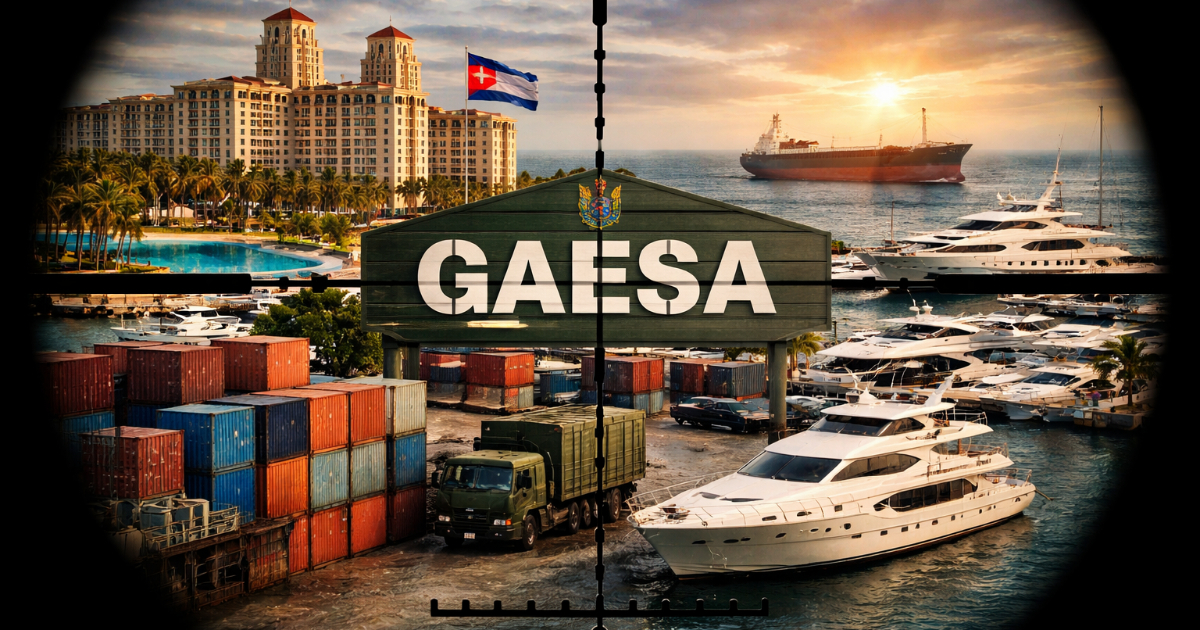
The Business Administration Group S.A. (GAESA) is not just another company within the Cuban state framework. It is the economic core that coordinates a significant portion of the regime's real power. Under its control are strategic sectors such as tourism, foreign currency trade, ports, remittances, telecommunications, and numerous financial operations.
Various estimates place its influence between 40% and 70% of the Cuban economy, especially regarding hard currency income. In practice, GAESA functions as the financial backbone of the system, ensuring the necessary resources to sustain both the political apparatus and internal control mechanisms.
For this reason, within the Washington environment, there is a growing consensus: any attempt at real transformation in Cuba inevitably involves modifying the role of this conglomerate. The Atlantic points out that key figures in President Donald Trump's administration, as well as political allies, have focused on structures like GAESA as part of a broader strategy toward the island.
Beyond Díaz-Canel: where is the real power?
The emphasis on GAESA also reflects an increasingly widespread understanding: power in Cuba does not solely reside in visible figures like Miguel Díaz-Canel, but rather in a much deeper, opaque institutional and economic framework, closely linked to the military establishment and the networks built over decades by Castroism.
In this context, any potential change in leadership without altering GAESA's control could have a limited impact. The structure that concentrates revenues, manages strategic sectors, and integrates the economy in foreign currency would remain intact.
This reality raises doubts about the effectiveness of any transition that does not directly address the economic core of the system.
The precedent of Venezuela and strategic reasoning
The approach being developed towards Cuba bears parallels with the strategy recently applied by the United States in Venezuela. In that case, the pressure was not limited to the political sphere but aimed to weaken the regime's main source of income: oil.
The logic behind that movement was clear. As long as a system retains control over its main economic resources, it also maintains its ability to sustain the power apparatus.
Translating to the Cuban case, the parallel is unavoidable.
If in Venezuela the goal was a Chavismo without oil, in Cuba the equation points to an equivalent element: GAESA.
The military conglomerate not only concentrates income but also directly connects the economy with political control, making it a key player in any attempt to reconfigure the system.
Negotiation, pressure, and possible scenarios
In this context, the ongoing conversations between Washington and Havana take on a more complex significance.
On the table are topics such as economic openness, structural changes, and compensation for confiscated properties, but also —implicitly— the future of the structures that sustain the regime's economic power.
However, the signals from Cuba indicate a clear resistance on fundamental aspects. Authorities from the regime have reiterated that the political system is non-negotiable and have avoided including sensitive topics such as political prisoners in the bilateral dialogue.
This combination of limited openness and rigid red lines increases the risk of negotiations failing.
The turning point: What happens if the dialogue fails?
It is in this scenario where the role of GAESA takes on a decisive dimension. According to The Atlantic, the Trump administration is not only considering a negotiated path, but it also would already have more forceful alternatives prepared in case the dialogue does not yield results.
The precedent set by Venezuela is once again crucial. There, the failure of negotiations was followed by a change in strategy that included more aggressive actions to weaken the regime.
Applied to Cuba, the reasoning is straightforward: if the conversations do not make progress on essential issues —including a possible reconfiguration of economic control— Washington could shift from political pressure to broader measures.
In that context, the inevitable question arises: if oil was the weak point of chavismo, can there be any real change in Cuba without affecting GAESA's control?
The response will not only determine the outcome of the current negotiations but also the kind of scenario that could unfold for the island in the coming months.
Filed under: