
Related videos:
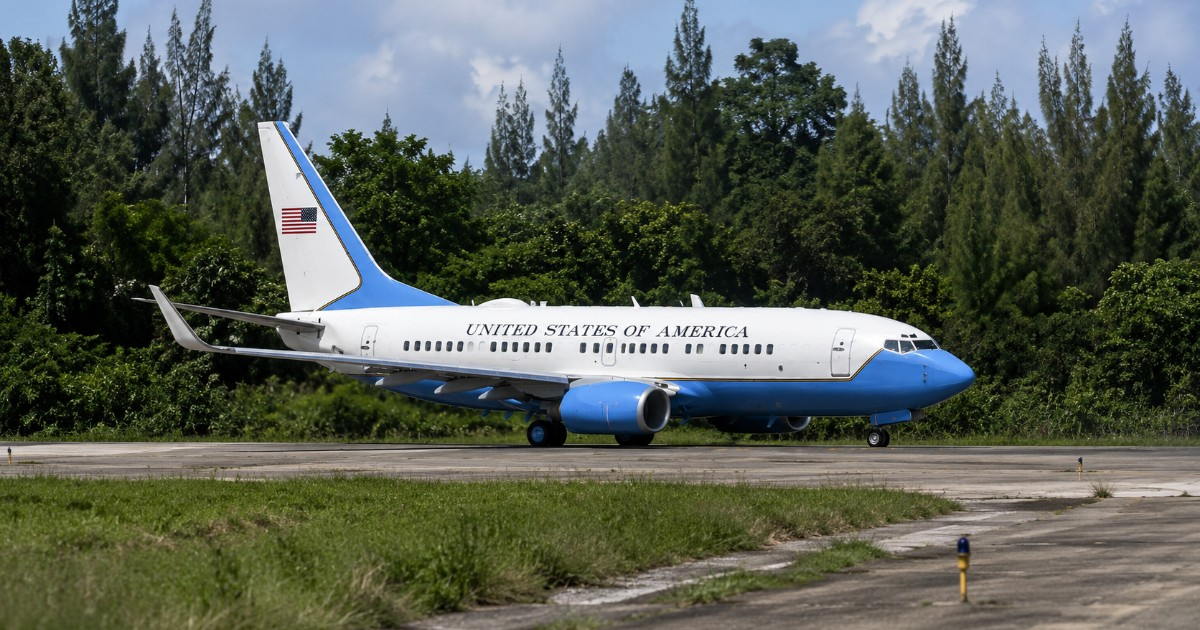
A VIP transport jet from the United States Air Force landed in Havana this Thursday coming from Joint Base Andrews, the main government airbase in Washington, marking the second known official U.S. flight to touch Cuban soil since 2016.
Update: Hours after the landing of flight SAM554 in Havana was reported, the Cuban regime confirmed that a U.S. presidential delegation led by the CIA director, John Ratcliffe, arrived on that flight. According to an official statement released by the Communist Party of Cuba, Ratcliffe held a secret meeting with high-ranking officials from the Ministry of the Interior (MININT), marking one of the highest-level contacts between Washington and Havana in decades. The visit confirms that the Boeing C-40B Clipper from Joint Base Andrews was used for an official mission directly linked to the White House and the U.S. intelligence community.
The flight, identified as SAM554 and operated by a Boeing C-40B Clipper with registration 01-0040 from the U.S. Air Force, arrived at José Martí International Airport around 13:00 UTC.
According to tracking data published by the specialized account @LatAmMilMVMTs on X, the plane was scheduled to continue to MacDill Air Force Base in Tampa, Florida, after its stopover in the Cuban capital.
The prefix SAM stands for "Special Air Mission," a designation reserved for high-level flights of the U.S. government.
The C-40B Clipper is a militarized version of the Boeing 737-700 used exclusively for the transportation of Secretaries of State, high-ranking military officials, Pentagon personnel, and diplomatic delegations.
Joint Base Andrews, located in Maryland, is the same base from where Air Force One operates.
The account @Flightwatcher1, which tracked the flight in real-time, accompanied the news with a loaded question regarding the purpose of this trip to Cuba: “Discussing the 'aid'?”.
Coincidentally, this Thursday the Cuban regime softened its stance on the offer of 100 million dollars in humanitarian aid proposed by the United States and stated that it is willing to "listen to the details of the offer."
The situation gains significance due to the context of the relations between both countries this week. On May 12, President Donald Trump posted on his social media that “Cuba is asking for help, and we are going to talk!”, just hours before traveling to China.
One day later, on May 13, the leader Miguel Díaz-Canel declared that they are "always ready for dialogue," amid the worst energy crisis the island is facing.
This flight arrives just a month after the first direct precedent. On April 10, a delegation from the State Department supervised by Secretary Marco Rubio made the first visit of an official U.S. airplane to Cuba since 2016.
That secret meeting included deputy secretaries from the State Department and Cuban deputy ministers, and it addressed issues such as the release of political prisoners, the opening of the internet through Starlink, and the presence of foreign groups on the island.
In parallel with these diplomatic contacts, the Trump administration has maintained a policy of maximum pressure: more than 240 sanctions imposed on Cuba since January 2026, the interception of at least seven tankers headed for the island, and at least 25 military surveillance flights near its shores with aircraft such as the P-8A Poseidon and the RC-135V Rivet Joint.
Neither party has officially confirmed the purpose or content of Thursday's visit, but the Cuban regime had already described the April meeting as “respectful and professional” according to Alejandro García del Toro, Deputy General Director for the United States at the Ministry of Foreign Affairs.
Filed under: