
Related videos:
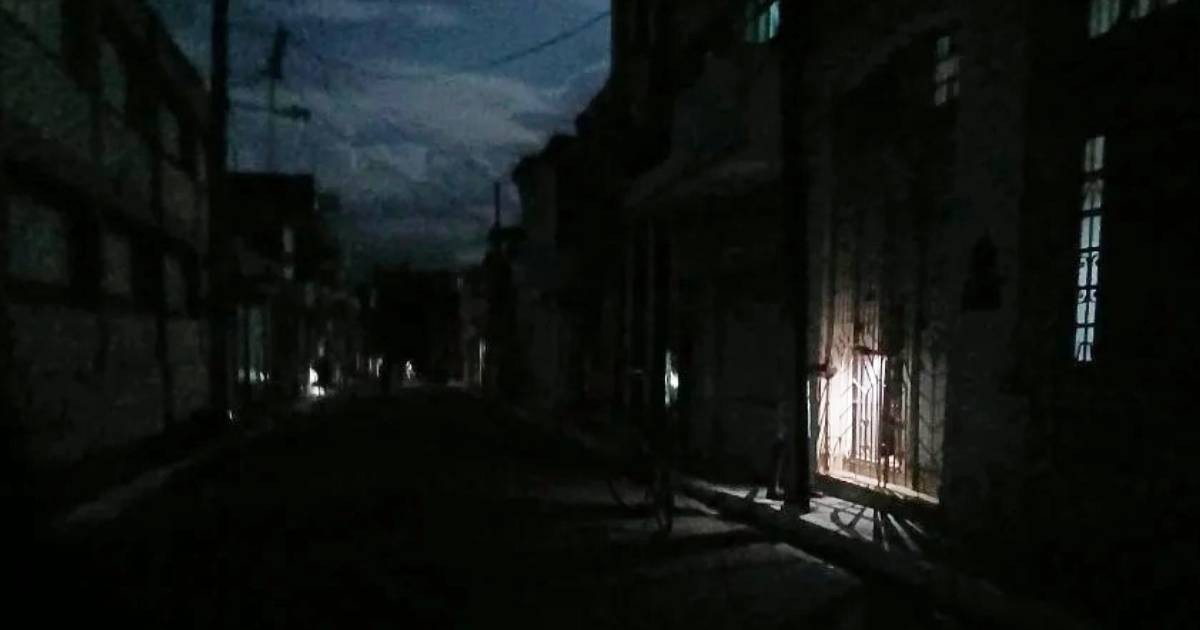
The National Electroenergetic System (SEN) of Cuba collapsed again on Wednesday night, when the entire province of Granma lost power following a sudden drop in frequency on the 110 kV Contramaestre-Bayamo line, while the Ministry of Energy and Mines acknowledged new "unexpected unit outages" that further exacerbated the existing deficit.
According to information from the Electric Company of Granma shared through its Telegram channel, and reported by CNC TV Granma, "the National Load Dispatch decided to affect the province to prevent the collapse of the National Electric Power System, which is why all of Granma is currently without electric service."
In parallel, the Ministry of Energy and Mines posted an update on Facebook admitting that "availability at this time is low, and efforts are ongoing quickly and continuously to recover generation capacity," although it specified that the system remains interconnected.
The crisis this Thursday comes after the worst energy day of the year: on Wednesday, the deficit reached an annual record of 2,113 MW at 8:40 PM, surpassing the previous maximum of 2,075 MW recorded in March.
For the peak hours this Thursday, an availability of only 1,245 MW was projected against a demand of 3,200 MW, resulting in an estimated deficit of between 1,955 and 2,050 MW.
The Minister of Energy and Mines, Vicente de la O Levy, acknowledged on Wednesday that Cuba "is out of fuel" and described the situation as "severe, critical" and "extremely tense."
De la O Levy also confirmed that the island did not receive any fuel shipments between December 2025 and the end of March 2026, and that due to the lack of fuel, the country ceased to generate 1,100 MW on a recent day.
The president Miguel Díaz-Canel himself acknowledged on Tuesday that "the situation of the National Electric System is particularly tense," marking one of the regime's most direct admissions regarding the magnitude of the crisis.
The disconnection of Granma is a response to an emergency mechanism from the National Dispatch to protect the integrity of the interconnected system against sudden frequency drops in transmission lines, a resource that has become increasingly common due to the accelerated deterioration of Cuba's electrical infrastructure.
Nine of the country's 16 thermoelectric units are out of service, and Cuba produces only 40% of the oil it consumes, critically relying on imports that have been notably absent in recent months.
The only exception was a Russian donation of 100,000 tons of crude processed at the Cienfuegos refinery in April 2026, which provided a temporary improvement with several days without blackouts in Havana, but whose effect quickly waned.
Cuba has recorded at least seven total collapses of the SEN in the last 18 months, the most severe of which occurred on March 16, 2026, when the entire country was left in the dark for 29 hours and 29 minutes.
Filed under: