
Related videos:
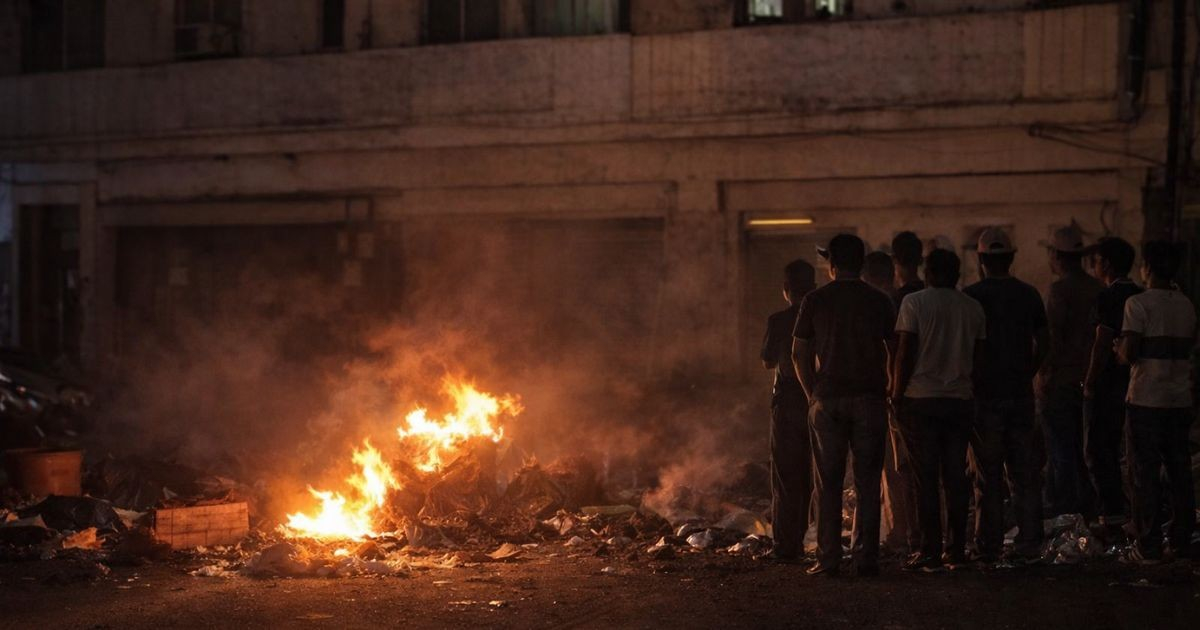
A Cuban mother identified as Zea Gisselle shared a testimony this Thursday on Facebook that starkly summarizes the desperation of thousands of families in Havana: while her son was awake at two in the morning due to the heat and mosquitoes from the blackout, the flames of burning trash bins in their neighborhood illuminated the darkness.
"We felt the drums echoing in our neighborhood, joining the new voice from our homes. The glow of the fire reflects on the wall of the hallway entrance, the smoke coming in... They set the trash bins on fire, it's a PROTEST," he recounted.
The account from Zea Gisselle took place in the context of the wave of protests reported in Havana on Wednesday night, when dozens of residents took to the streets in at least nine municipalities: Diez de Octubre, Playa, Marianao, Guanabacoa, Boyeros, Regla, La Habana del Este, San Miguel del Padrón, and Plaza.
The forms of protest included banging pots and pans, blocking streets, burning garbage, and bonfires at street corners.
"A neighbor says that the fire on the corner looks like the Bayamo fire... the sound of the pot-banging may be the new cry of Yara," the woman recounted in the post.
"Cuba is at war, which is the defenseless people against the State," he told his child when the boy compared the flames at the corner to an armed conflict.
Zea Gisselle reported that on Wednesday they had only two hours of electricity throughout the entire day, and that the previous week she was only able to send her son to school on Monday and Tuesday due to power outages. She rejected calls from some teachers for the children not to miss classes, stating that "this is here to stay" and "we must adapt."
On the night of the protest, neither she nor her neighbors were awake for long due to extreme fatigue and physical exhaustion from the sleepless nights and anxiety. "Sleep deprivation is a method of psychological torture, and those who (mis)govern know it."
"The fire crackles, pieces of fiber cement roofing bursting like the sound of projectiles. At the noise, someone shouts: 'The Yankees have arrived!' and we all laugh together at once, because even in perpetual darkness, laughing together is an act of rebellion and defiance; it means that we continue to exist even though they are trying to kill us," he described.
Multiple protests in the city
In San Miguel del Padrón, residents gathered in front of the municipal government headquarters with the slogan "Power and food!"; and in the Bahía neighborhood, "Down with the dictatorship!" was heard during a pot-banging protest.
In Nuevo Vedado, residents protested after 24 consecutive hours without electricity; and in Marianao, neighbors closed the intersection of 100 and 51 streets after more than 20 hours without power.
The police violently suppressed demonstrators in Playa, and there were massive Internet outages in the city during the protests.
The immediate trigger was an unprecedented energy crisis: the Electric Union reported a generation deficit of 2,113 MW at 8:40 PM on Wednesday, with only 1,230 MW available against a demand of 3,250 MW.
The Minister of Energy and Mines, Vicente de la O Levy, acknowledged power outages of between 20 and 22 hours daily in some circuits of Havana, describing the situation as a "special case."
The Cuban Observatory of Conflicts recorded 1,133 protests in April 2026, a 29.5% increase compared to the same month in 2025, and 1,245 in March, the highest monthly figure since July 11.
At least 14 people have been arrested in Havana in connection with pot-banging protests since March 6, and 176 repressive acts were documented in April alone.
Activists and protesters mention May 20 - the date of the proclamation of the Cuban Republic in 1902 - as a possible day for a new mass mobilization.
Zea Gisselle concluded her testimony with a phrase that encapsulates the exhaustion and determination of those who took to the streets in their neighborhoods early this morning: "Let it be Freedom, and let it be soon... or we all die."
Filed under: