
Related videos:
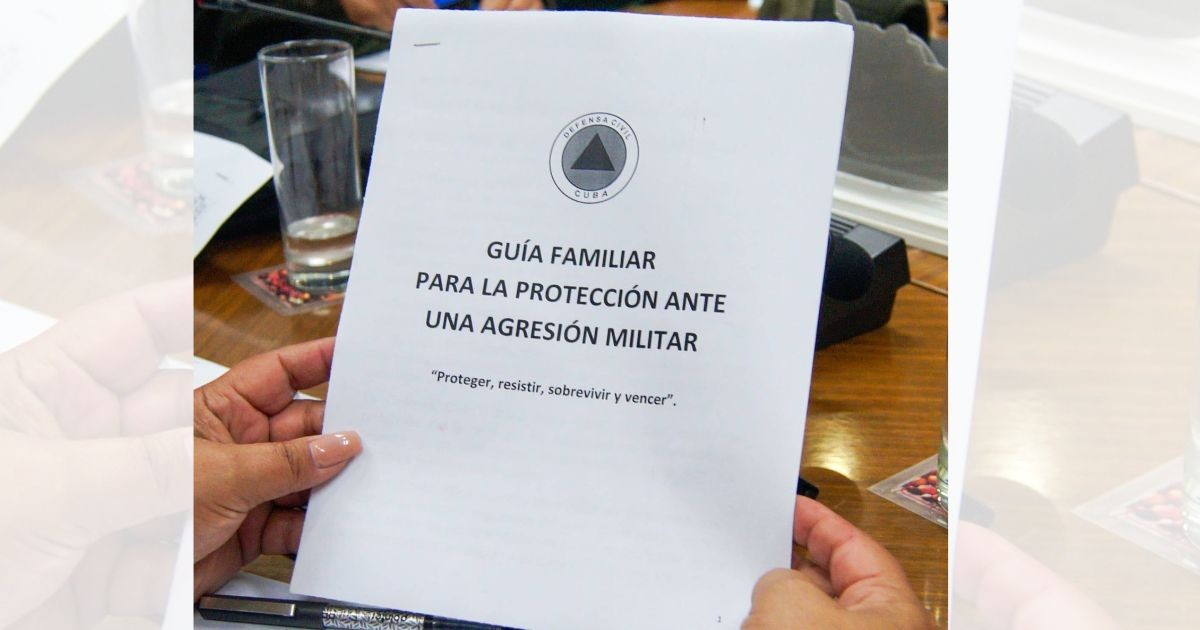
The National General Staff of Civil Defense of Cuba released a Family Guide for Protection Against Military Aggression through its official Facebook profile, amid rising tensions with the United States.
The nine-page document, titled "Protect, Resist, Survive, and Overcome," was presented as part of the Popular Exercise Meteoro 2026. It instructs Cuban families on how to act in the event of air bombings, what to include in an emergency backpack, and how to administer first aid in situations of armed conflict.
The guide recommends preparing a family bag with identification documents, a radio with alternative energy, candles, matches, a flashlight, ready-to-eat food for three days (canned goods, cookies, fruits, bread, cereals), drinking water, hygiene items, medications for chronic illnesses, and toys for young children.
Regarding the conduct guidelines, the document advises on how to recognize warning signs in the event of "enemy airstrikes," to take shelter in basements, tunnels, or trenches, to avoid open spaces, not to touch suspicious objects, and to refrain from using elevators during alarms.
The introduction of the text directly blames the United States for threatening Cuba and explicitly mentions Fidel Castro: "Currently, it threatens to militarily attack and destroy our society in order to perpetuate capitalism in Cuba and eliminate the example of humanism and solidarity that it represents, annihilating the dream of our Commander in Chief Fidel Castro Ruz."
The publication was amplified by official provincial media such as the Provincial Government of the People's Power in Camagüey and the Venceremos Newspaper of Granma, which urged families to "study these measures with the same preparedness as they face natural disasters."
The reaction of Cubans on social media was one of irony, sarcasm, and widespread indignation.
The point that drew the most criticism was the contradiction between requesting backpacks with bread, cereals, and canned goods —precisely the products that are most scarce on the island— and the severe shortage crisis faced by the population.
Many pointed out that the regime shifts the responsibility of surviving a conflict onto families amid a humanitarian crisis that the government itself has caused after decades of mismanagement.
The guide is set against a backdrop of sustained militarism during 2026, the year the regime declared as the "Year of Preparation for Defense", with Saturdays designated as permanent days for military preparation starting from January 11.
On January 18th, the National Defense Council, chaired by Raúl Castro, approved plans for the "shift to a state of war."
The rhetoric intensified in the last week. On May 3, the leader Miguel Díaz-Canel warned of the "imminence of a military aggression" from the United States and stated that "every Cuban man and woman has a rifle" and an assigned defensive position.
On May 5, the Ministry of the Revolutionary Armed Forces declared that "the order for a ceasefire will never be given"; and on May 7, Roberto Morales Ojeda stated that "the united people is our main weapon."
While the regime calls on Cubans to prepare for a war with backpacks they cannot fill, the population faces blackouts of more than twelve hours a day, shortages of food and medicine, and an unprecedented mass emigration.
Filed under: