
Related videos:
The hardening of Washington's policy towards Havana seems to have entered a new phase.
The report published this week by the New York Times, which reveals discussions within the Trump administration about the possibility of applying a version of the “Venezuela model” in Cuba used against Nicolás Maduro, has heightened political and strategic tension between the two governments.
Additionally, there is the potential federal charge against Raúl Castro for the downing of the Hermanos al Rescate planes in 1996, the increase in surveillance flights around the island, the energy embargo, and the recent public visit of CIA Director John Ratcliffe to Havana.
In this context, a question has resurfaced that has accompanied national security analyses in the United States for decades: to what extent does Cuba retain operational capability within North American territory?
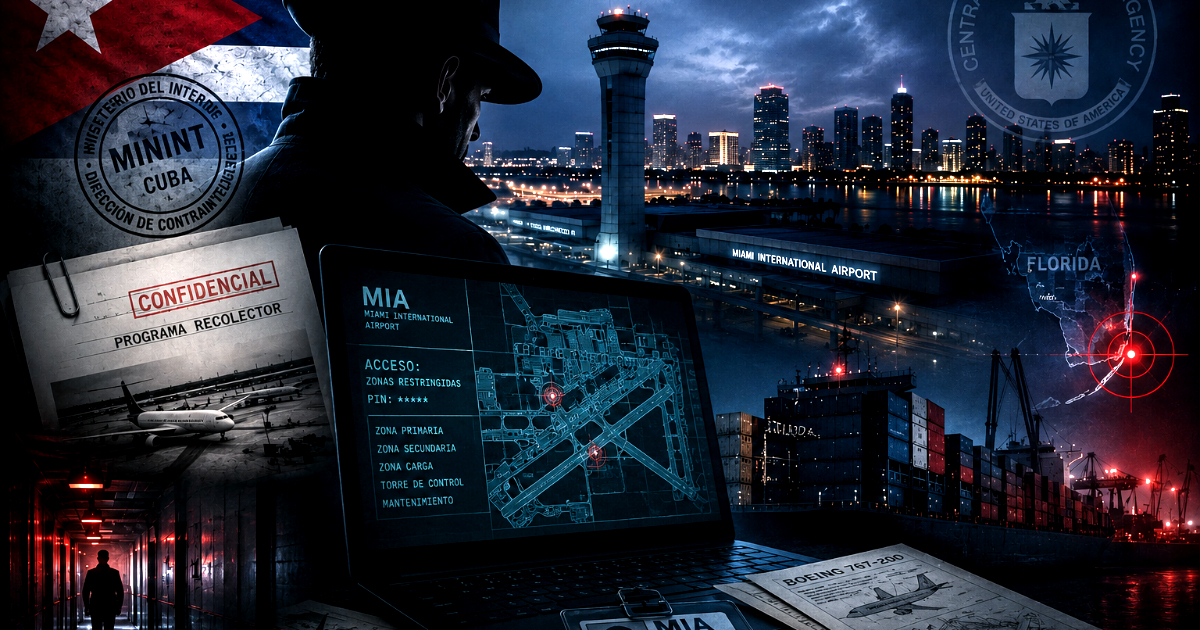
The question gains importance in light of the revelations from #CiberCubaLeaks, the investigation published by CiberCuba in 2019 based on leaked documents from the Cuban State Security.
The files revealed how agents linked to the island's intelligence apparatus
The documents, dated between 2015 and 2017 and classified by the Counterintelligence Directorate of MININT, showed the Cuban regime's interest in infrastructure deemed strategic for the United States and particularly sensitive for South Florida.
One of the reports reproduced messages attributed to an "Agent Charles" with PIN codes to access restricted areas of the airport. Others included employee identifications, internal data from the cargo airline ABX Air, and technical documentation for Boeing 767-200 aircraft.
Specialists consulted by CiberCuba warned that the Cuban intelligence's interest in the MIA was not coincidental.
The Miami airport is under the scrutiny of Cuban espionage because it is a critically important hub for the movement of people and goods, stated at that time Enrique García, former senior official of the Cuban General Directorate of Intelligence (DGI).
For former officials and analysts, the significance of Miami lies not only in its geographical proximity to Cuba or in the presence of the largest Cuban exile community, but also in its logistical, economic, and political value.
The MIA is one of the main air hubs in America, handling millions of passengers annually and concentrating vital cargo operations for the United States and Latin America. Any security vulnerability in such a level of infrastructure would have huge implications.
There is no public evidence that the Cuban government has executed or planned acts of sabotage against U.S. facilities. There is also no proof of active operations against Miami Airport arising from the documents leaked by CiberCuba.
However, intelligence experts believe that the systematic collection of information on critical infrastructure is a common practice in security doctrines and hybrid warfare.
The concept of "hybrid warfare" is used to describe forms of confrontation that do not rely solely on conventional military force. It includes intelligence operations, cyberattacks, migratory pressure, disinformation campaigns, institutional infiltration, and the use of human networks with the capacity for influence or strategic access.
In that regard, Cuba has extensive experience.
For decades, Cuban intelligence services were regarded as among the most effective in the Western Hemisphere. The Wasp Network, dismantled by the FBI in 1998, showcased Havana's ability to infiltrate agents for years into exile organizations, military installations, and political circles in Florida.
The so-called "illegals" — agents operating under false or undercover identities — have historically been part of the operational doctrine of Cuban intelligence, inheriting structures and methods developed during the Cold War from Soviet practices.
Infiltration does not always aim to execute direct actions. Oftentimes, its objective is to gather information, build influence, identify vulnerabilities, or create pressure capabilities for future scenarios.
Security analysts believe that, in the event of an extreme escalation between Washington and Havana, the main response capability of the Cuban regime would not be conventional military, but rather asymmetric.
Cuba lacks the military capacity to confront the United States directly. However, experts argue that it could attempt to raise the political or economic costs of certain actions through indirect means.
Among them:
- intelligence networks
- political influence
- informational operations
- cyberactivity
- migratory pressure
- or access to sensitive infrastructures.
The possibility that there are Cuban assets within U.S. strategic sectors is precisely one of the elements that has historically fueled the concern of federal agencies.
The report from the New York Times suggests that within the Trump administration, there is an awareness that any drastic move regarding Cuba could lead to uncontrollable consequences. The newspaper itself states that Trump and Marco Rubio are seeking to “put an end to communist control” on the island, while avoiding “total chaos”.
That concern would not be linked solely to a possible internal Cuban collapse or a new migration crisis, but also to the regional and security impact that could arise from a scenario of open confrontation.
Miami occupies a particularly sensitive position within that calculation.
The city not only hosts strategic air and maritime infrastructure but also houses financial operations, telecommunications, logistics chains, technology centers, and a vast array of activities related to tourism and international trade.
Additionally, it will be one of the key venues for the 2026 World Cup, an event that will turn South Florida into one of the most internationally prominent locations in the United States.
Precisely for this reason, specialists consulted by CiberCuba in previous investigations emphasized that Cuban intelligence has always considered Miami a priority target. “Cuba was, is, and will be a threat to the national security of the United States,” stated former official García in 2019.
Nevertheless, experts emphasize the need to avoid exaggerations or conspiratorial interpretations. U.S. security agencies have been monitoring intelligence activities related to Cuba for decades and have extensive surveillance and counterintelligence mechanisms in place.
Except for statements from Miguel Díaz-Canel and other regime leaders warning of a "Cuban resistance" and "response" in the event of aggression, there is no public information confirming plans for sabotage, active cells, or specific operational preparations within the United States related to the current bilateral crisis.
But the intensification of Washington's pressure on Havana has brought the issue back to the forefront.
Amid the highest tensions between the two countries in years, the old files of Cuban espionage on U.S. soil no longer seem like mere relics of the Cold War, but rather pieces that some analysts consider relevant for understanding the delicate strategic landscape that is beginning to take shape between both governments.
Filed under: