
Related videos:
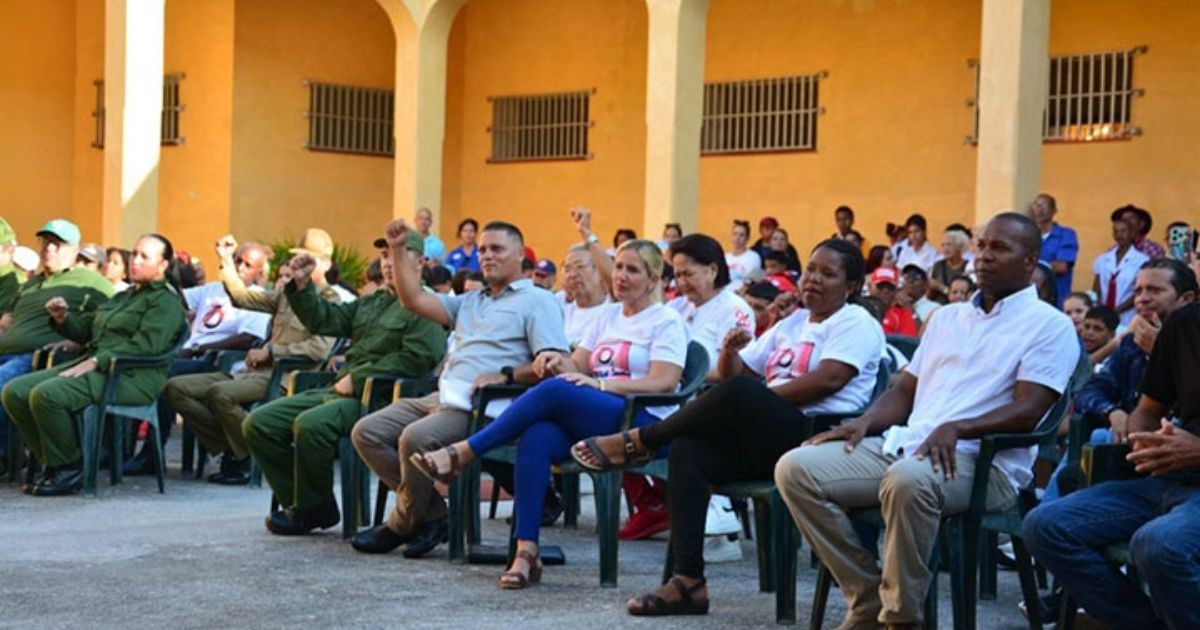
The Cuban regime commemorated yesterday in the Isle of Youth the 71st anniversary of the release of the Moncadistas from Presidio Modelo, which took place on May 15, 1955, during an official event framed within the commemorative year of the centenary of the birth of the former dictator Fidel Castro Ruz, which will be celebrated on August 13.
The event, presided over by the highest authorities of the special municipality, was dominated by speeches reaffirming revolutionary principles. The main speaker, Yander Zayas Pérez, a member of the Municipal Bureau of the Communist Party of Cuba (PCC), stated that "just as the youth of Moncada turned the prison into a school and a platform, the people of Pino are committed to transforming every obstacle into an opportunity, every shortage into creative drive, and every aggression into a reason to reaffirm their commitment to the Revolution," according to a report by ACN.
Zayas Pérez also cited President Miguel Díaz-Canel, who had stated: "In the face of external threats, our response will always be the same: more unity, more resistance, more confidence in victory," the source indicated.
The party leader also denounced what he described as "the intensification of the blockade and the energy siege by the United States" as attempts to suffocate the country, attributing to the U.S. embargo responsibilities that belong to 67 years of dictatorial governance.
The event glorified the history of the Presidio Modelo, recalling that, since Fidel Castro's arrival in October 1953, the Moncadistas founded the Abel Santamaría Ideological Academy, established the Raúl Gómez García library, and organized an internal cooperative. On May 15, 1955, 30 young people, including Fidel Castro, Raúl Castro, and Juan Almeida, were released from the prison following a popular campaign advocating for amnesty. Castro had been sentenced to 15 years in prison in Case 37 of 1953 by the Urgent Court of Santiago de Cuba.
What the official act omitted is that the same Presidio Modelo, presented as a symbol of revolutionary resistance, was used by Fidel Castro's own government to imprison thousands of political prisoners after 1959 according to journalistic records, until its closure in 1967.
The irony of the act becomes even sharper in light of the most recent data. One day before the commemoration, on May 14th, the organization Prisoners Defenders published a report with a title that says it all: “Tortures, sexual assaults, and death threats mark a new absolute record of 1,260 political prisoners in Cuba.”
Of those 1,260 political and conscience prisoners, 785 were in effective prison and 475 under house arrest, forced labor without internment, or other restrictive measures as of the end of April 2026.
Since July 1, 2021, the date of the 11J protests, 2,048 people have been incarcerated in Cuban prisons for political reasons, according to Prisoners Defenders. Among the new prisoners in April 2026 were minors linked to the protests on March 13 in Morón.
The event also highlighted the campaign "My Signature for the Homeland" as evidence of popular support: Zayas Pérez indicated that more than 46,000 signatures from the Isle of Youth backed the movement. However, opponents and citizens reported pressures in workplaces, schools, and communities to force individuals to sign, labeling the campaign as a mechanism of political coercion disguised as voluntary support.
Zayas Pérez concluded his remarks in the style of the propaganda that the regime repeats like a mantra: "On the centenary of Fidel, the remembrance of that May 15th becomes a symbol of continuity: Cuba does not bend, Cuba does not surrender, Cuba stands firm defending its right to exist free and sovereign." Meanwhile, Amnesty International warned in April that, despite the announcement of a pardon for 2,010 people on April 2, the process remained marked by opacity and discretion, and political repression had not ceased.
Filed under: