
Related videos:
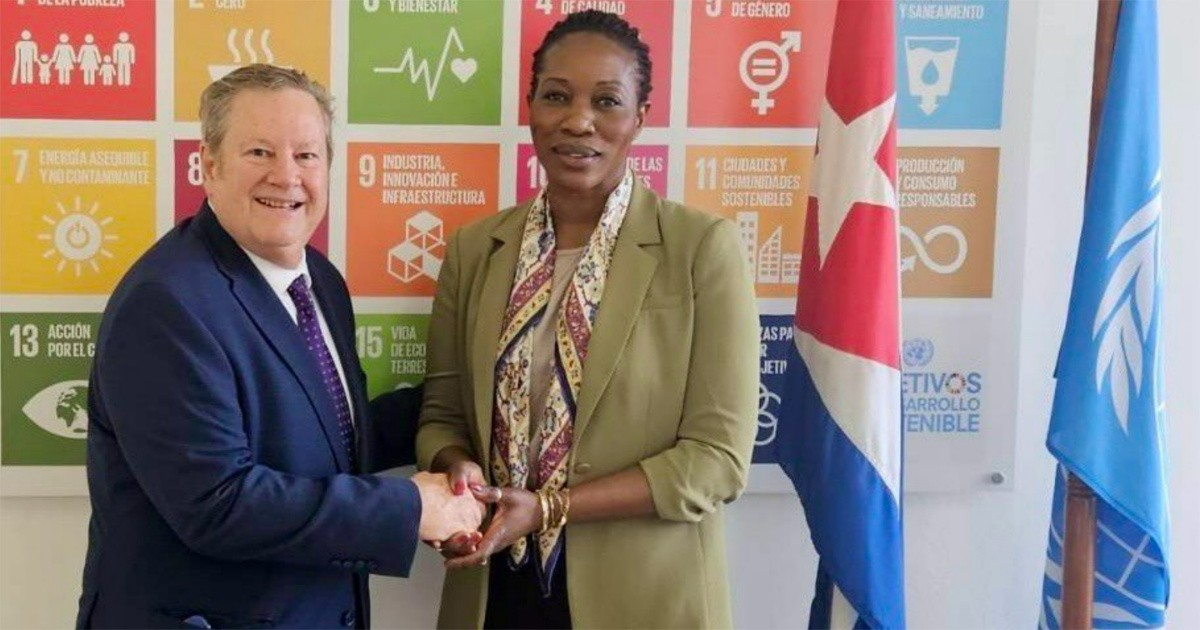
Mike Hammer, head of mission at the United States Embassy in Cuba, met on Monday with Edem Wosornu, Director of Humanitarian Response at the UN Office for the Coordination of Humanitarian Affairs (OCHA), in a meeting that the embassy itself described as a “productive meeting”.
In the official post from the U.S. Embassy in Cuba, Hammer reiterated the urgency of the situation on the island and recalled that Secretary of State Marco Rubio has offered 100 million dollars in humanitarian assistance—primarily food and medicine—to be distributed through the Catholic Church and non-state entities.
"It is urgent to support the Cuban people, and for this reason, in addition to the three million that have already been distributed, Rubio offered 100 million in humanitarian aid, primarily food and medicine, through the Catholic Church and non-state entities," the embassy stated on its official account.
The meeting takes place days after Wosornu and Altaf Musani from the World Health Organization completed a four-day mission in Cuba and warned last Friday from Panama that the humanitarian crisis on the island due to prolonged blackouts, fuel shortages, and a lack of medicines.
During that mission, the UN team observed that at a maternal clinic in the province of Artemisa, the staff had to manually carry water up the stairs because the pumps did not operate during power outages.
Wosornu warned that "without sufficient fuel and more funding, the most vulnerable people — children, the elderly, and pregnant women — will be the ones who suffer the most."
OCHA has launched a humanitarian appeal for 94 million dollars to assist nearly two million people in Cuba, but is facing a funding shortfall of over 60 million, just before the start of the Atlantic hurricane season in June.
The distribution mechanism proposed by Washington explicitly excludes the Cuban regime. The State Department formalized the offer of 100 million last Wednesday, specifying that the funds would be channeled through Caritas Cuba and independent non-governmental organizations.
Rubio was emphatic on the matter: "The Cuban people must know that there are 100 million dollars in food and medicine available for them right now, and the only reason they are not reaching them is the Cuban regime."
The direct precedent of this mechanism is the response to Hurricane Melissa: as of May 8, 82% of the initial donation of three million dollars had already been disbursed by Cáritas Cuba, benefiting approximately 8,800 families in Santiago de Cuba, Holguín, Las Tunas, Granma, and Guantánamo.
The Cuban regime, which initially labeled the offer as a "fable" and a "lie," softened its stance last Wednesday and stated that it has "no objections to working with the Catholic Church" and is "willing to listen to the details of the offer."
That 48-hour shift coincided with the worsening of the energy crisis: the electric deficit exceeded 2,204 MW during peak nighttime hours last Wednesday, with blackouts lasting up to 22 hours in Havana, and the Minister of Energy, Vicente de la O Levy, admitted that Cuba "absolutely has no fuel or diesel, only associated gas."
OCHA's call for $94 million, funded at less than a third, is approaching its critical deadline with the hurricane season about to begin in June, further exacerbating the vulnerability of the Cuban population.
Filed under: