
Related videos:
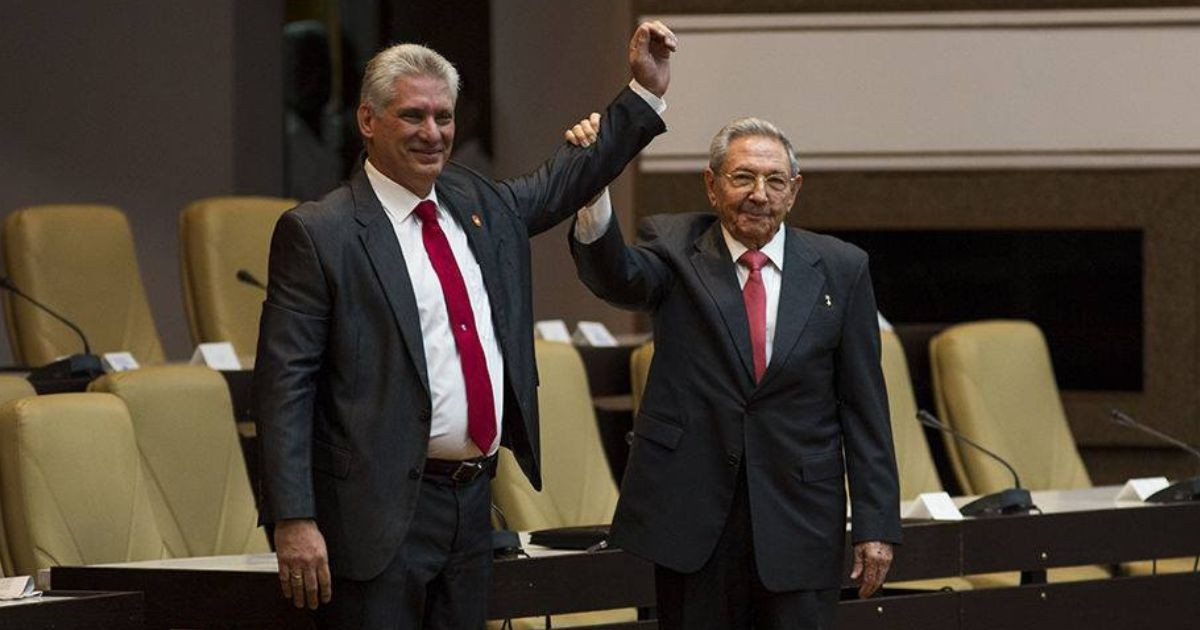
The Cuban president Miguel Díaz-Canel became romantic this Wednesday as he defended Raúl Castro following the federal charges brought against him by the U.S. Department of Justice, describing the 94-year-old dictator as a mentor, a dear friend, and a father figure.
Through the official account of the Presidency of Cuba on X, Díaz-Canel expressed a defense filled with "personal affection" towards his predecessor: "To me, Raúl has been above all a teacher, a leader whose steps one tries to follow every day. But he has also been a dear friend, and I feel like he is a father to me. Fidel is Fidel, and Raúl is Raúl."
The statements came hours after the Acting Attorney General of the United States, Todd Blanche, announced at the Freedom Tower in Miami the federal charges against Raúl Castro for the shooting down of two civilian aircraft belonging to the organization Brothers to the Rescue on February 24, 1996, which resulted in the death of four Cuban-Americans.
The indictment, approved by a grand jury in the Southern District of Florida on April 23, 2026 and made public this Wednesday —Cuba's Independence Day—, includes charges of conspiracy to assassinate U.S. citizens, destruction of aircraft, and four counts of homicide.
Díaz-Canel described the accusation as a "political action without legal basis" and stated that it aims to justify a potential military aggression against Cuba, attributing it to the "arrogance and frustration" of Washington in light of the "steadfastness of the Cuban Revolution."
In his defense, the leader also described the everyday role that Castro maintains despite having formally ceded power: "He has one foot in the cold and remains attentive to everything; he offers great encouragement and stimulates when he sees that things are being done and yielding results. He also advises with great respect."
Díaz-Canel also emphasized that Castro, despite his historical significance within the regime, "has never constrained us, has never made us hold back, has never limited us."
He concluded his defense on an epic note: "The ethical stature and humanistic sense of his work dismantle any infamy that may be attempted against Army General Raúl Castro."
Alongside Castro, five other Cuban military personnel were charged: Emilio José Palacio Blanco, José Fidel Gual Barzaga, Raúl Simanca Cárdenas, Luis Raúl González-Pardo Rodríguez, and Lorenzo Alberto Pérez-Pérez.
The four victims of the shootdown were Armando Alejandre Jr., Carlos Costa, Mario de la Peña, and Pablo Morales. The International Civil Aviation Organization concluded at the time that the shootdowns occurred outside Cuban airspace, and among the evidence is a recording from June 1996 in which Castro reportedly gave the order to "take them down in the sea."
There is no extradition treaty between Cuba and the United States, which makes effective prosecution of Castro practically impossible, as he has never set foot on U.S. soil at the age of 94.
Filed under: