
Related videos:
The Cuban regime is building around twenty community charging centers in the city of Guantánamo, powered by solar panels, in response to the prolonged blackouts that have been plaguing the island due to fuel shortages.
The initiative includes two centers in each People's Council of the Guantánamo city, with plans for gradual extension to the rest of the municipalities in the province, as reported by the Cuban News Agency.
Each installation will feature solar panel systems of approximately 30 kW and a backup storage of 60 kW, sufficient to provide charging for cell phones, portable stations like Ecoflow, motorbikes, and electric tricycles, as well as cooking with up to 10 rice cookers and 10 multi-purpose cookers, and television service.
This "solution," as expected, was presented by the regime with great fanfare.
Yusiff Borot Jiménez, director of the Guantánamo Integral Construction Company (Guanco) and delegate of the Ministry of Construction in the province, stated that "the total investment is estimated at nearly 25 million pesos, and the service to the public will be charged at affordable prices."
The investment will be jointly executed between state companies and small and medium-sized enterprises, a model that has gained prominence as a provider of photovoltaic technology amid the crisis.
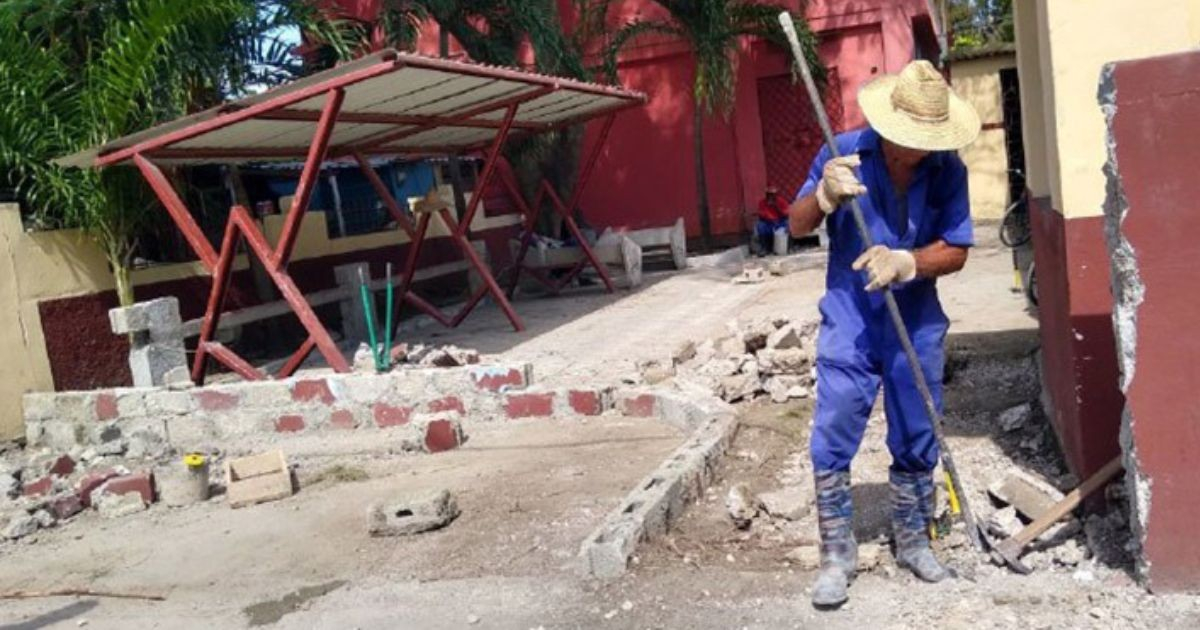
José Humberto Matos, in charge of the center being built in the Caribbean Popular Council, acknowledged that the 15 workers in the brigade "are trying to progress as quickly as possible, amid material and fuel limitations."
The facility, located in the parking area of the brigade itself, started with the demolition of the premises to accommodate six motorbikes, while outside, a space is being prepared for three or four electric tricycles.
The municipality of Imías, outside the provincial capital, has already begun preparations for the first of these centers, signaling the expansion of the program.
Joaquín Catillo, director of the Electric Company of Guantánamo, also announced the installation of solar charging stations for electric transport, two of which will be located at the entrance of the capital city, "as an alternative to the current complex situation."
The model is not new in Cuba: on April 5th, the first solar station in Villa Clara was inaugurated in Santa Clara, featuring 56 solar panels, 30 kW of photovoltaic capacity, and 60 kW of battery storage, operating independently from the National Electric System.
The regime presents these initiatives as a response to the fuel embargo imposed by Washington, but the crisis fundamentally stems from decades of disinvestment and the structural deterioration of the Cuban electrical system.
The Minister of Energy and Mines acknowledged on May 14 that Cuba still lacked fuel reserves, with an availability of only 1,230 MW against a demand of 3,250 MW and a projected nighttime deficit of 2,204 MW, while some areas of the country experienced power outages of between 20 and 22 hours daily.
In December 2025, the Cuban government itself acknowledged that blackouts will not end in 2026, although they may be "slightly" reduced due to repairs and increased installed solar capacity.
Filed under: