
Related videos:
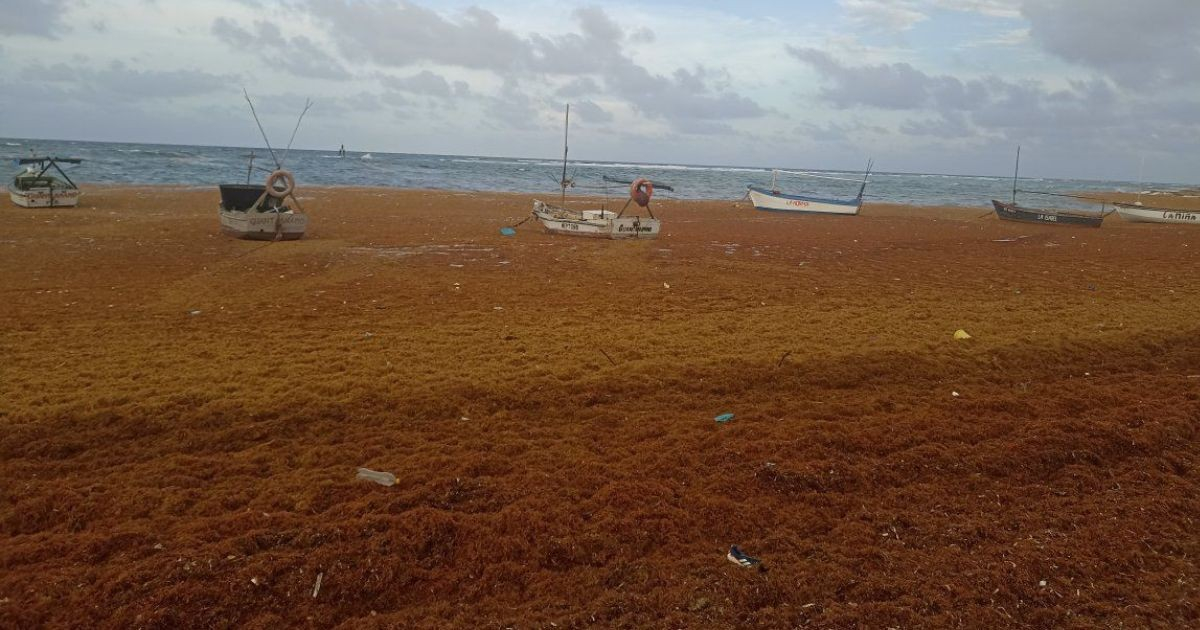
The dock at Punta de Maisí, in the easternmost part of Cuba, was found this week buried under a new and massive layer of sargassum, as documented on Facebook by resident Alexis Morales with a series of photographs showing the beach completely covered by the brown-orange macroalgae.
The images, posted on social media, reveal between five and six fishing boats stranded on the shore amidst the seaweed, with names visible such as “La Norma,” “La Pinta,” “Lenida,” “La Cañonita,” and “La Reina,” all immobilized by the accumulation of the algae.
"Mooring at Punta de Maisí, another major influx of sargassum, I hope that one day we can turn pollution into useful products; it's a resource in other places," wrote Morales, succinctly capturing the frustration of a community that faces this phenomenon repeatedly without the means to manage it.
Punta de Maisí, the easternmost point of Cuba, is one of the most vulnerable areas in the country to massive influxes of sargassum due to its direct exposure to the tropical Atlantic and the Caribbean.
Its local economy relies heavily on artisanal fishing, an activity that comes to a standstill whenever the algae block access to the sea.
The phenomenon is not new to the province.
In June 2025, a massive invasion devastated the entire coast of Guantánamo, affecting towns such as Baitiquirí, El Guanal, Baracoa, San Antonio del Sur, and Yateritas, among others.
In response to that emergency, the CITMA issued a maximum alert due to the health risks associated with the decomposition of the algae, which releases hydrogen sulfide and ammonia, gases that can cause eye irritation, nausea, dizziness, and respiratory issues.
In the Bay of Baitiquirí, residents reported headaches and nausea due to the decomposition of the accumulated sargassum, with no local resources available to manage the situation.
The regional outlook worsens prospects for Cuba. Satellite images from May 2025 already showed a record biomass of 38 million tons of sargassum floating between Africa and the Caribbean, according to data from the University of South Florida and NASA, and the 2026 season is shaping up to be one of the most intense ever recorded.
While countries like Mexico deployed 16 surface units and 9,500 meters of containment barriers only at the beginning of 2026 in Quintana Roo, Cuba lacks the technical and economic means to respond on such a scale.
In September 2025, the island joined a regional Caribbean plan against sargassum with European support, although the implementation of concrete solutions—such as converting the algae into biofertilizers, biogas, or building materials—remains practically nonexistent in the national territory.
The Guantánamo Fishing Company has previously pointed out that sargassum hinders artisanal fishing, reduces recreational activities on beaches, and negatively impacts the coastal economy—a cycle that the residents of Punta de Maisí are experiencing again this season without solutions in sight.
Filed under: