
Related videos:
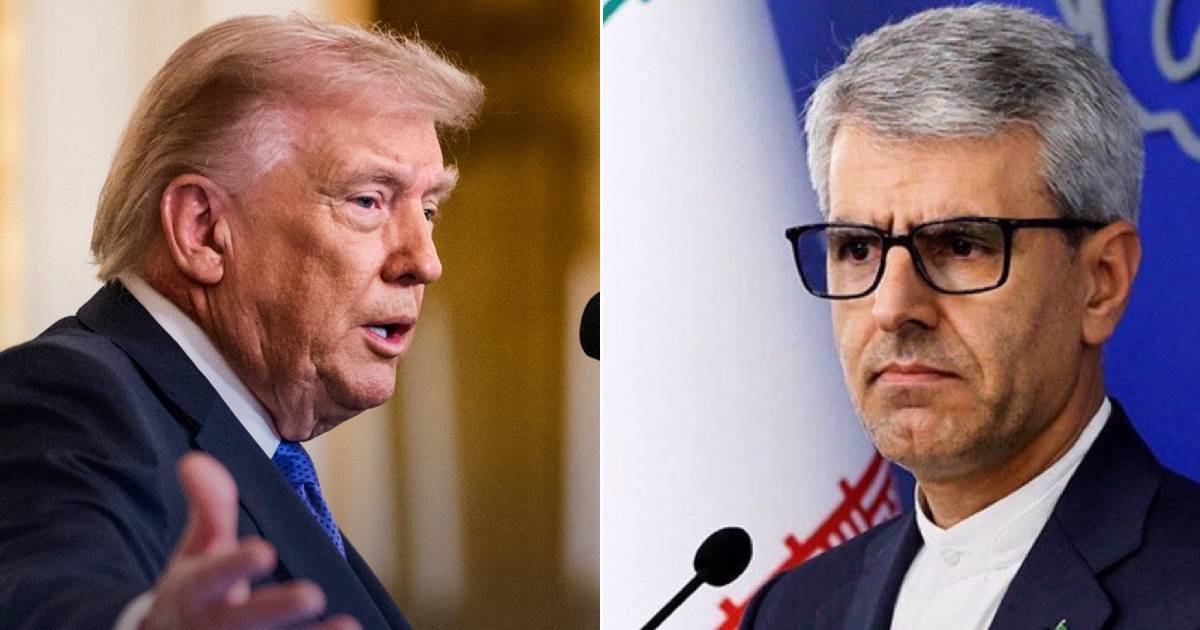
The Iranians released propaganda images this Saturday claiming that "Trump has surrendered to Iran," after the spokesperson for the Ministry of Foreign Affairs, Esmaeil Baqaei, stated that both countries are in the "finalization stage" of a 14-point memorandum of understanding aimed at ending the armed conflict, halting U.S. naval aggression, and unblocking frozen Iranian assets.
Baqaei's statements came on the same day that Trump claimed the agreement with Iran was "largely negotiated" and that the Strait of Hormuz "will be opened," although according to Axios, there were still differences in wording and the president kept the option of resuming military action on the table.
In that context, media and accounts affiliated with the Iranian government broadcast triumphant messages. The account "Iran in Arabic" posted on X the headline: "Message to the enemy: Trump has surrendered to Iran."
Even more striking was the publication by Baqaei on his official account, where he made a deliberately provocative historical analogy: "Rome believed it was the undisputed center of the world, but Persia shattered that illusion when Philip the Arab marched east and ultimately accepted a peace imposed by the Sassanids."
The post, accompanied by an image of the bas-relief at Naqsh-e Rostam —where the Sassanian king Shapur I commemorated his victories over three Roman emperors—, gathered over 315,000 views, 4,143 likes, and 402 comments.
The historical reference is deliberate: Iran is portrayed as the power that subdued the "Western Empire," reversing the narrative of unconditional surrender that Trump himself demanded in March when he wrote: "There will be no deal with Iran except for UNCONDITIONAL SURRENDER!"
In his television interview, Baqaei specified the framework of the negotiations: first, the memorandum would be signed, and then, within a period of 30 to 60 days, the parties would negotiate the details of a final agreement.
"Approaching does not mean that Iran and the U.S. are about to reach an understanding. It means that, based on a set of parameters, both parties could reach a solution that benefits everyone," clarified the spokesperson.
The nuclear issue was explicitly excluded from this first phase. "At this stage, we are not discussing the details of the nuclear matter. Our entire focus is on ending the war," Baqaei emphasized, although he clarified that Iran's demand for the removal of all sanctions is indeed included in the text of the memorandum.
Regarding the Strait of Hormuz, the spokesperson was emphatic: "It has nothing to do with America," and pointed out that Iran and Oman, as coastal states, must define the mechanism for its management.
Pakistan acts as the official mediator in the negotiations, while Qatar facilitates certain items of the memorandum. A Pakistani delegation led by the Chief of Army Staff, Marshal Asim Munir, visited Tehran on Saturday to continue the exchange of messages between the two capitals.
The armed conflict between the US-Israel and Iran erupted on February 28, 2026 with airstrikes that, according to Iranian sources, eliminated Supreme Leader Ali Khamenei and other high-ranking commanders. Iran responded by closing the Strait of Hormuz, which caused a surge in oil prices worldwide.
On April 8, 2026, forty days after the conflict began, a temporary ceasefire mediated by Pakistan came into effect, although negotiations in Islamabad stalled due to Washington's maximalist demands. Iran submitted its 14-point proposal on May 3 and delivered its formal response to the U.S. counterproposal on May 10.
According to Axios, Trump spoke on Saturday with the leaders of Saudi Arabia, the United Arab Emirates, Egypt, Turkey, and Pakistan, who urged him to accept the agreement, although the final decision —to sign or resume the attack on Iran— remains in the hands of the U.S. president.
Filed under: