
Related videos:
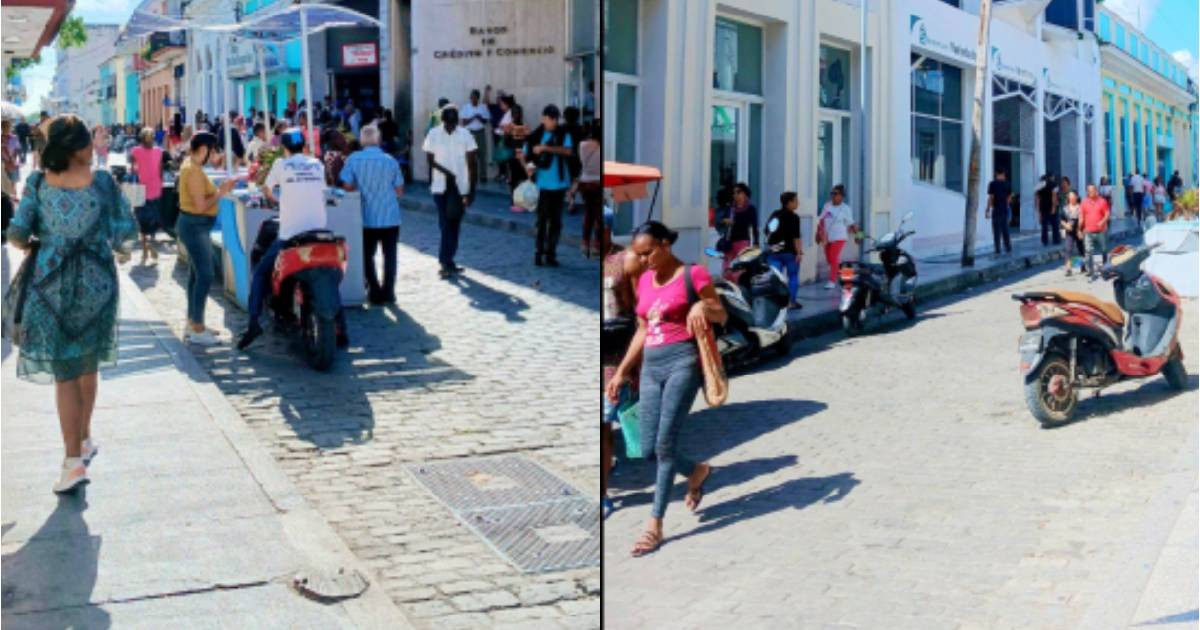
The Middle Street in Matanzas, a pedestrian artery of the Urban Historic Center designated as a National Monument, is experiencing rapid decline marked by illegal motorcycle traffic, the accumulation of garbage, and acts of vandalism that authorities are unable to stop.
According to the situation described recently by the official newspaper Girón, walking peacefully along that busy street "is almost an obstacle course," considering that scooters, motorcycles, bicycles, and other vehicles travel at any speed on a path that should be exclusively for pedestrians.
In addition to this, there is scattered litter, broken bins and lighting fixtures, people sitting improperly on the few benches, thefts, and other acts of vandalism, as added by specialists from the Office of the City Conservator of Matanzas (OCCM).
The most striking thing is that almost six months after the Municipal Assembly of the People's Power approved the Specific Urban Regulations for the Historic Center, the disorder continues unabated.
This legal document, publicly presented in March by the Conservator Leonel Pérez Orozco, establishes legal and administrative provisions to protect the territorial, urban, and architectural planning of the area.
However, according to the media outlet, "the aforementioned legal body seems to be in a lethargy that threatens to jeopardize one of the most beautiful locations in the city of rivers and bridges."
The control mechanisms simply do not work, as there is a shortage of inspectors, fines are practically nonexistent, and "essential figures such as custodians, park rangers, or any others intended to prevent these indisciplines from proliferating are nearly nonexistent."
From the OCCM, workshops are held with neighbors and institutions, as well as spaces like the Casa del Adolescente, but these initiatives are insufficient to reverse behaviors that the reporter herself attributes to a loss of values, the source emphasized.
Today, that effort is diluted in the face of institutional inaction. As Girón warned, "these two arteries of the Calle del Medio, as well as the Plaza de la Vigía, are in no case a transit route for motorcycles or other vehicles."
The deterioration of Calle del Medio is not an isolated incident, but rather part of a broader pattern of degradation of Matanzas' heritage.
In April, a bush growing on the facade of the José White Hall, inaugurated in 1860, was causing visible cracks due to lack of maintenance.
In April 2025, the Teatro Sauto reported daily vandalism such as crude inscriptions, trash thrown through the gates, the use of its entrances as a public restroom, and motorcycle parking in its vicinity.
This is compounded by the widespread garbage crisis in Matanzas. A few days ago, the Municipal Communal Company was operating with only 11 active trucks out of a total of 24 to 25 available, due to a lack of fuel.
In April, health authorities issued a provincial alert for hepatitis A in the municipalities of Matanzas, Cárdenas, and Versalles, linked to poor sanitary conditions.
Calle del Medio was refurbished as a pedestrian promenade for the 325th anniversary of the founding of Matanzas, featuring the underground installation of utilities, restoration of colonial facades, and preservation of the original 19th-century paving.
Filed under: