
Related videos:
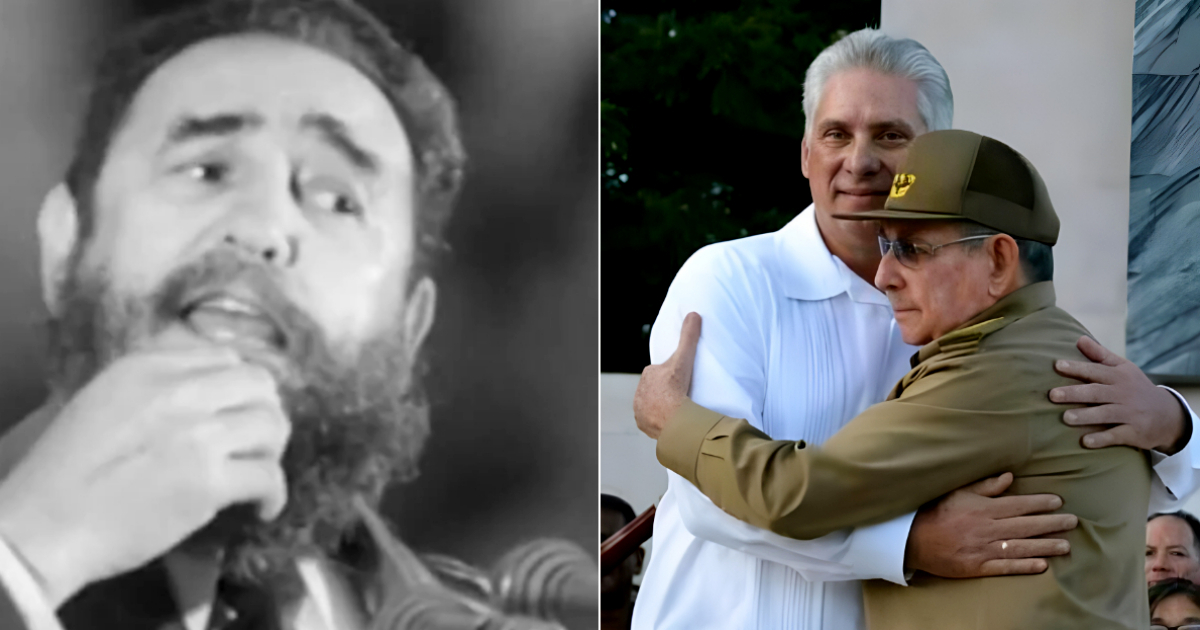
While millions of Cubans are surviving without electricity, water, or food, the Cuban Union of Writers and Artists (UNEAC) found time and energy—perhaps from a generator—to publish this Friday an official statement on its Facebook page that concludes with a triple cheer for Fidel Castro, Raúl Castro, and Miguel Díaz-Canel.
The trigger for the patriotic outburst was the criminal accusation from the U.S. Department of Justice against Raúl Castro, declassified on May 20 and approved by a federal grand jury on April 23. The charges relate to the downing of two aircraft from Brothers to the Rescue on February 24, 1996, which resulted in the deaths of four Cuban Americans: Carlos Costa, Armando Alejandre Jr., Mario de la Peña, and Pablo Morales.
UNEAC described the accusation as a "spurious condemnation of our historical leader" and, with notable historical erudition, compared it to the sinking of the Maine in 1898, the invasion of Iraq, and the coup in Chile. They nearly invoked the fall of Troy.
The text states that "Cuban artists and writers categorically reject the dangerous aggressive escalation of the U.S. imperialist government." The organization, true to its role as an ideological conveyor since Fidel Castro founded it in 1961 under the principle of "within the Revolution, everything; against the Revolution, nothing," did not disappoint its handlers.
The most striking aspect of the document is not what it states, but what it inadvertently reveals. In a paragraph that aims to be epic, the UNEAC rhetorically asks what happens when a people live "without electricity, sometimes without running water, with shortages of food and medicine" and still go to the squares. The response they expect is heroic; the one that reality offers is different: according to the Cuban Observatory of Human Rights, 89% of the Cuban population lives in extreme poverty and 78% want to emigrate or know someone who does.
The artists also promised to defend the homeland "in front of the computer, if there’s electricity, or with a piece of paper, if they take that away from us." A moving gesture of selflessness, considering that in provinces such as Granma, Matanzas, Pinar del Río, and Sancti Spíritus more than 80% of households reported food loss due to blackouts, and that Cuba has recently experienced generation deficits exceeding 2,000 MW with outages of over 24 hours daily in some provinces.
The statement is part of the mobilization campaign orchestrated by the regime. On Thursday, May 22, an anti-imperialist rally was held in front of the United States Embassy along the Malecón in Havana, with Díaz-Canel present in olive green uniform but without delivering a speech. The regime called for rallies across the country from May 23 to June 3, the date of Raúl Castro's 95th birthday.
While the UNEAC was drafting its praises, 7 out of 10 Cubans had stopped having breakfast, lunch, or dinner due to lack of money or shortages, according to the Food Monitor Program. Cuba also recorded more than 1,000 protests in April 2026, suggesting that not everyone in the country shares the literary enthusiasm of its official representatives.
This is not the first time that the UNEAC has disregarded the citizenry of which it is a part. Following July 11, 2021, playwright Yunior García Aguilera publicly resigned from the institution, stating that he could no longer be part of an organization that "turns its back on a considerable part of the people." The UNEAC continued on its path unperturbed, and its statement from Thursday confirms this: it ends with "Long live Fidel! Long live Raúl! Long live Díaz-Canel! Long live a free Cuba!" Free, yes—free from electricity, water, food, and apparently from official writers and artists willing to write about that.
Filed under: