
Related videos:
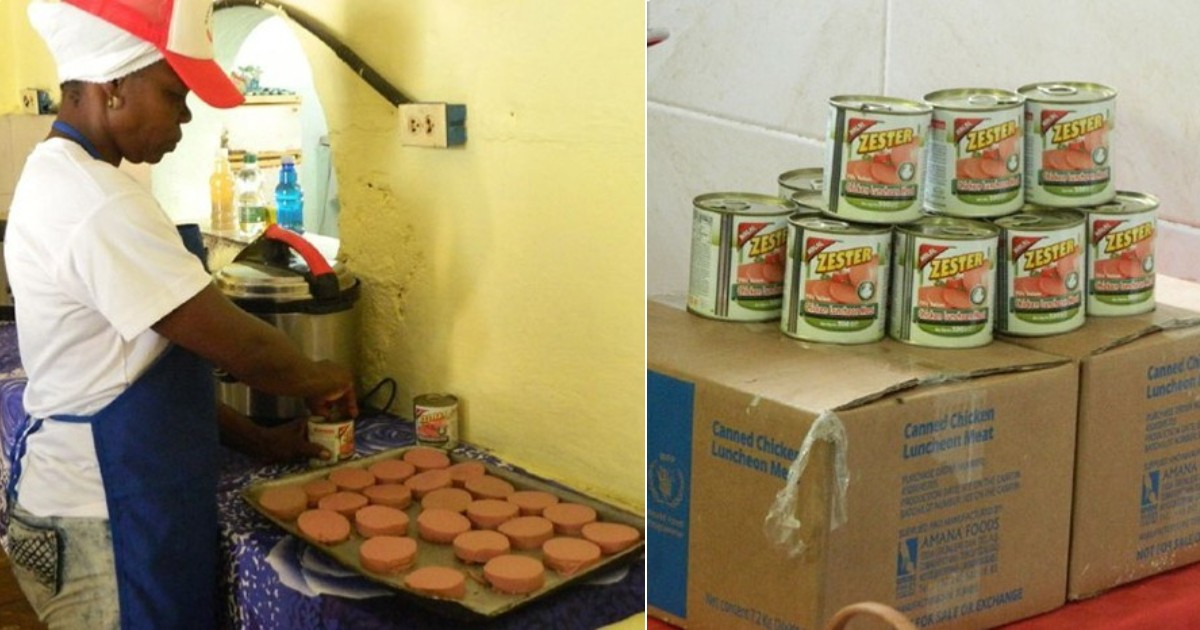
The World Food Programme (WFP) delivered 106 tons of canned meat to the Family Care System (SAF) in the province of Villa Clara, aiming to "supplement the diet" of over 8,500 vulnerable individuals, the agency reported this Monday.
This donation adds to a basic food basket that the global organization was already distributing in the province, consisting of rice, oil, and peas, and will supply 130 dining halls spread across the central region of the country, said the national nutrition officer of WFP in Cuba, Zoe Díaz, to the Cuban News Agency.
Díaz stated that, with the delivery of animal-based protein, the WFP is supporting "the significant improvement in the nutritional intake of the diet" received by vulnerable individuals assisted by the SAF in that area.
The initiative is funded by the Government of the Canary Islands and jointly implemented by the Ministry of Domestic Trade and the provincial government of Villa Clara, with technical support from the WFP, the note specified.
It is not the first time that the Canary Islands government has contributed to this program: in April 2026, it announced the donation of 75 tons of canned chicken to the SAF of Villa Clara, and previously had sent 48 tons of frozen chicken and 5.5 tons of canned chicken to that same program.
Jansel Raúl Utrera Rivas, administrator of SAF El Plaza, positively evaluated the contribution: "This donation represents a significant relief for the families we serve," while Ariel Aguilar Cuba, an elderly beneficiary of the program, also expressed his gratitude for the assistance: "Receiving this additional protein improves our daily nutrition."
Meat is an increasingly scarce and inaccessible food for most Cubans.
The donation arrives at a time of severe food deterioration in Cuba, where hunger has become a daily reality. According to data from the observatory Food Monitor Program (FMP), 96.91% of the Cuban population lacks adequate access to food due to inflation and the decline in purchasing power.
The survey "In Cuba, There is Hunger 2025," published earlier this month by the observatory and Cuido60, revealed that one in three surveyed families reported experiencing hunger over the past year, and 33.9% indicated that at least one household member went to bed without eating, an increase of 9.3 percentage points compared to 2024.
The study, based on 2,513 valid responses collected between May and July 2025 across the 15 Cuban provinces and the special municipality, shows a sustained deterioration compared to the previous year.
According to the World Food Programme, between 2018 and 2023, Cuban production of pork fell by 95%, rice by 87%, beans by 70%, and milk by 58%.
Cuba imports about 70% of the food it consumes, with an estimated expenditure of 2 billion dollars annually.
The SAF, established in the 1990s to serve the elderly, people with disabilities, and high-risk pregnant women, has seen a steady increase in demand: it went from serving about 59,000 people in 2023 to approximately 67,000 by mid-2025.
In March 2026, the Cuban government publicly acknowledged that it does not have sufficient budget to assist all applicants of the program, highlighting the magnitude of the social crisis facing the island after decades of failed governance.
Villa Clara has been one of the provinces most affected by scarcity: its agricultural markets have reported chaotic prices and a reduced supply of meat, rice, root vegetables, and eggs, a situation that makes international donations a vital support for the most vulnerable groups.
The WFP significantly expanded its operation in Cuba following Hurricane Melissa in November 2025, when it announced assistance for more than 900,000 people in the eastern part of the country, with over 2,900 tons of food in the initial phase.
Filed under: