
Related videos:
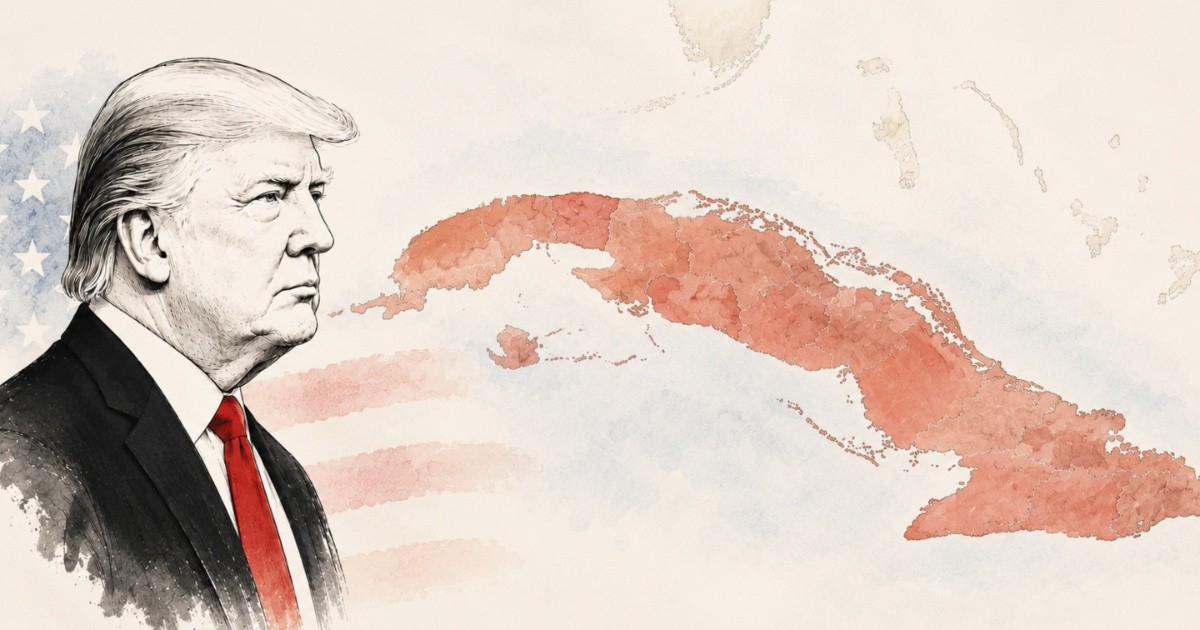
Clifford D. May, president of the Foundation for Defense of Democracies (FDD), published an opinion piece on Tuesday in The Washington Times asserting that President Donald Trump has a historic opportunity to end Cuban communism without military intervention, by combining economic pressure, legal accountability, and diplomatic incentives.
May, a conservative analyst specializing in foreign policy and national security, argues that Trump could be remembered not only as a "peacemaker" but also as a "liberator."
To support that thesis, he quotes the president's own words: "I will not rest until the people of Cuba have the freedom that their ancestors fought so valiantly to establish more than 100 years ago."
The expert frames the issue as both a matter of human rights and national security.
Trump has warned that "America will not tolerate a rogue state that hosts military, intelligence, and terrorist operations only 90 miles from U.S. territory," referring to the presence of Russian and Chinese facilities on the island, as well as the regime's ties to groups like Hezbollah and Hamas.
The article is published amidst an intense diplomatic offensive and pressure from Washington towards Havana.
In April, the administration reportedly gave the regime a two-week ultimatum to release high-profile political prisoners such as Luis Manuel Otero Alcántara and Maykel Osorbo. The Cuban government denied the existence of this ultimatum and stated that political prisoners "are not on the negotiating table."
On May 1, Trump signed an executive order to expand sanctions against Cuba, and on May 8, new sanctions against GAESA and other regime entities were announced.
On May 14, the CIA director, John Ratcliffe, traveled to Havana on an unannounced visit to meet with the Minister of the Interior Lázaro Álvarez Casas and Raúl Guillermo Rodríguez Castro, known as "El Cangrejo," conveying the message that Washington would only engage in dialogue if Cuba made "fundamental changes."
During that same visit, a pledge of 100 million dollars in humanitarian aid was reported, conditional on reforms and that the distribution would take place through independent channels such as the Catholic Church.
Miguel Díaz-Canel responded that any U.S. assistance "will not encounter obstacles or ingratitude from Cuba," while Chancellor Bruno Rodríguez described Trump's statements as "cynical and hypocritical."
May also highlights the indictment presented on May 20 by the acting Attorney General Todd Blanche against Raúl Castro and five co-defendants for the downing of two Brothers to the Rescue planes on February 24, 1996, which resulted in the deaths of four Cuban Americans: Carlos Alberto Costa, Armando Alejandre Jr., Mario de la Peña, and Pablo Morales.
The charges include conspiracy to murder American citizens and four counts of homicide.
The Department of Justice described the case as the first time in almost 70 years that high-ranking leaders of the Cuban regime have been formally charged in the United States for acts of violence that resulted in the deaths of American citizens, an element that May considers central to the pressure strategy.
According to data from Prisoners Defenders cited in the report, Cuba had 1,250 political prisoners and prisoners of conscience in April, of which 738 were incarcerated and 476 faced restrictions outside of prison, figures that illustrate the magnitude of the repression faced by the Cuban people after 67 years of communist dictatorship.
May concludes that all these elements —presidential statements, sanctions, the CIA visit, and the indictment— are part of a coordinated strategy that could, for the first time in decades, put an end to Fidelism.
Trump, for his part, declared on May 19 that he is "very proud of Cuban-Americans" and believes a diplomatic agreement is possible, as long as the regime accepts real political changes.
Filed under: