
Related videos:
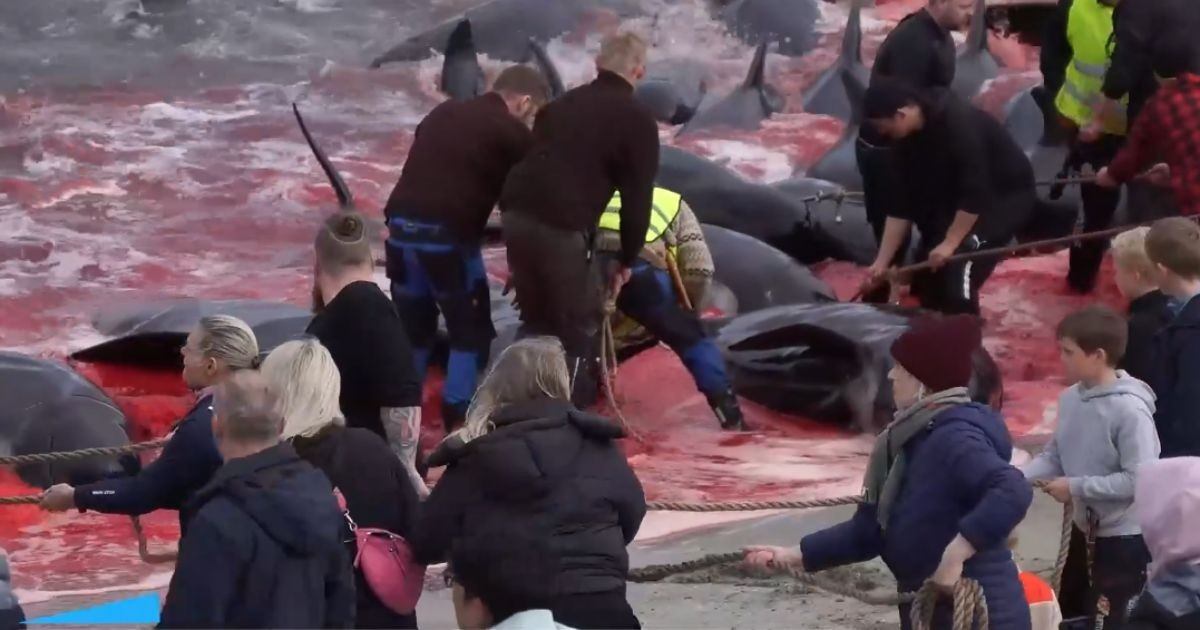
The environmental organization Sea Shepherd reported the death of 706 dolphins in three hunts carried out last Wednesday in the Faroe Islands, an autonomous archipelago located in the North Atlantic between Iceland, Norway, and Scotland. The images released by the NGO show beaches filled with people, including children, watching as the animals were driven ashore by force and slaughtered while the water turned red.
According to the report by El País, this refers to the practice known as grind or grindadráp, a method of capture that dates back to the 9th century. It involves surrounding pods of cetaceans with boats, blocking the exits of bays, and driving the animals towards the shore to be sacrificed. Sea Shepherd warned that "the scale of these slaughters already exceeds two-thirds of the total number of marine mammals killed in the islands during the entire past year," when around 1,000 animals were killed.
Among the cetaceans sacrificed were pilot whales, Atlantic white-sided dolphins, and some bottlenose dolphins, all species classified as "least concern" on the International Union for Conservation of Nature's Red List. 406 of the 706 animals were killed in Tórshavn, the capital of the archipelago, the report indicates.
The conditions under which the hunts took place further worsened the situation. Valentina Crast, in charge of Sea Shepherd's campaign in the Faroe Islands, reported that "the hunters themselves acknowledged a shortage of spinal lances, which are mandatory for killing the dolphins. As a result, several marine mammals were killed solely with knives." Two members of the organization were arrested while documenting the events and are facing possible deportation, the Spanish newspaper reports.
Crast also questioned the food justification put forth by local authorities. "The demand for whale and dolphin meat is about one kilogram per person per year. With a population of 55,000, that would amount to around 55 tons annually," he noted, recalling that a single pilot whale can provide between 1.5 and 2 tons of meat and fat, which means "there would be no need to kill hundreds of dolphins and pilot whales each year."
The biologist Bruno Díaz López, director of the Institute for the Study of Bottlenose Dolphins (BDRI), was emphatic: "We are talking about dolphins, which are highly social, superior mammals, with enormous similarities to species like our own; they are equivalent to a primate in the terrestrial environment." According to the researcher, the practice "has no justification in today's society, nor from a biological or scientific perspective; it is merely a way to carry on ancient traditions that are established as a symbol of national pride." He added that the consumption of cetacean meat has declined in the archipelago itself due to the high concentrations of heavy metals that these animals accumulate.
The Faroe Islands, although part of Denmark, are not members of the European Union and are not obligated to comply with EU regulations or international agreements on whale protection. Crast lamented that "Brussels has criticized these hunts on several occasions, but this has not translated into effective political or economic pressure measures," adds the report by journalist Esther Sánchez.
This is not the first time the archipelago has been involved in an episode of this magnitude. In 2021, the hunting of 1,423 dolphins in a single day triggered unprecedented international condemnation; authorities attributed it to a miscalculation regarding the size of the pod. Subsequent surveys indicated that nearly 70% of the Faroese population opposed dolphin hunting, although internal social pressure remains a barrier to open dissent.
In Cuba, cetaceans have also been involved in episodes that captured public attention. In February of this year, a whale was found dead on the beach of Santa Lucía, in Pinar del Río, and in April 2025, as part of an effort to revive the tourism sector, the Cuban regime relaunched a program for dolphin-assisted therapies at luxury hotels in Cayo Guillermo, aiming to attract foreign families interested in such medical services.
Cuba does not have a tradition of whaling, but the scarcity of resources for marine conservation on the island stands in stark contrast to the institutional indifference that conservationists denounce in other contexts.
For Díaz López, the only sustainable solution involves a cultural change from within: "We need to work from the inside, educate; it can't just depend on a politician banning it, because then another one might come along and reverse that decision and reauthorize it."
Filed under: