
Related videos:
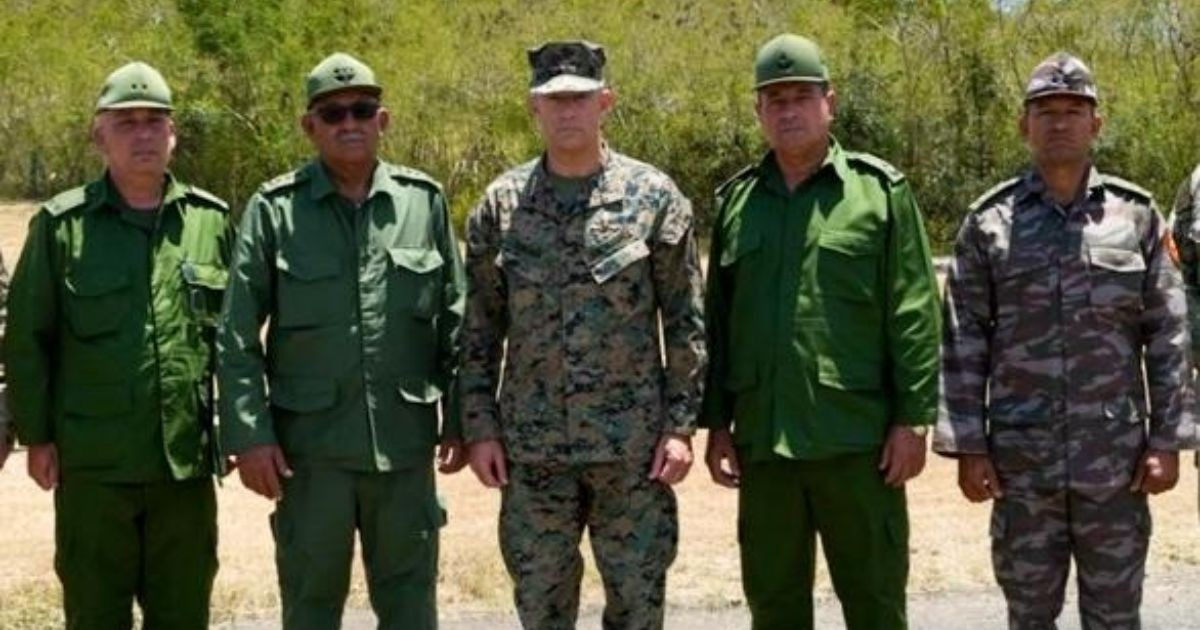
General Francis L. Donovan, head of the United States Southern Command, met last Friday with high-ranking military officials from the Cuban regime in the vicinity of the Guantanamo Naval Base, in one of the highest-level contacts recorded in years between Southern Command and the Revolutionary Armed Forces (FAR).
Officially, both parties described the exchange as focused on operational security issues regarding the perimeter of the base and agreed to maintain communication channels between military commands. The Cuban Ministry of the FAR characterized the meeting as "positive" and indicated that it was "by mutual agreement." However, intelligence analysts believe that the political and strategic backdrop of the meeting goes far beyond what was publicly stated.
For the former Cuban intelligence officer José Cohen, interviewed by journalist Jany González for Martí Noticias, the meeting reflects much broader interests than those officially explained. "Cubans can't record there; they are on U.S. territory, and no one knows what was said or what was explained, but I believe it is undoubtedly part of a process to dismantle the regime," Cohen asserted, who thinks that Washington would seek a transition without military confrontation.
The analyst also pointed out that the regime needed to publicly justify the contact to its own population. "It was made public, and Cuba has to justify that contact. To keep the population entertained, they say it's an exchange to review the security perimeter of Guantánamo. The deputy minister of the FAR goes with the consent of Raúl Castro," he stated, directly referring to General Roberto Legrá Sotolongo.
Legrá Sotolongo, First Deputy Minister and Chief of the General Staff of the Armed Forces, was promoted to the Political Bureau of the Communist Party of Cuba in December 2025 and is one of the highest-ranking active military officials on the island. His presence was interpreted by analysts as a sign that the regime authorized contact at the highest level.
Cohen also highlighted the generational profile of the Cuban officials present at the meeting as a telling detail. "They are no longer historical generals from the Sierra. They are officers trained after the Revolution and are likely also thinking about the future of their families and children. They now have a direct communication channel with Southern Command," the media outlet pointed out.
In parallel with the meeting, a sustained escalation of U.S. military pressure on the island has been documented. In the weeks leading up, more than 20 aerial intelligence missions and over 150 hours of aerial surveillance were recorded near Cuba. Additionally, the 24th Marine Expeditionary Unit confirmed the deployment of more than 1,300 marines under Southern Command operations, with missions for rapid response, embassy protection, and combating drug trafficking and terrorism networks. "They have Cuba militarily surrounded. Drones pass by every day and have already gathered a vast amount of intelligence on military and strategic targets," Cohen stated.
The meeting in Guantánamo is part of a series of pressure actions that Washington has deployed in recent weeks. On May 14, CIA Director John Ratcliffe visited Havana and met with the Minister of Interior, the head of the Intelligence Directorate of MININT, and Raúl Guillermo Rodríguez Castro, the grandson of Raúl Castro.
Six days later, on May 20, federal prosecutors announced criminal charges against Raúl Castro for the downing of the aircraft from Brothers to the Rescue on February 24, 1996, in which Carlos Costa, Armando Alejandre Jr., Mario de la Peña, and Pablo Morales lost their lives, including charges of conspiracy to murder U.S. nationals and four counts of murder.
According to Cohen, this entire set of actions represents a coordinated process that does not allow for benevolent interpretations. "It's not a friendly process. It’s a process of pressure and ultimatums. And of course, if they need to speak with Raúl Castro, they will, but to force him out of power or even to have him arrested," concluded the former official, in an assessment that captures the perspective from which much of the Cuban exile community interprets Washington's movements toward Havana at this moment.
Filed under: