
Related videos:
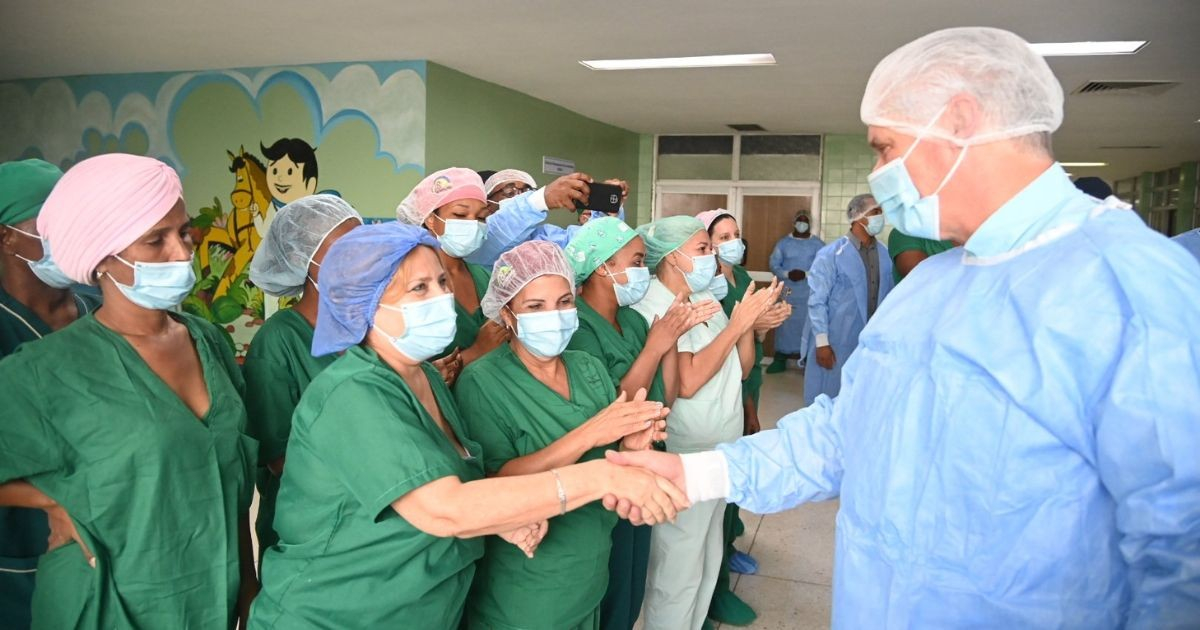
The Cuban president Miguel Díaz-Canel visited the International Orthopedic Scientific Complex "Frank País" in Havana last Friday to celebrate the advancements in digital transformation at one of the country’s most privileged hospitals, while the rest of the Cuban healthcare system is plagued by raw sewage under patients' beds, collapsed ceilings, and surgical waitlists exceeding 96,000 patients.
The visit to Frank País was the eighth of its kind undertaken by the leader to health centers as part of the digital transformation process that began in late 2025. He was accompanied by Vice Prime Minister Eduardo Martínez Díaz, Minister of Public Health José Ángel Portal Miranda, and Minister of Communications Mayra Arevich Marín.
The director of the center, Dr. Osvaldo García Martínez, presented to the president the advancements in electronic records, electronic medical history, and distance tele-education. However, among the achievements, a revealing confession slipped through: "Many times, we have to sterilize materials at other institutions; many times, we have to adapt, create, or transform devices for patient treatment," the director himself admitted. Even the "showcase" hospital is not immune to the crisis.
Díaz-Canel, true to his script, acknowledged the shortcomings but attributed them to Washington. In the guest book, he wrote that the staff overcomes “the adversities imposed by the collective punishment resulting from the maximum pressure policy of the United States government to suffocate us,” and referred to them as “a bastion of creative resistance.” He had previously mentioned the complexity of the situation, “where we lack electricity, where we lack supplies, where we face thousands of transportation and medication limitations.”
The minister Portal Miranda admitted in July 2025 that there was only coverage for 30% of the basic medicine supply across the island. Cuba ended that year with an infant mortality rate of 9.9 per 1,000 live births, the worst record in decades compared to 7.1 in 2024, and an increase of 148% from the levels of 2018.
In Havana, that figure reached 14 per 1,000 live births in January-February 2026. The maternal mortality rate also worsened: 44.1 per 100,000 live births in 2025, compared to 40.6 the previous year.
While Díaz-Canel toured the Frank País Ludoteca, the national surgical waiting list reached 96,387 patients in March 2026, including more than 11,000 children.
The contrast between the hospital that the regime chooses for its photos and the reality of the rest of the country is shocking. At the Juan Bruno Zayas Hospital in Santiago de Cuba, sewage was reported under the beds and an infestation of cockroaches in the delivery room. At the Orlando Pantoja Tamayo Hospital in Contramaestre, collapsed bathrooms and dirty floors in the intensive care unit were reported in April 2026. At the Children's Hospital La Colonia Española in Santiago de Cuba, admitted children remained untreated due to a lack of distilled water. The Calixto García Hospital in Havana suffered a partial roof collapse in November 2025.
The Pan American Health Organization documented damage to at least 385 health facilities in Cuba, in a context it described as an unprecedented crisis. Díaz-Canel concluded his visit with a "Until victory, always" in the guestbook of Frank País. For those sleeping on the floors of other Cuban hospitals, perhaps waiting to be attended to, victory still means being able to receive basic medical care.
Filed under: