
Related videos:
While Cuba experiences blackouts lasting over 24 hours, food shortages, and what UN agencies have described as a "humanitarian collapse," the regime spares no resources in celebrating with verses and literary panels the centenary of the man who designed that system.
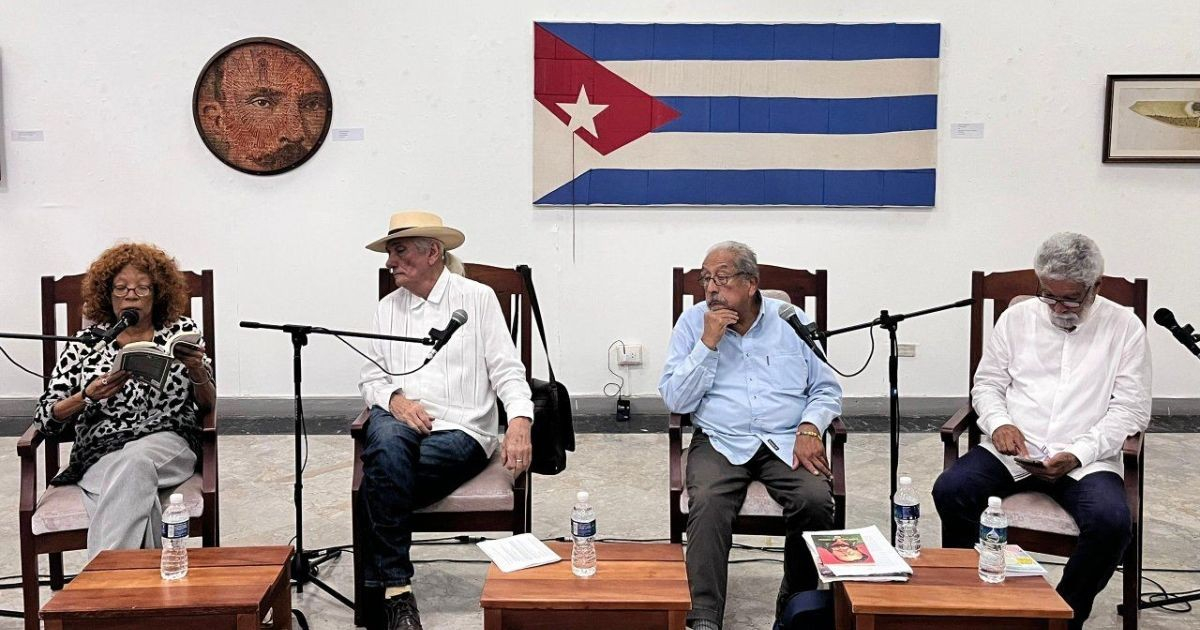
This Friday, the Cuban Institute of the Book announced on its social media that the "Poets Meeting for Peace and Life" was held at the José Martí National Library, in tribute to the centenary of Fidel Castro, which will take place on August 13th.
The event was part of the 32nd International Poetry Festival of Havana, held from May 26 to 30, 2026, and dedicated, in its main edition, to the former dictator. The official poster of the event sums it up unambiguously: "In Tribute to the Centenary of Fidel (1926-2026)."
The session was moderated by Waldo Leyva, National Literature Prize 2024, and featured the participation of Nancy Morejón, National Literature Prize 2001, and Alex Pausides, director of the CubaPoesía Cultural Center. The Peruvian poet Hildebrando Pérez Grande also took part, along with Cubans Germán Sánchez, Oscar Oramas, and Luis Toledo Sande.
The official poster of the festival also included among the guests Tarek William Saab, an official of Nicolás Maduro's government in Venezuela, which illustrates with whom the Cuban regime shares the stage when celebrating its founder: with representatives of other dictatorships on the continent.
The meeting is just one more piece of the propaganda machinery that the government of Miguel Díaz-Canel has set in motion for the year he officially designated as the "Year of the Centenary of Commander in Chief Fidel Castro Ruz". The program includes the I International Colloquium "Fidel: Legacy and Future", scheduled for August at the Palace of Conventions in Havana, the publication of 23 volumes of Selected Works with over 600 documents, youth caravans, tree planting, and museum restoration.
The festival, which brought together more than 100 poets from over 17 countries, also pays tribute to José Lezama Lima and Rainer Maria Rilke, although the main homage is undoubtedly for Castro, who, as far as is known, did not write any poetry. The Cuban Institute of the Book, the organizer of the event, is a state agency subordinate to the Ministry of Culture, which underscores the official and institutional nature of these literary tributes to the former dictator.
The contrast with the reality experienced by the Cuban people could not be more brutal. Economist Pedro Monreal recently warned that the Cuban GDP could fall by as much as 15% in a critical scenario; CEPAL estimated a decline of 6.5%, and The Economist Intelligence Unit projected a drop of 7.2%. Cuba produces only 40,000 barrels of oil daily when it needs between 90,000 and 110,000, resulting in power outages that last over 24 continuous hours in several provinces. This does not take into account the critical state of the country's thermoelectric plants.
This energy crisis is compounded by widespread shortages of food and medicine, the deterioration of basic services, and an exodus that is now considered the largest in recent Cuban history, which began in 2021, with over a million Cubans having left the island. United Nations agencies used the term "humanitarian collapse" in February 2026 to describe the situation the Caribbean nation is heading towards.
That is the true legacy of the man to whom national and international poets dedicated their verses this Friday at the National Library: a country in collapse, emptied by exodus and steeped in darkness, both literal and figurative, while the regime he founded invests energy in celebrating its centenary with literary panels, youth caravans, and 23 volumes of selected works.
Filed under: