
Related videos:
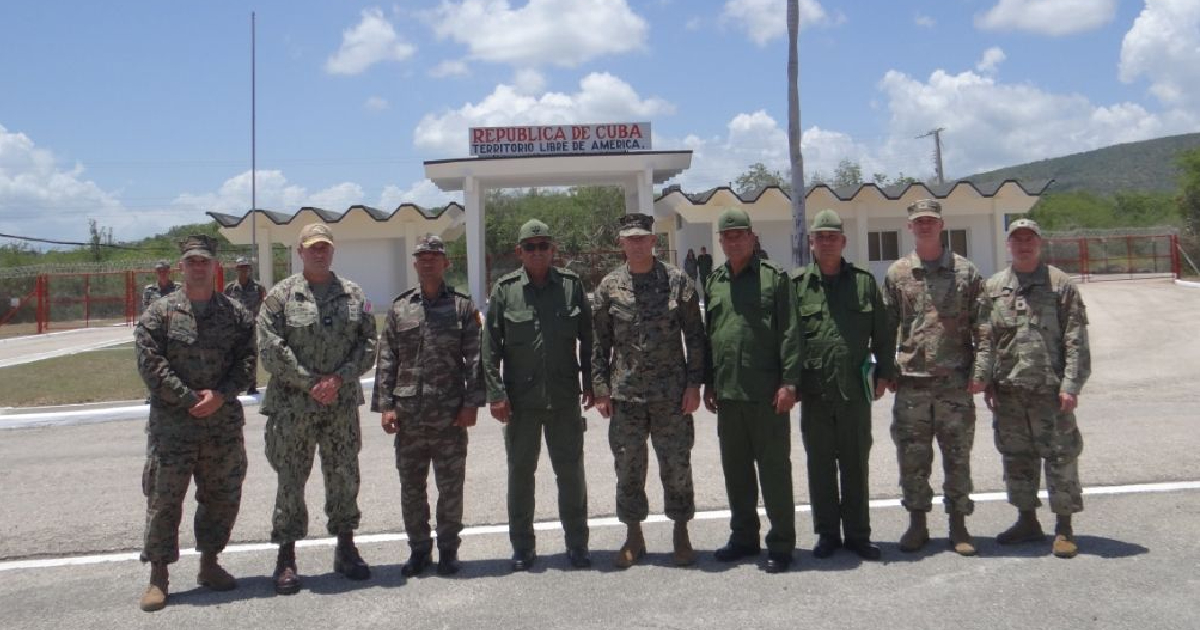
The meeting between the Commander of the United States Southern Command and high-ranking Cuban military officials at the perimeter of Guantanamo Naval Base should not be viewed as merely a ceremonial gesture. In international politics, and especially in situations of high tension, military movements are rarely innocent.
When a U.S. military chief of that level appears at one of the most sensitive borders in the hemisphere, inspects base security, reviews personnel protection, and talks with Cuban regime leaders, it's legitimate to ask what is really happening.
The public version discusses operational security, perimeter protection, and communication channels. However, in the current context, that explanation seems insufficient. The United States has intensified pressure against the Cuban regime; sanctions have been imposed against political, military, and intelligence figures; Washington has declared that Cuba represents a serious regional security threat; and the case of Raúl Castro, implicated in the murder of the four pilots from Brothers to the Rescue, has placed the historical leadership of Castroism in a judicial and political scenario of enormous gravity.
One possible interpretation is that Washington is not only addressing border security. It may be assessing the landscape, calculating risks, studying the behavior of the Cuban Armed Forces, and evaluating to what extent certain high-ranking officials would be willing to avoid a pointless clash when the time comes to implement decisions that have already been made in the judicial, political, or strategic realm.
It is not necessarily about a classic invasion or an open war. The Venezuelan precedent has shown that the United States can opt for surgical, precision operations aimed at capturing or neutralizing figures accused of serious crimes, minimizing human costs, internal chaos, and collateral damage. If this is the model that Washington is considering for Cuba, Guantánamo holds a central position: it is territory under U.S. military control, located within the island, with infrastructure, communications, self-defense, and a long history of tension with the communist regime.
The Guantanamo Naval Base originated from the agreements signed between Cuba and the United States in the early 20th century, after the Spanish-Cuban-American War. In 1903, a lease was established for areas in Guantanamo Bay for a naval station and coaling station. The 1934 Treaty of Relations maintained this arrangement: Cuba retained ultimate sovereignty, but the United States maintained control and jurisdiction over the leased area unless there was a mutual agreement to terminate it or a withdrawal of U.S. presence from the base.
Before 1959, the relationship between the base and Cuba was very different. There were nationalist tensions because part of the Cuban population viewed that enclave as a wound to national sovereignty. However, in everyday practice, there was no war-like border between the Cuban state and the U.S. base. There was exchange, work, trade, and a relatively normal relationship between the U.S. military installation and the people of Guantánamo, Caimanera, and Boquerón. Thousands of Cubans worked there as laborers, mechanics, cooks, construction workers, drivers, maintenance staff, and service personnel. The base was part of the local economy.
There was also no hostile militarization before 1959, which later developed under castrism. There were fences, checkpoints, and a military presence, as is appropriate for a naval base, but there was not an ideological border that was closed, mined, and turned into a symbol of permanent confrontation. This reality changed radically with the arrival of Fidel Castro to power. The communist regime transformed Guantánamo into a propaganda tool against the United States and into a line of military, political, and symbolic confrontation.
Starting in the 1960s, the perimeter of the base became one of the tensest frontiers of the Cold War in the Western Hemisphere. During the Missile Crisis of 1962, Guantánamo was on high alert. Families of U.S. personnel were evacuated, and the base prepared for a possible attack. In 1964, Fidel Castro ordered the cutting off of water supply to the base, forcing the United States to seek emergency solutions and to develop greater self-sufficiency.
There were also armed incidents, reported incursions, gunfire, injuries, and fatalities. U.S. documents record episodes in which Cuban military personnel were detected inside or near the perimeter, leading to exchanges of fire. On the other hand, Cuban propaganda has denounced for years the deaths and injuries of Cuban border guards from gunfire originating from the base. As is the case in all militarized borders, the narratives from both sides do not always align, but the central fact is indisputable: after 1959, Guantánamo ceased to be a point of practical coexistence and became a confrontation border.
Another dramatic element was the minefield. During the Cold War, tens of thousands of mines were placed around the perimeter of the base. This death belt not only symbolized the distrust between the United States and the Cuban regime, but it also had human consequences. Cubans attempting to escape were exposed to a deadly danger. Guantánamo was both a refuge, a border, and a trap.
For thousands of Cubans, however, the base also represented a chance to escape. For years, many saw in that territory controlled by the United States a desperate gateway to freedom. The most significant expression of that reality occurred during the 1994 rafter crisis. Tens of thousands of Cubans fled by sea from the oppression, misery, and lack of future imposed by the regime. Many were taken to temporary camps in Guantánamo, where they lived for months in tents, surrounded by barbed wire and uncertainty, waiting for a migratory solution. Those camps demonstrated how the base was not just a military facility, but also a stage for the Cuban human drama.
Today, more than a century after its establishment, the Guantánamo base is once again at the center of the historical tension between Cuba and the United States. The difference now is that the Cuban regime is weaker than ever: economically broken, internationally discredited, lacking internal legitimacy, with an exhausted population and an aging leadership that can no longer deceive anyone.
For this reason, the meeting between U.S. and Cuban commanders in the Guantanamo area should be taken seriously. The United States may be putting each piece in its place: reviewing the security of the base, studying the posture of the Cuban Armed Forces, assessing the potential for cooperation or neutrality among high command, and preparing a scenario in which any future operation is quick, precise, effective, and as least traumatic as possible for the Cuban people.
Raúl Castro and the historical leadership of Castroism know that time is not on their side. The case of the Brothers to the Rescue pilots is not just a political dispute: it involves the shooting down of civil aircraft and the death of four men. If U.S. justice moves forward to its final consequences, the regime will have to decide whether to protect a figure that belongs to the past or to avoid dragging all of Cuba into a greater crisis.
Guantánamo was initially a naval base established amidst an unequal relationship; later, it became a source of employment and practical coexistence; and subsequently, it turned into a frontier of the Cold War, a mined area, a scene of gunfire, migrations, and tensions. It may now be becoming the point from which the United States observes, calculates, and prepares for the outcome of a dictatorship that has oppressed Cuba for 67 years.
The story seems to come full circle. The same place that for decades the Castro regime used as a symbol of anti-American propaganda might end up being the space from which the end of tyranny is ensured to be more precise, orderly, and less chaotic. Guantánamo is not just a military base. It is a historical frontier. And on that frontier, the final chapter of Castro-communist power may be beginning to be written.
Filed under:
Opinion article: Las declaraciones y opiniones expresadas en este artículo son de exclusiva responsabilidad de su autor y no representan necesariamente el punto de vista de CiberCuba.