
Related videos:
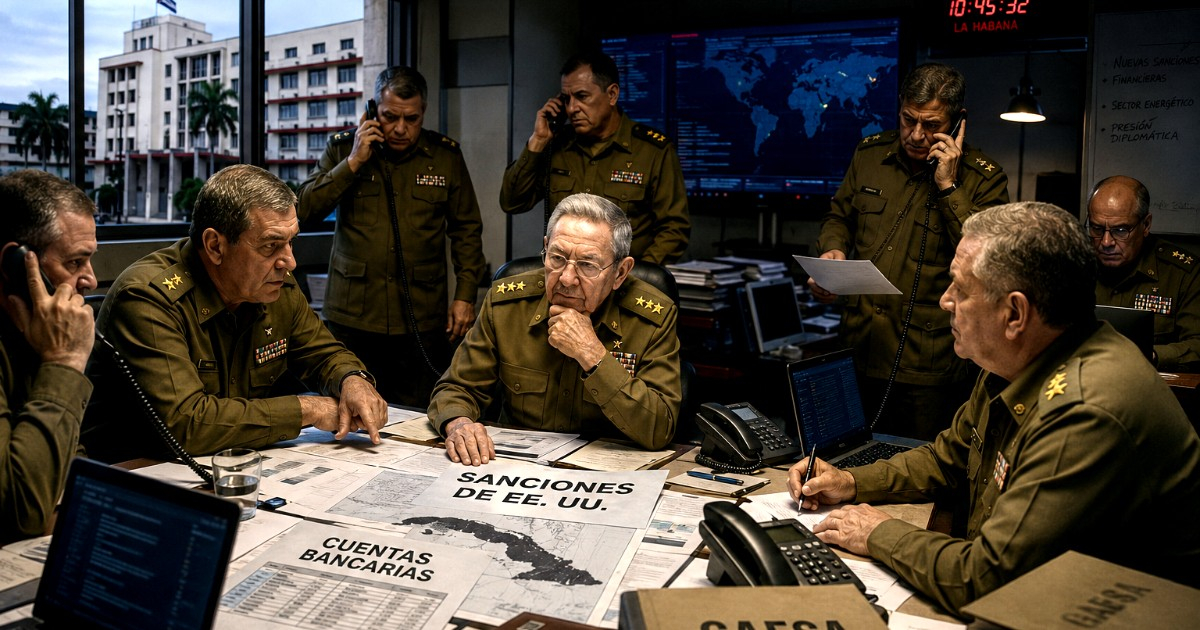
The Cuban government published an article this Tuesday in Granma under the seal "Government of the Republic of Cuba," in which it defended the Business Administration Group S.A. (GAESA) against the sanctions imposed by the Trump administration.
The note, published in the official organ of the Communist Party of Cuba (PCC), constitutes the first time the regime defends its "golden goose" and attempts to publicly explain what the income from the military conglomerate is used for.
The text, titled "Cuba, the GAE and the United States: Anatomy of a State Slander", is a direct response to Executive Order 14404, signed by Donald Trump on May 1, which designated GAESA as a sanctioned entity and established secondary sanctions for any foreign company that maintains ties with the group.
The regime listed in the article a series of projects it attributed to the conglomerate: the construction of over 10,000 homes in various provinces, investments in the Lidio Ramón Pérez (Felton) thermoelectric plant in Holguín, hydraulic works such as the East-West and North-South transfers, and repairs to polyclinics, medical offices, and schools.
The text states that "the GAE is not an opaque structure, nor parallel to the Cuban State" and that "it is not the result of secrecy, nor of elites, and much less a means for the enrichment of a few."
However, the defense is revealing precisely because of what it omits: it does not provide a single figure, any financial balance, or independent audit to support its claims.
The documented reality contradicts the official narrative. In May 2024, the former Comptroller General of the Republic, Gladys Bejerano, acknowledged that GAESA was not under her supervision, justifying it by stating that the conglomerate has "superior discipline and organization."
The Law 158 of 2022 also removed references to audits of military institutions, leaving self-monitoring in the hands of the presidential environment.
For its part, the U.S. Department of State accuses GAESA of controlling up to $20 billion in illicit assets diverted to hidden bank accounts abroad, and estimates that its income "likely triples the Cuban state's budget," controlling approximately 40% or more of the island's economy.
The Secretary of State Marco Rubio directly targeted the financial heart of the regime on May 7, when he announced personal sanctions against the executive president of GAESA, Brigadier General Ania Guillermina Lastres Morera, and warned that "new sanctions are expected in the coming days and weeks."
The context in which this official defense appears is one of maximum pressure on the regime's business model. The deadline set by the Office of Foreign Assets Control (OFAC) for foreign companies to sever ties with GAESA expires on June 5, and the response from the international market has been devastating.
Iberostar has withdrawn from managing 12 hotels in Cuba effective June first. Blue Diamond Resorts, with 62 hotels and over 12,900 rooms, announced an immediate cessation of operations. The shipping companies Hapag-Lloyd and CMA CGM have implemented a total ban on bookings to and from Cuba.
The tourism in Cuba plunged by 55.8% year-on-year in the first four months of 2026, with only 328,608 international visitors, the lowest figure since 2002 excluding the pandemic.
Without the income from GAESA —which controls tourism, ports, remittances, foreign currency trade, and strategic sectors— the Cuban regime loses its main source of foreign currency.
The publication in Granma is not an exercise in transparency: it is the clearest signal so far of the regime's desperation in the face of the collapse of its economic backbone.
Filed under: