
Related videos:
What was intended to be a solemn tribute to Raúl Castro ended up becoming one of the most talked-about viral phenomena in recent hours among Cubans on social media.
The controversy began when Cubadebate shared an article by Miguel Barnet on Facebook dedicated to the 95th anniversary of the retired general. To promote the text, the official media chose a phrase that appeared at the end of the tribute:
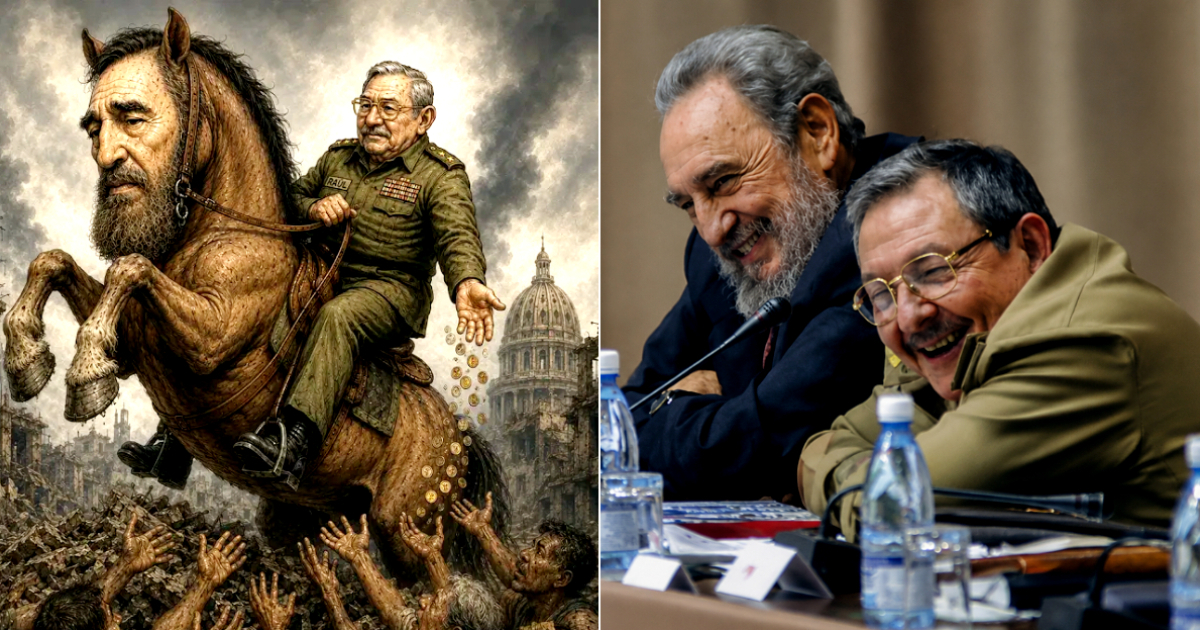
"If Fidel is the horse, Raúl is the most intrepid and brave rider."
The post was accompanied by a photograph of the Castro brothers smiling and a green heart. What was likely intended to be an image of historical loyalty between the two leaders had a very different effect than expected.
Within hours, hundreds of users began flooding the comments section with jokes, memes, and sarcastic remarks about the equestrian metaphor.
The most repeated interpretation was as simple as it was devastating for the authors of the tribute: if Fidel was the horse and Raúl the rider, then the latter was mounted on the former.
So was Raúl riding Fidel?", asked dozens of comments. Others summarized the matter with phrases like "they made it too easy", "someone didn't read that before publishing it", or "this must have been intentional".
Many users claimed that the person responsible for the post must work for the CIA, a humorous theory that was repeated time and again throughout the day. "The administrator of Cubadebate is one of us", wrote one internet user. Another stated that the post was "the meme of the year".
Of the tribute to the choteo
The situation became even more complicated for the official media because the phrase did not appear lost within a lengthy text, but rather stood out as the main promotional hook of the publication.
Barnet had written a deeply servile and sentimental portrait of Raúl Castro, whom he described as "an unimpeachable leader beloved by all" and as "the light of Fidel in the most sacred of shadows." However, it was the metaphor of the horse and rider that captured public attention.
Practically no comments discussed the political content of the flattering tribute. The conversation revolved almost exclusively around the image chosen by the writer and amplified by Cubadebate.
Numerous users confessed to having logged in just to read the comments. Others stated they had been laughing for hours or expressed gratitude to Cubadebate for brightening their day amidst the blackouts and daily challenges.
The horse, number one, and the Cuban riddle
Part of the success of the prank seems to have been related to a cultural reference deeply rooted in Cuba.
The expression "the horse" has been used for decades by admirers of the dictator Fidel Castro as a synonym for leader, chief, or exceptional figure. Additionally, in the popular Cuban charade, "the horse" corresponds to the number 1.
That association caused several users to make immediate connections with the historical hierarchy of Castroism, where Fidel was always number one and Raúl held the position of second in command for decades. And in the charade, the 2 is "butterfly".
Although few mentioned the charade directly, the coincidence fueled numerous wordplays and ironic comments about the eternal division of roles between the two brothers.
From rider to "mare"
As the hours went by, the tone of the comments became increasingly irreverent.
A large number of users began to complete the original phrase on their own. If Fidel was the horse, many said, then Raúl must be "the mare."
The references appeared time and again, accompanied by terms such as "amazon," "jinetera," "rider," or "the mare of Birán."
Although many of these comments bordered on homophobic mockery, they reflected a popular perception that has circulated for decades in the form of rumors, jokes, and informal comments about Raúl Castro. The publication by Cubadebate seemed to suddenly activate all that accumulated imagery.
Other users insisted that the phrase had an obvious unintentional connotation and claimed that no one in the editorial team could have overlooked how it would sound to the Cuban audience.
It can't be that they didn't see this coming, summarized one of the most shared comments.
The correction that came too late
In response to the overwhelming reactions, Cubadebate ended up modifying the original post.
The phrase about the horse and the rider disappeared and was replaced by a much more conventional institutional paragraph:
"We, the creators of the Union of Writers and Artists of Cuba, celebrate its 95 years of exemplary life, dedicated to the defense of our homeland..."
However, by then it was already too late.
Numerous users had taken screenshots of the original version and began sharing them along with new jokes about the correction.
They have already edited it, some commented. The screenshots remain, others replied. Several users pointed out that the change was proof that the outlet itself had understood the issue created by the publication.
Paradoxically, the correction only fueled the virality of the episode further.
What began as a tribute ended up turning into a story about the communication error itself.
A case study on propaganda and social media
The episode illustrates the challenges that Cuban official propaganda faces today in a digital environment where every message can be reinterpreted, parodied, and spread at great speed.
The phrase by Barnet aimed to exalt the relationship between Fidel and Raúl Castro. Cubadebate turned it into a promotional headline. Social media did the rest.
In just a few hours, a metaphor designed to glorify the historical leaders of the so-called "revolution" had been absorbed by Cuban humor and turned into an endless source of memes, jokes, and double entendres.
And when Cubadebate tried to close the door, the horse, the rider, or the mare had already escaped from the stable and were prancing amid the taunts, laughter, and antics of thousands of Cubans.
Filed under: