
Related videos:
The Ministry of Domestic Trade of Cuba (MINCIN) published this week the distribution of the regulated family basket for June 2026, and the document reveals a reality that the regime cannot hide: the food supply for millions of Cubans today relies on international donations, not on national production or state management.
According to official publications from MINCIN on Facebook, the three pounds of rice each consumer will receive this month come from a donation from China. "With the Chinese donation, three pounds are guaranteed to all consumers in the country."
"The distribution began in May in the western region and continues as fuel becomes available," the statement notes, acknowledging that the delivery depends on the availability of gasoline to transport it.
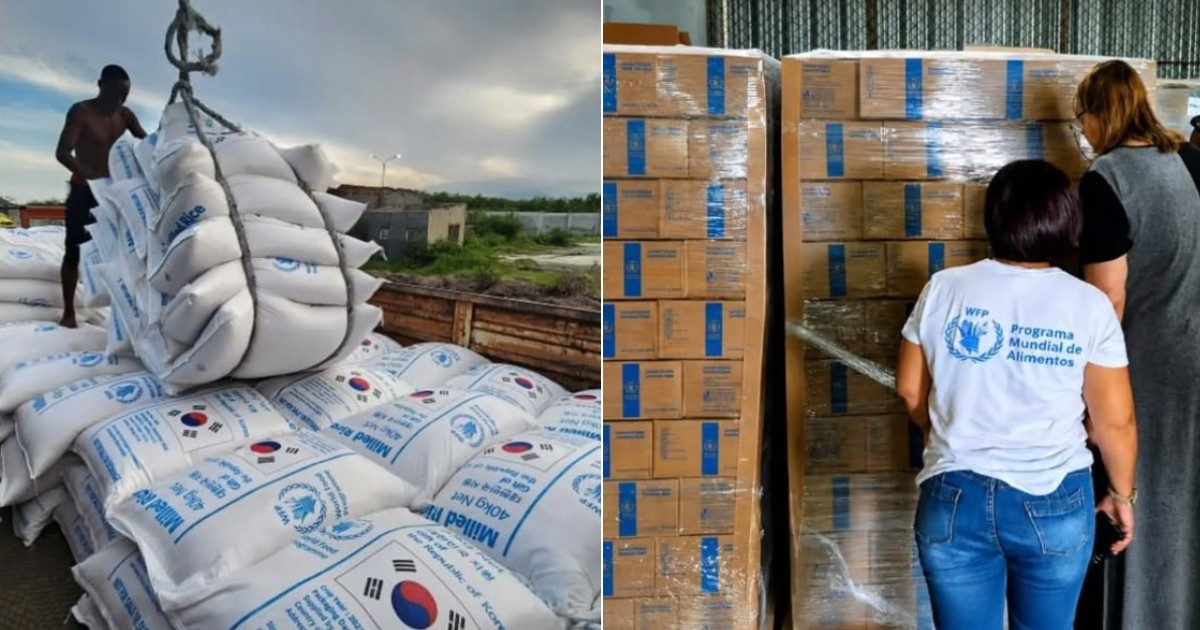
In Santiago de Cuba, meanwhile, 3,000 tons of rice are being transported to the municipalities of the province. The bags bear the inscription "Gift of the Republic of Korea" and the logo of the United Nations World Food Programme (WFP), with the clarification "Not for Sale or Exchange."
It is rice donated by South Korea - a total of 24,600 tons channeled by the WFP since December 2025 - which now supports part of the diet of Eastern Cubans.
In Villa Clara, the situation is similar. The WFP delivered 106 tons of canned meat to the Family Care System (SAF), aimed at over 8,000 vulnerable individuals in 130 dining facilities in the central region of the country.
The initiative was funded by the Government of the Canary Islands and executed in collaboration with MINCIN and the provincial government of Villa Clara. Zoe Díaz, the WFP official in Cuba, explained that the meat complements the basic food basket already distributed in the province—rice, oil, and peas—and enhances the nutritional intake of the beneficiaries.
The MINCIN itself acknowledges in its statement that "the distribution of rice donated by the World Food Program to pregnant women and vulnerable individuals across the country continues," with modules in the eastern provinces also including peas and oil.
The distribution of other basic products in June reveals the cracks in the system: sugar is only guaranteed in Havana and the Isle of Youth; beans do not reach Matanzas, Ciego de Ávila, or Villa Clara due to a lack of sources; and in Havana, pregnant women will receive two kilograms of lentils "from donations."
The backdrop of these donations is a structural food crisis of alarming proportions. Cuba produces only 111,000 tons of rice per year compared to a demand of 600,000 tons, and imports about 70% of the food it consumes. Between 2018 and 2023, its rice production fell by 87%, according to data from the PMA itself.
The survey "There is Hunger in Cuba 2025" revealed that 33.9% of households had at least one member who went to bed hungry, and the Food Monitor Program estimated in April 2026 that 96.91% of the Cuban population lacked adequate access to food.
To sustain the basic basket, the regime has resorted to donations from China— which committed 90,000 tons of rice by 2026—South Korea, Vietnam, Mexico, and the Government of the Canary Islands, among others.
In March 2026, the government acknowledged that it does not have sufficient resources to care for all vulnerable individuals, a confession that encapsulates six decades of economic failure under the communist dictatorship.
Filed under: