
Related videos:
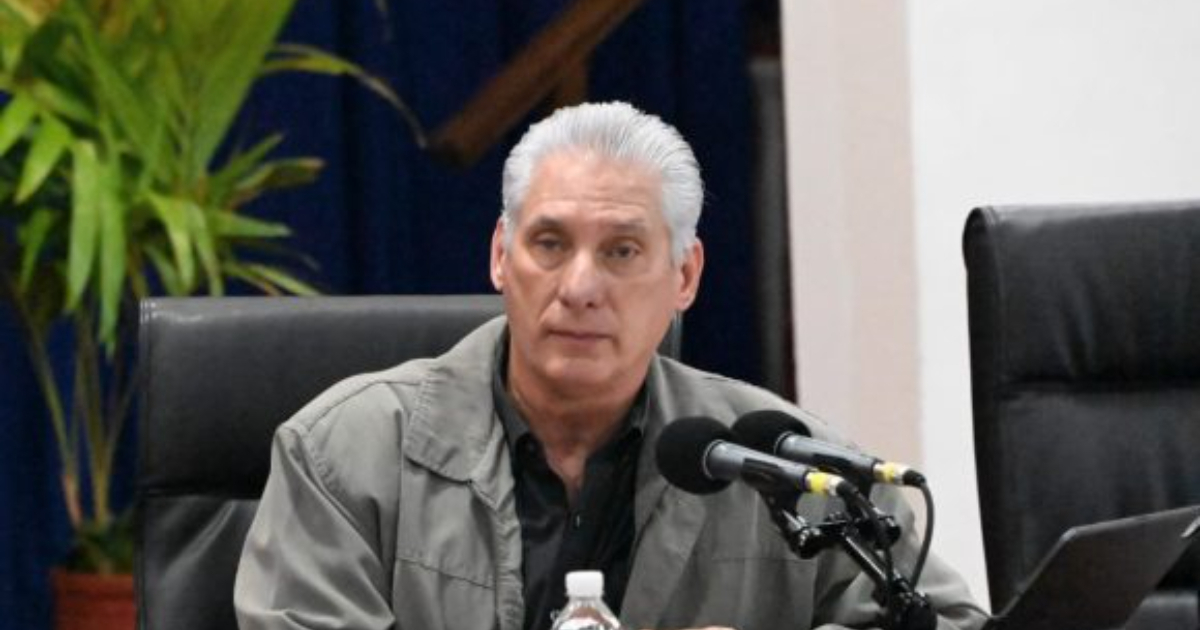
Miguel Díaz-Canel reacted on Thursday to the new round of sanctions from the U.S. Department of the Treasury with a defiant message on his X account, hours after Washington personally designated him on a sanctions list for the first time in his history as a Cuban leader.
On June 4, 2026, the Treasury Department directly sanctioned the Cuban leader in the third wave of measures under Executive Order 14404 signed by Donald Trump on May 1. Along with Díaz-Canel, his wife Lis Cuesta, his stepson Alejandro Castro Espín, the Ministry of Revolutionary Armed Forces (MINFAR), and the Committees for the Defense of the Revolution (CDR) were designated.
In his post on X on Thursday, Díaz-Canel described the sanctions list as "illegitimate" and accused Trump of making "new threatening statements" against Cuba.
"They are aimed at reinforcing the measures of blockade and the conflict scenario between Cuba and the United States," wrote the leader, using the term "blockade," which the regime employs to refer to the U.S. embargo.
Díaz-Canel framed the new appointments as part of a broader offensive: "This political blindness adds to the coercive measures implemented in recent weeks against our country, designed to harm the Cuban people."
He closed his message with a direct challenge to Washington: "The aggression and perversion of the Yankee government will clash with our determination to face the worst scenarios and resist the imperial assault," accompanied by the hashtag #LaPatriaSeDefiende.
The sanctions from Thursday mark the third wave of a staged process. The first, on May 7, targeted the military conglomerate GAESA and Moa Nickel S.A. The second, on May 18, imposed sanctions on nine high-ranking Cuban officials, the Directorate of Intelligence (DGI/G2), the MININT, and the National Revolutionary Police.
The third wave escalates to the highest political level by directly appointing the head of state, something unprecedented in the recent bilateral relationship.
The Executive Order 14404 signed by Trump also introduced secondary sanctions, a mechanism that penalizes companies and financial institutions from third countries that do business with designated Cuban entities.
That mechanism generated immediate pressure on the European partners of the regime: Spanish hotel chains like Meliá and Iberostar began to prepare for their disengagement from operations with GAESA in light of the threat of reprisals.
This Friday marks the deadline set by the Office of Foreign Assets Control (OFAC) for foreign companies to sever those ties under the threat of secondary sanctions.
The Secretary of the Treasury, Scott Bessent, warned on May 29 that sanctions against Cuba "may be tightened or relaxed depending on the behavior of the Cuban government," leaving the door open for both increased pressure and potential negotiation.
Filed under: