
Related videos:
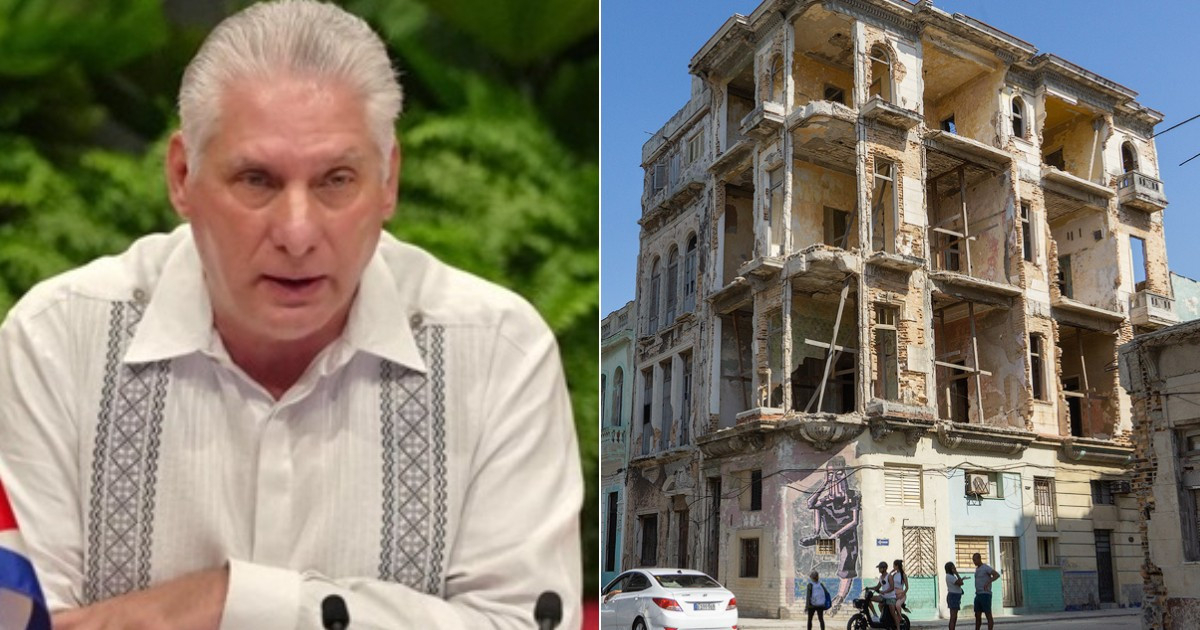
President Miguel Díaz-Canel responded to the repeated accusations from U.S. Secretary of State Marco Rubio, who has described the Cuban regime as "incompetent communists," questioning why Washington maintains sanctions if the Cuban system is so incapable of sustaining itself.
In an extensive interview granted to the Spanish newspaper elDiario.es in Havana, published this Friday, the Cuban leader questioned the argument used by Rubio to explain the crisis that the island is experiencing. "If we are so inadequate, if we are so incompetent, why are they blocking me?" he stated.
The interview was conducted by journalist Andrés Gil and is published at a particularly sensitive time for Havana. It coincides with the implementation of new measures resulting from Executive Order 14404, signed by President Donald Trump on May 1, and just one day after the Department of the Treasury included Díaz-Canel for the first time on the list of Specially Designated Nationals (SDN) by the Office of Foreign Assets Control (OFAC).
During the conversation, Díaz-Canel insisted that the country's economic difficulties are a direct consequence of U.S. policy.
"Remove the blockade and let’s see how we can move forward. If you lift the blockade and we are still unable to progress as a country, then it could be said that we were incompetent," he stated. He also asked, "Why don’t you let me collapse on my own?"
The statements respond to a line of argument that Rubio has repeated in recent months. Rubio declared on May 27 that "Cuba is in serious trouble because, unfortunately for them, it is governed by a group of incompetent communists," a phrase that he has repeated at least four times between March and May from the podium of the White House and in cabinet meetings.
Díaz-Canel also stated that U.S. sanctions have worsened critical indicators within the country. He mentioned that there are over 100,000 patients waiting for surgical interventions, including more than 12,000 children, while nearly 67% of the essential medication supply is affected.
Regarding the energy crisis, he acknowledged that since the end of 2025, Cuba has practically stopped receiving Venezuelan fuel. He explained that in more than five months, only one shipment from Russia arrived, which had a temporary effect on electricity generation.
The ruler also stated that Washington's strategy aims to provoke a social explosion that would justify external intervention. "Trump seeks to suffocate Cuba to create a social upheaval and have a pretext to intervene," he asserted.
Finally, when referring to a possible U.S. military action, he invoked the official doctrine of "War of the Entire People" and stated that any invasion would have a high human cost for both Cuba and the supposed aggressor.
The interview takes place in the context of the withdrawal of the hotel chains Iberostar and Meliá from the island, a direct consequence of the secondary sanctions of the executive order of May 1.
Díaz-Canel stated that both companies "are going against their will" and called on the European Union and Spain to "protect their businesses and citizens" against Washington's "extraterritorial laws."
On Wednesday, Rubio announced new sanctions against the Ministry of Revolutionary Armed Forces, the Committees for the Defense of the Revolution, and the Cuban Institute of Friendship with the Peoples (ICAP), stating that "the Trump administration will no longer tolerate radical Marxist regimes in our hemisphere".
The day before, Trump had promised from the Oval Office to "address Cuba" after resolving the crisis with Iran, while referring to the Cuban regime as a "failed nation."
Filed under: