
Related videos:
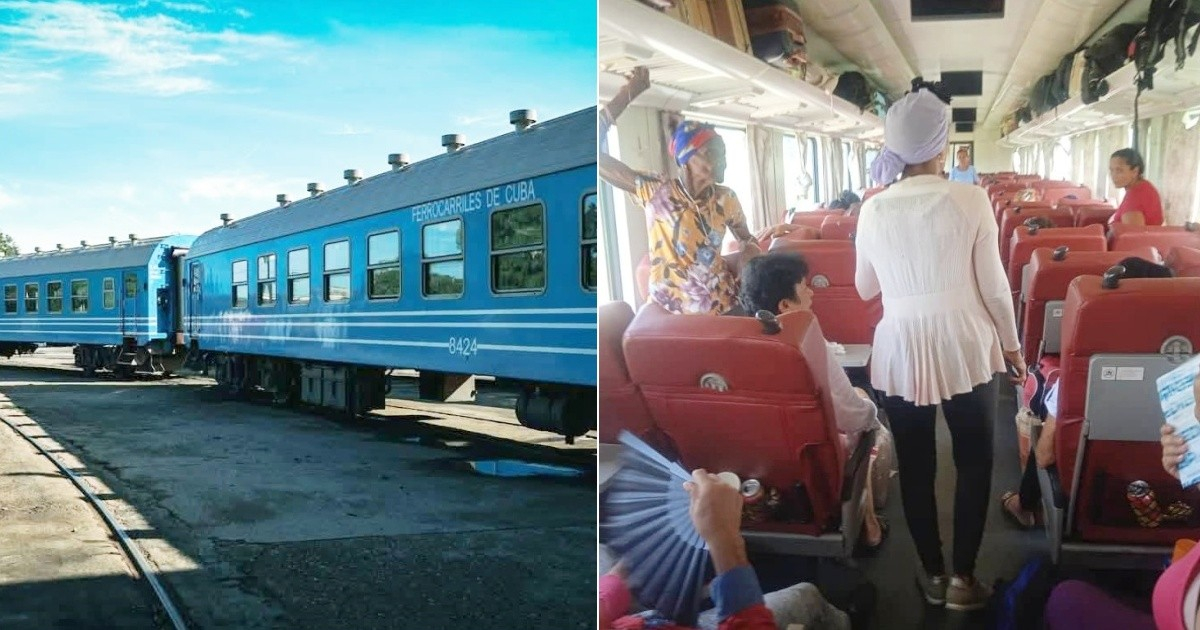
The train Manzanillo-Bayamo-La Habana was stranded for more than 13 hours in the town of Guamo, in the municipality of Río Cauto, Granma province, following an alleged criminal incident related to fuel, as reported by the First Secretary of the Party in Granma, Yudelkis Ortiz Barceló, on her Facebook profile.
The train had departed from Bayamo at 11:20 PM on Thursday.
However, at 1:20 am on Friday - during a technical stop in Guamo - the electromechanical technician detected an issue that prevented the continuation of the journey.
On board were around 200 children and 80 elderly adults, in addition to the rest of the passengers.
An alleged robbery that paralyzed the convoy
Ortiz Barceló went straight to the point regarding the cause: “Since early morning, that train was stranded there because apparently a criminal act is being investigated in connection with the fuel, which prevented its normal journey.”
The delay extended until 2:30 PM on Friday, when the train resumed its journey to Havana after changing part of the crew and refueling.
Passengers were stranded for approximately 13 hours.
The official warned about the consequences for those responsible, whose identities are currently unknown.
"We will await the outcome of the investigation, but if the cause was due to malice, wrongdoing, or a lack of control, it will not go unpunished, and they will have to face the full force of the law for putting the lives of so many people, especially children and the elderly, at risk," he warned.
Present at the location were Miriela Pilat, First Secretary of the Party in Río Cauto, and the mayor Yaniel Yero Nápoles, along with provincial officials and representatives from the railway department in Granma.
The neighbors did what the State did not guarantee
While the authorities were slow to resolve the issue, the neighbors of Guamo took the initiative: they gathered milk, water, and yogurt for the children, prepared soups, fried foods, and pizzas, and supported the passengers "in every need", as narrated by Ortiz Barceló.
Comments on social media reflected both gratitude and outrage.
A mother wrote: "I am the mother of two children who were on that train, and I sincerely appreciate the solidarity of the people of Guamo. My family is immensely grateful for everything you did."
But others pointed to the institutional failure: "The railway management should have been the first to ensure food and assistance for the passengers."
Another comment was more straightforward: "What I find very troubling is that the fuel has been lost. It's an abuse."
A neighbor from Guamo summed up the spirit of the popular response: "We do not give what's left over; we share what we have."
Three serious incidents in a single week
The stranding in Guamo was not an isolated incident.
The week from June 2 to June 5 witnessed three serious incidents in the Cuban railway: the derailment of train 13 Santiago-La Habana in Las Tunas with approximately 900 people on board; the blocking of train 17 La Habana-Manzanillo in Bayamo due to a fallen pole - with 900 passengers stranded for over 24 hours - and this alleged fuel theft in Granma.
The theft of fuel in the Cuban railway system has documented precedents.
In 2021, the Ministry of the Interior dismantled a network in Cienfuegos that stole 3,455 liters of oil from locomotives.
In 2019, 20 defendants were tried in Villa Clara for the same crime.
The collapse of the railway system has deep roots: in March 2025, the Minister of Transport acknowledged that only 14 of the 20 necessary locomotives were operational and that barely 63% of the planned carriages were functioning.
In February 2026, the fuel crisis forced a reduction in the frequency of national trains from every four days to every eight days per destination.
The official narrative portrayed the response of the residents of Guamo as a gesture of solidarity, but the facts reveal something more uncomfortable: it was the citizens themselves, not the State, who ensured basic assistance for hundreds of passengers stranded in the middle of the night.
Filed under: