
Related videos:
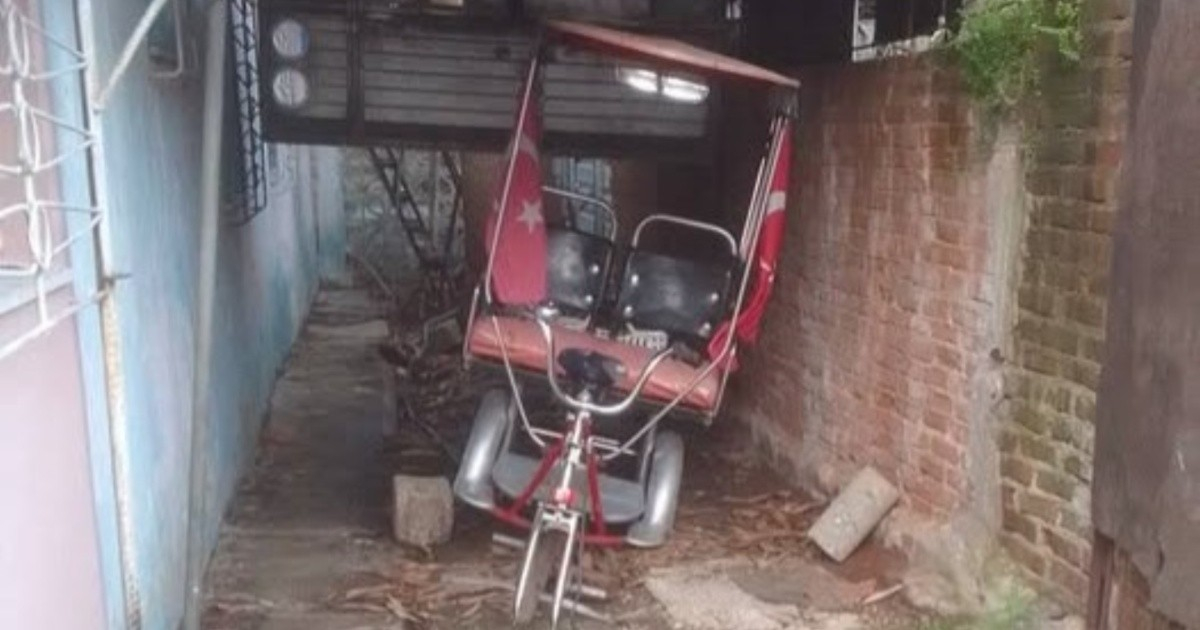
A Cuban identified as Vladimir Palma, resident of Bayamo, Granma, reported this Friday on Facebook that in the early morning his bicytaxi tires were stolen, his only means of livelihood to care for his mother, who suffers from blindness.
In two consecutive public posts, Palma described the condition of the vehicle—a red tricycle stored in a tight space under an improvised sheet metal roof—and expressed his despair over the loss.
"They had no reason to do this with the work I do to support my mother, who is blind, and they have taken away the only thing I had," the man wrote in his first post.
In a second installment, he showcased the damaged bicitaxi and summarized his situation with a phrase that encapsulates the struggles of thousands of Cubans: "This is how they’ve left my bixi, it’s not easy because they did this, I don’t harm anyone, I only work to support my mother who is blind."
Palma did not identify those responsible but entrusted them to God: "The one who stole the tires, or those who stole the tires, are in God's hands."
The man also directly referred to the crisis the island is experiencing: "They have no awareness of what it is, and given the situation in the country, supporting a mother like mine in the conditions she’s in."
The case reflects the extreme vulnerability of those who rely on informal means of transportation to survive in Cuba.
The Cuban state transportation has collapsed by 93% between January and September 2025, forcing thousands of citizens to turn to bicycles and cycle-taxis as a source of income, in a context where the average salary is equivalent to just 16 dollars a month in the informal market.
The theft of work materials has become a growing phenomenon in Cuba. According to the Cuban Observatory of Citizen Audit (OCAC), in 2025, 2,833 verified crimes were recorded, an increase of 115% compared to 2024 and 337% compared to 2023.
Thefts were the most frequent crime, with 1,536 cases, an increase of 479% since 2023, in a context where approximately 20% of the police forces may have abandoned the agency in the past year.
Similar cases to that of Palma have multiplied in recent months. In September 2025, a bicitaxero in Bayamo, Granma, was murdered while they were attempting to steal his vehicle and belongings.
In May 2026, a Cuban farmer was killed while trying to steal his oxen, his means of livelihood.
In the absence of effective police response, Cubans are increasingly turning to platforms like Facebook to bring visibility to their cases and seek solidarity.
The religious and resigned tone of Palma's message —which concludes by asking for blessings for those who stole from him— reflects a widespread distrust in the authorities to address this type of crime: "God is our refuge and our strength. God will take care of you. As for me, I can only say that God blesses you abundantly."
Filed under: