
Related videos:
The United States conducted an unprecedented rescue operation by employing an autonomous vessel equipped with artificial intelligence to recover two pilots from a helicopter Apache downed by Iran off the coast of Oman.
The military remained in the water for approximately two hours after an Iranian drone struck their AH-64 Apache near the Strait of Hormuz, one of the most strategic maritime routes in the world.
The mission successfully concluded when both were located by an uncrewed boat, the Saronic Corsair, and were subsequently transported to a safe area for medical attention, according to The Telegraph.
According to the confirmation from the United States Central Command (CENTCOM), this is the first known instance in which an autonomous naval vehicle directly participates in the rescue of military personnel in a combat zone.
The vessel used was developed by the American company Saronic Technologies and is part of a new generation of autonomous systems capable of navigating without a crew, avoiding obstacles, identifying targets, and transmitting information in real time to military operators.
The operation also represents a practical demonstration of the capabilities that the U.S. Southern Command (SOUTHCOM) has been promoting in recent months as part of its autonomous warfare strategy.
At the end of April, SOUTHCOM released images of the FLEX2026 exercises conducted in Key West, Florida, where it deployed an integrated network of aerial drones, unmanned surface vehicles, and autonomous platforms for surveillance, tracking, and interdiction of threats in the Caribbean.
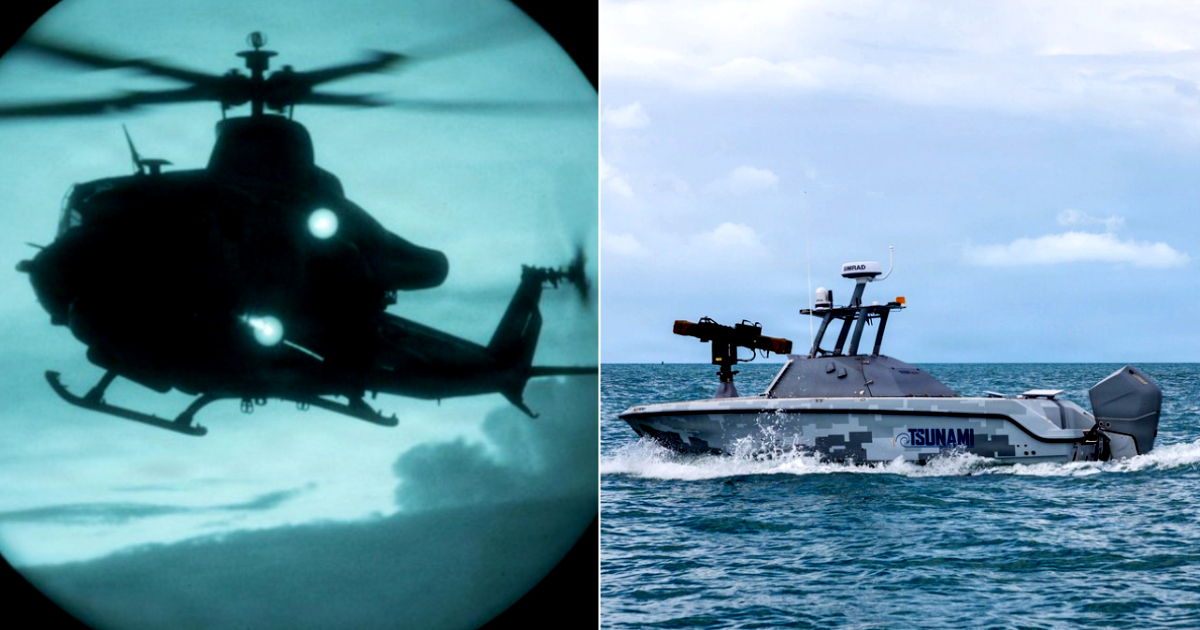
During those maneuvers, systems such as the Tsunami USV, Vanilla UAS, Orca UAS, and Aerosonde UAS participated, all coordinated to detect vessels and carry out operations with minimal human intervention.
The exercise culminated in the formal establishment of the Autonomous Warfare Command of SOUTHCOM (SAWC), a new military structure dedicated specifically to the use of autonomous and semi-autonomous platforms in regional operations.
The rescue mission in Oman now offers a tangible demonstration of the capabilities of these technologies beyond training exercises. Instead of exposing more military personnel to enemy fire, the U.S. Navy deployed a robotic vessel to recover the pilots, reducing risks and streamlining the operation.
Military experts believe that this episode marks a turning point in the integration of artificial intelligence into naval operations. Until now, most public demonstrations have focused on surveillance or attack tasks, but the successful rescue highlights new applications for such systems.
The incident also occurs in a context of increasing technological competition. As Washington expands the deployment of autonomous systems in various regions around the world, recent reports have indicated that Cuba has reportedly acquired hundreds of military drones through cooperation agreements with Russia and other allies.
The technological difference between both scenarios is striking. While the United States is already using autonomous vessels in real combat and rescue operations, the Cuban Revolutionary Armed Forces continue to rely heavily on obsolete equipment inherited from the Soviet era.
For Washington, the rescue of the pilots not only prevented a potential larger military crisis after the downing of the Apache, but also served to demonstrate a capability that could transform the way naval and rescue operations are conducted in future wars.
The president Donald Trump confirmed the downing of the helicopter and promised to respond to Iran. However, U.S. analysts believe that the success of the rescue operation may have prevented a further escalation of the conflict.
Filed under: