
Related videos:
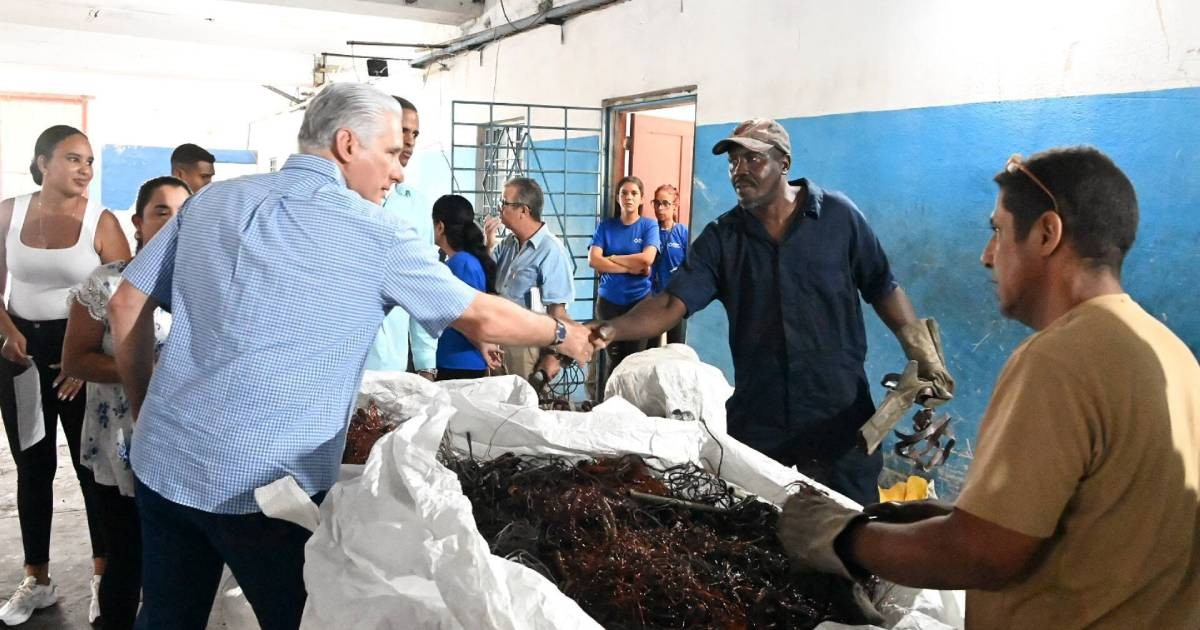
Miguel Díaz-Canel defended on Tuesday the idea of turning waste into a source of income for the Cuban economy during a visit to two entities of the Business Group of Recycling (GER) in Havana, amid a garbage crisis that continues to affect the capital and that the government itself acknowledges has not been resolved.
According to a report from the Presidencia de Cuba, after touring facilities dedicated to the processing and marketing of recyclable materials, the leader emphasized the economic potential of an activity that, he stated, can generate resources that the country needs in a context of profound financial difficulties.
The first stop of the tour was the Base Business Unit "Alfredo Ramonal," located in the municipality of Regla, where non-ferrous waste is classified and processed. Subsequently, the visit continued to Desequip, the company responsible for the import and export operations of GER under the supervision of the Ministry of Industries.
The visit takes place at a particularly challenging time for Havana. The capital generates between 24,000 and 30,000 cubic meters of solid waste daily, but difficulties with fuel and a lack of equipment have severely limited collection capacity. Last May, only 44 of the 106 available collection trucks were operational.
During the tour of the UEB "Alfredo Ramonal," the director of the entity, Sadie Jiménez Condés, explained how the company has managed to maintain its operations despite the blackouts affecting the country.
"We have differentiated work schedules with electric transportation for the workers. They were very interested in the salary and the turnover of the workers. Here, there is no turnover; the workforce is always fully staffed, and they are very happy with their salaries, which motivates them to continue," he stated.
According to data provided by the unit's management, the average salary exceeds 40,000 pesos per month, and the profits accumulated up to May surpass three million pesos.
Díaz-Canel insisted that part of those earnings should be allocated to improving working conditions and addressing social issues faced by workers, including housing difficulties.
The company also announced projects to expand its processing capacity. These include the installation of a copper crusher and systems that would provide energy autonomy to certain production areas.
Later, at Desequip, the leader learned details about a new local waste management system that has recently begun to be implemented in Havana. The initiative arose from studies conducted by the Ministry of Science, Technology, and Environment (Citma) and aims to increase the recovery of recyclable materials without the need for significant investments or a larger workforce.
Marian Herrera Delgado, a member of the recovery team from the Raw Material Recovery Company of Havana, explained that the system has already started to generate greater income from exports, although it still faces significant challenges, such as the implementation of a mobile application and a greater participation of the population and non-state economic actors.
The Recycling Business Group reported exports nearing 50 million dollars in 2025 and plans to extend this management model to the rest of the country.
During the meeting, Díaz-Canel advocated for increased community organization to promote waste sorting at the neighborhood level and to facilitate the participation of state enterprises, private businesses, and citizens in raw material recovery chains.
However, the official discourse on the economic potential of recycling contrasts sharply with the reality faced daily by the residents of Havana. The city has only about 10,000 garbage bins, while official estimates suggest it would need between 20,000 and 30,000 to adequately meet the demand.
One more revealing piece of information adds to this: in November 2025, the authorities themselves publicly acknowledged that they did not have accurate figures on the total volume of waste generated by the capital, a situation that has hindered the planning of long-term solutions for a crisis that remains evident in numerous neighborhoods of Havana.
Filed under: