
Related videos:
While thousands of families in Granma endure blackouts lasting almost two consecutive days, lack of water, and food going bad due to the absence of refrigeration, the top leader of the Communist Party in the province presented the scene of neighbors cooking tamales in the street as a demonstration of "resilience" and "humanism."
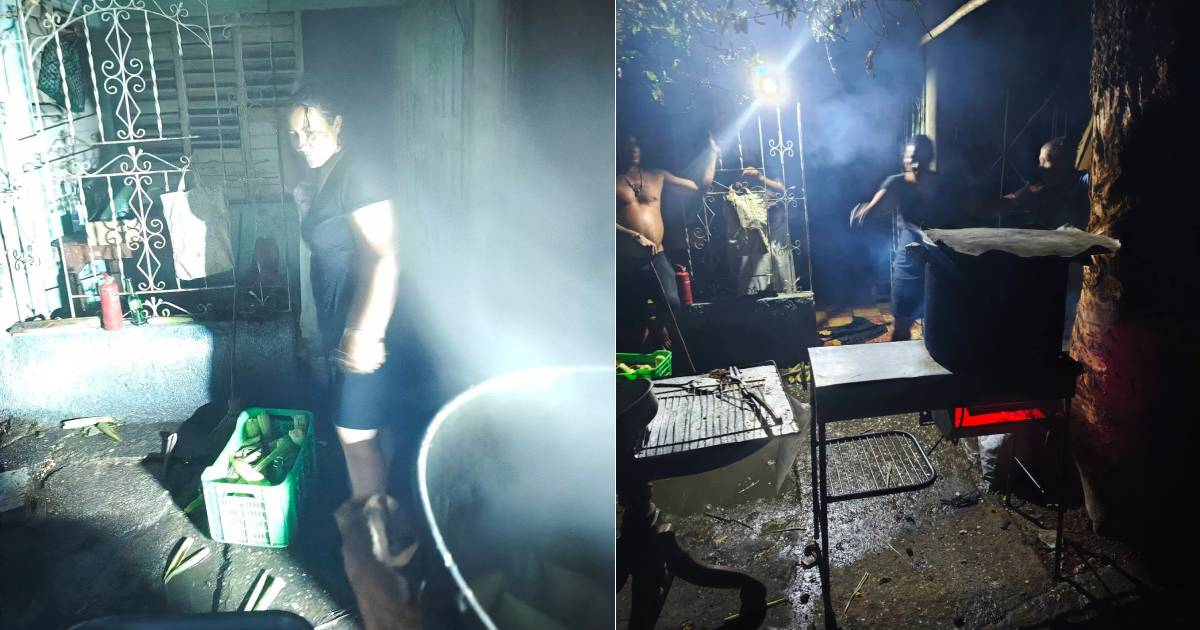
Yudelkis Ortiz Barceló, the first secretary of the Communist Party of Cuba (PCC) in Granma, published a message on Facebook this Wednesday, where she poetically described a day of collective cooking in the Rosa la Bayamesa neighborhood in Bayamo, without mentioning the energy crisis that forced residents to prepare food outdoors.
"In Rosa la Bayamesa, as in hundreds of neighborhoods in Granma, there is no electricity, but there is warmth. A large pot, one of those that hold stories, boils in the middle of the street, filled with tamales. It is the warm embrace of a neighborhood that does not give up," wrote the leader.
In another part of the publication, he stated that "there is no electricity, but there is power. The kind that passes from hand to hand, from heart to heart," and concluded that "the darkness of the blackout becomes small next to a people who prefer to share what they have."
Ortiz Barceló's words stand in stark contrast to the situation currently facing the eastern province, one of the hardest hit by the deterioration of the National Electroenergy System.
According to data from the Electric Company of Granma, on Wednesday the province was experiencing an outage of 93 megawatts, with only 19 megawatts remaining in service. Several circuits had accumulated nearly 48 consecutive hours without electricity.
The most affected territories included Jiguaní, with almost 49 hours of blackout, as well as Media Luna, Yara, and Las Novillas, where the outages also significantly exceeded 46 hours.
The crisis worsened further on Tuesday when the entire province was temporarily disconnected from the National Electric Grid due to an emergency. Restoration began partially, with only six active circuits and minimal generation.
While the communist leader emphasized neighborhood solidarity, residents of the province described a much harsher reality.
"We have no water, and the little food we have is going bad due to the lack of refrigeration. They are wiping out the population," commented a resident of the Conil and Bellavista communities quoted on social media.
This is not the first time that Ortiz Barceló has used this type of narrative to address crisis situations.
In November 2025, the head of the PCC in Granma described the passage of Hurricane Melissa as an "opportunity" and an "uplifting moment", while recently she has repeatedly emphasized presenting economic and productive difficulties as challenges that must be faced with sacrifice and collective effort.
The publication also comes just a few days after the authorities launched political mobilization efforts in Bayamo to explain to the population the reasons behind the blackouts. On June 5th, members of the Association of Combatants of the Cuban Revolution toured neighborhoods in the city as part of the initiative called Neighborhood for the Homeland.
Meanwhile, the energy crisis continues to deepen across the country.
For many Cubans, the image of tamales being cooked on the street reflects a very different reality than the one described by the communist leader: not a community choice, but a forced adaptation to a crisis that seems endless.
Filed under: