
Related videos:
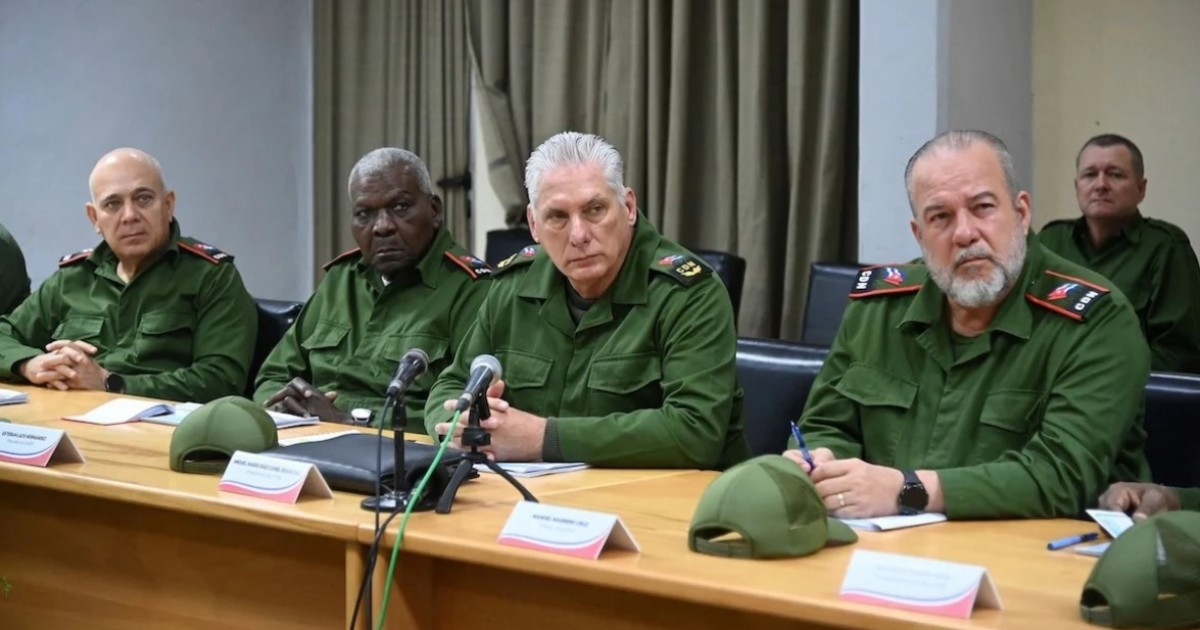
Cuban Prime Minister Manuel Marrero Cruz posted a message on X stating that "Cuba wants peace and is preparing to defend its sovereignty," accompanied by a photo taken during a military meeting in the Siboney defense area, located in the capital municipality of Playa.
The image, shared in the context of National Defense Day, shows a military briefing in a semi-open space, where about 15-20 people, most of them in the uniforms of the Revolutionary Armed Forces (FAR), are listening to an officer leading the session.
According to the official press, measures were evaluated during the day for the protection of the population and food production in that defense zone.
Marrero insisted on "accurately defining the demand for basic supplies" to ensure the vitality of the area, and plans for alerts, medical services, points of potable water supply, and the availability of renewable energy sources were reviewed.
The event is part of the "Year of Preparation for Defense" declared by the Ministry of Revolutionary Armed Forces (MINFAR) in January, which has included Saturdays dedicated to political-military training for the civilian population, in an environment that blends institutional elements with the precariousness of resources.
The University Student Bastion Exercise on March 27 was also conducted, featuring shooting practices with AK rifles and mine handling.
The contrast between the militaristic rhetoric and the reality faced by the Cuban population is stark. On the same Friday that Marrero posed at his military meeting, President Miguel Díaz-Canel acknowledged that in the past five months, only one oil tanker had arrived in Cuba.
The energy expert Jorge Piñón warned on the same day that there are between 10 and 11 thermal power units out of service, nearly 60% of the 19 units in the country, and that "there will be no quick solution" to the electrical crisis.
On May 14, a record electrical deficit of 2,174 MW was recorded, with only 976 MW available against a demand of 3,150 MW, leaving 70% of the country without electricity simultaneously. The government acknowledged that day that it had "absolutely no fuel, no diesel, only associated gas."
The ECLAC projects a decline of 6.5% in Cuba's GDP for 2026, following a contraction of 3.8% in 2025, while economist Pedro Monreal warns that the decline could reach 15% if inflation, the lack of foreign currency, and the energy crisis persist.
In this context, the medical students reported in May that their hospital rotations were suspended to involve them in a "week of concentrated Defense Preparation," while some military exercises have shown such rudimentary means as oxen and carts to transport weaponry.
On June 8, Marrero already sent a public message challenging the Trump administration's sanctions against GAESA, asserting that the United States would not succeed in "suffocating" Cuba.
The slogan "The Fatherland is defended" has been the leitmotiv of the official discourse throughout the year, while the population faces power outages of up to 48 consecutive hours and an unprecedented fuel shortage in decades.
Filed under: