
Related videos:
The announcement by Donald Trump of having reached a "great agreement" with Iran strongly reignites a question that has been hanging for months about the Caribbean: is Cuba next?
On June 4, Trump promised from the Oval Office to address Cuba as soon as he resolved the Iranian front.
"I like to do one thing at a time. We will focus on the Islamic Republic of Iran and, once that is resolved, we will make a brief stop. We will take care of that," he said before the press.
With the agreement with Tehran announced this Sunday—although Iran has not issued an official confirmation of the final text—this "small pause" takes on new urgency.
Trump's rhetoric on Cuba has followed a sustained escalation throughout 2026.
On March 5, he told Marco Rubio at the White House: "Your next project will be Cuba".
Similarly, on March 27, at the FII Priority Summit in Miami Beach, he was more direct: "I built this great army. I said I would never have to use it, but sometimes you have to. And Cuba is next, by the way, but pretend I didn’t say that, please."
On April 13, amidst heightened tensions with Iran, Trump once again brought Cuba into the mix: "Maybe we'll stop in Cuba after we finish with this."
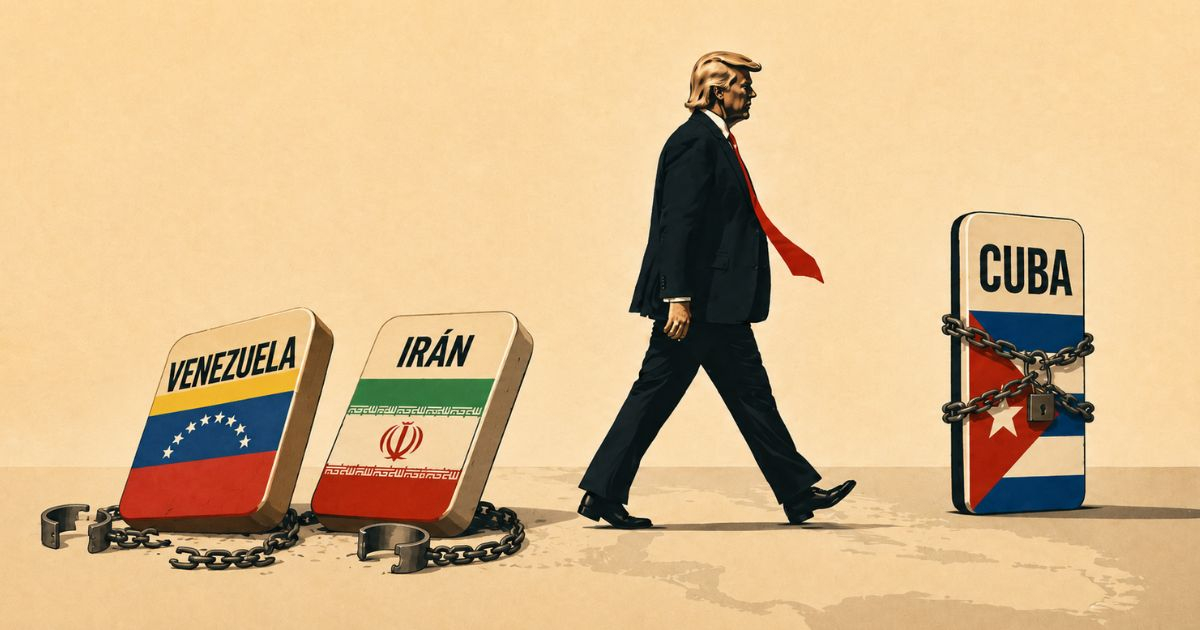
The pattern is clear: first Venezuela —with the capture of Nicolás Maduro on January 3— then Iran, and Cuba as the third step explicitly announced.
The pressure on Havana is not just rhetorical. On January 29, Trump signed Executive Order 14380, declaring the regime an "extraordinary threat" and imposing tariffs on countries that supply it with oil.
On May 1, he signed Executive Order 14404, which introduced secondary sanctions against third parties that operate with GAESA, the military conglomerate that controls the Cuban economy.
The deadline for foreign companies to sever ties with GAESA was June 5, and on the same day, Washington imposed sanctions on the Ministry of the Armed Forces, the Committees for the Defense of the Revolution, and the Cuban Institute of Friendship with the Peoples. Since January, the administration has imposed over 240 sanctions against the regime.
The situation on the island is catastrophic. Maduro's capture has cut between 26,000 and 70,000 barrels of Venezuelan crude oil daily, which accounts for 80-90% of Cuba's imports.
Power outages exceed 20 hours daily, the generation deficit reaches 2,100 megawatts, and GDP has accumulated a decline of 23% since 2019, with an additional contraction of 7.2% projected for this year. According to the UN, infant mortality has doubled to 9.9 per thousand births, and essential medicines are at 30% of their normal level.
On May 28, Axios revealed that the administration is preparing for a potential collapse of the regime "as early as this summer" and that Southern Command conducted simulation exercises for scenarios of unrest on the island, although officials dismissed any imminent invasion.
Rubio has set the conditions with surgical precision: "Their economy needs to change, and it cannot change unless their system of government changes. Who is going to invest billions of dollars in a communist country run by incompetent communists?"
Díaz-Canel, for his part, ruled out any political transformation—"my position is non-negotiable"—although he confirmed conversations with Washington and released 51 political prisoners in March.
The Deputy Foreign Minister Josefina Vidal clarified in April that there are only "initial contacts," not a structured negotiation. Cuba recorded 1,214 political prisoners in March, evidence that internal repression is not easing.
Trump summed it up on June 4 with a phrase that encapsulates his entire strategy: "We're going to take care of Cuba. And you know what? They are asking us for it. The people are asking us."
Filed under: