
Related videos:
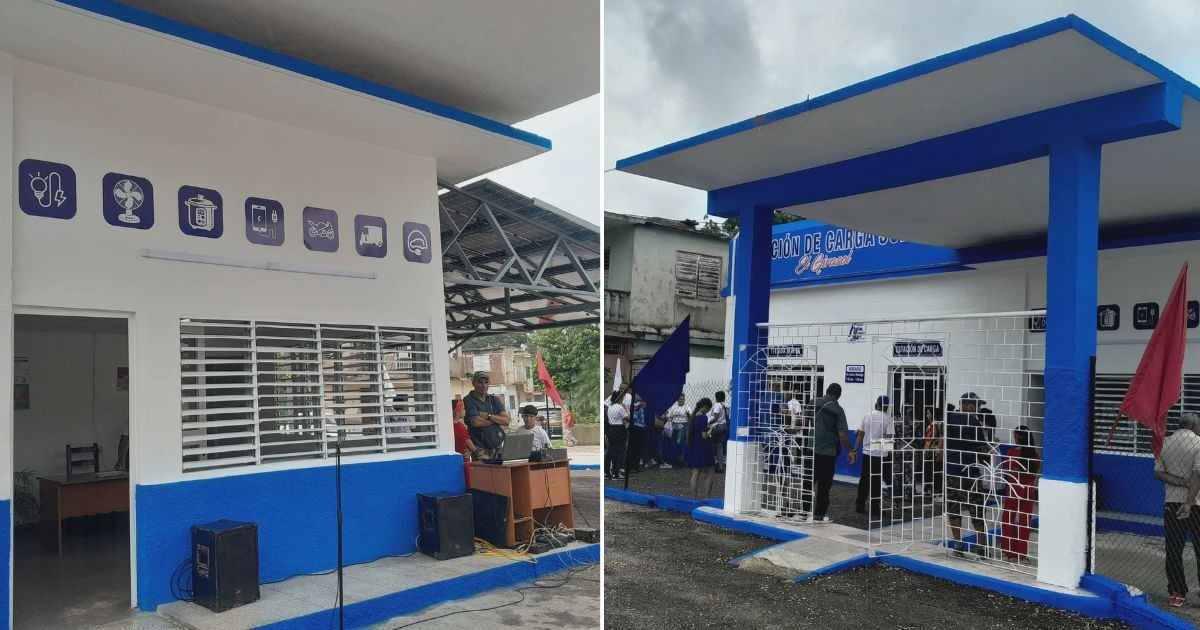
With great fanfare, the regime inaugurated in Holguín the first photovoltaic charging station in the province —named "El Girasol"— presenting it as a solution to the energy crisis facing the population, when in reality it is a small facility capable of charging electric tricycles, motorbikes, and cell phones in a city where power outages exceed 24 consecutive hours.
The station, inaugurated by the private micro, small, and medium enterprise Frenas Conmigo in the Alcides Pino popular council, has in its first stage only 30 kilowatts in inverters and 60 kilowatts in batteries, was prepared in 40 days, generates 10 jobs, and operates 12 hours a day.
While the initiative may provide slight relief to some individuals and serves as a commendable example of what the private sector can contribute, the reality is that the energy crisis affecting the population is far from being resolved with such solutions.
Álvaro Grass González, sole partner and founder of the company, explained that the station "provides supply facilities to residents and offers free services for everyday low-consumption devices, such as phones and rechargeable lamps."
The center also features cooking areas and a shop with various products, according to the Cuban News Agency.
At the inaugural event, Joel Queipo Ruiz, the first secretary of the Communist Party of Cuba in the province, Governor Manuel Hernández Aguilera, and the delegate of the Minister of Transport, René Rodríguez Morales, were present, highlighting the political significance that the regime assigned to the event.
The popular reaction on social media was, however, skeptical and strong.
"To the average Cuban, how does that benefit him?" asked Arielito Pego Quintan in the comments of the post. Rigoberto Arochena was more direct: "What does that solve? Six motorbikes and batteries."
Other users claimed that no one provided information on the service prices, which adds uncertainty regarding its actual accessibility for most people in Holguín.
The contrast between the official announcement and reality is stark. Holguín operates with only 70 megawatts of electrical capacity against a demand of between 225 and 240 megawatts —less than 30% of what is needed— and its residents endure schedules of just three hours of electricity for every 39 or 40 hours of blackout.
The crisis worsened on February 4th, when a malfunction at the Lidio Ramón Pérez thermoelectric plant in Felton caused a total blackout in Holguín, Granma, Santiago de Cuba, and Guantánamo.
The Holguin solar farm is part of a national trend driven by the energy crisis.
The first solar station in Cuba was inaugurated on April 5 in Santa Clara by the small and medium-sized enterprise Eléctrica Total, built in just nine days.
After her, Matanzas projected nine solar charging points and Havana announced a charging station in Vedado.
Grass González announced that in a second phase, the installation will expand its capacity to 76 kilowatts in inverters and 100 kilowatts in batteries, allowing it to operate 24 hours a day and also service electric vehicles.
Meanwhile, Fernando Bacallao Siré summarized the sentiment of many: "There needs to be a lot done in all the neighborhoods of Holguín and Cuba to alleviate the lack of electricity that the Government can provide."
Filed under: