
Related videos:
The problems in Cuba are as chronic as the solutions are unusual — and ineffective: while Santiago de Cuba endures up to 20 hours a day of power outages and its electrical grid collapses time and again, the Provincial Transportation Company announced that it is in the "final phase" of a project to bring electricity to neighborhoods with a solar bus.
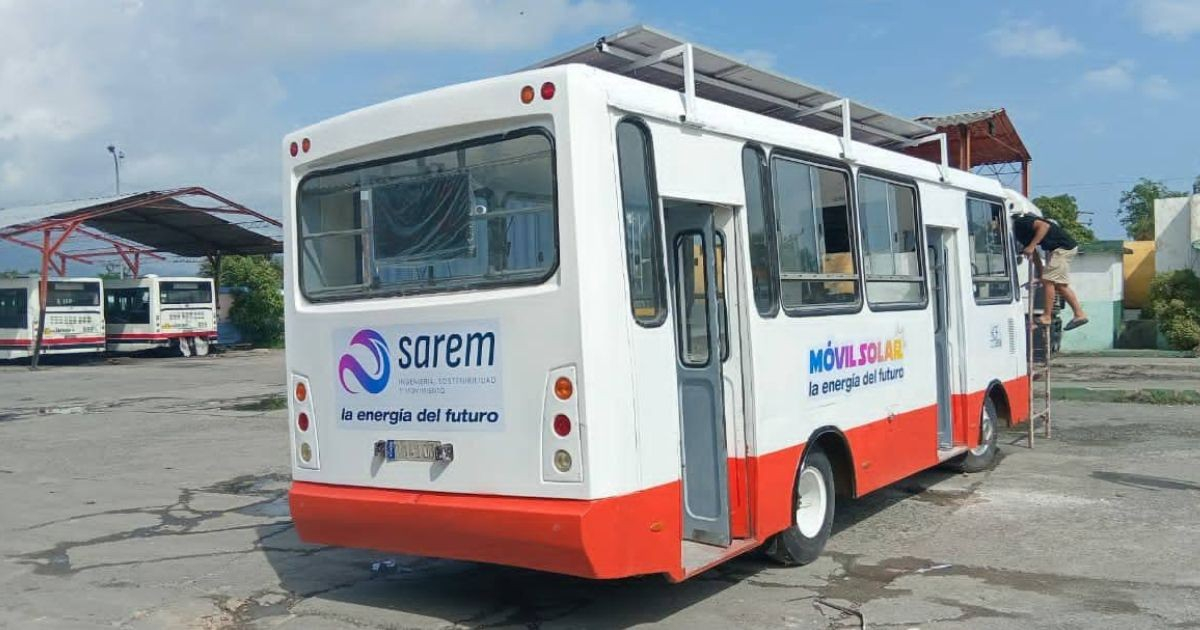
The vehicle in question is a Diana bus —one of the most common buses in Cuban transportation— adapted with photovoltaic panels on the roof and named "Solar Mobile."
According to the company, "this vehicle will not only transport but will also generate clean energy to provide electricity to communities facing supply difficulties," which it qualifies as "a firm step towards energy sovereignty."
The images from the advertisement show the interior still in the process of being prepared: outlets installed on the sides, white counter-style furniture, non-slip aluminum flooring, and a screen mounted at the back covered with protective plastic.
It seems that this "technological advance" will allow people to charge their devices, perhaps while cooking meals and keeping updated with the National Television News or the always useful Round Table.
The company did not provide details about routes, schedules, generating capacity, or the exact start date of operations.
He only promised that "he will soon be visiting prioritized areas of Santiago" and that there will be "more details coming soon."
The announcement comes at the worst time of the energy crisis in Santiago de Cuba, a province that has experienced blackouts lasting between 14 and 18 hours daily, with the three units of the Renté thermoelectric plant out of service repeatedly.
The hurricane Melissa left the province without electricity for more than a week in November 2025, and the blackouts ruined Christmas Eve that same year.
In May 2026, Santiago reported impacts even to radio and television signals due to generation deficits and lack of fuel.
Nationally, the electrical deficit exceeds 2,000 MW during peak hours in June 2026, and the system has experienced at least seven total collapses in 18 months, including a nationwide blackout on March 16 of this year.
The Santiago project is not the first of its kind. In April 2026, the private company Eléctrica Total introduced the ESTACIÓN-001 in Villa Clara, a solar bus converted into a mobile charging point for electric vehicles, independent of the national grid.
The difference is that the Santiago project is state-run and promises something more ambitious: to deliver electricity directly to residential neighborhoods.
Cuba has 54 photovoltaic solar parks that contribute up to 531 MW at noon, but that energy disappears at sunset, precisely when blackouts are most severe and when Cubans need it the most.
Filed under: