
Related videos:
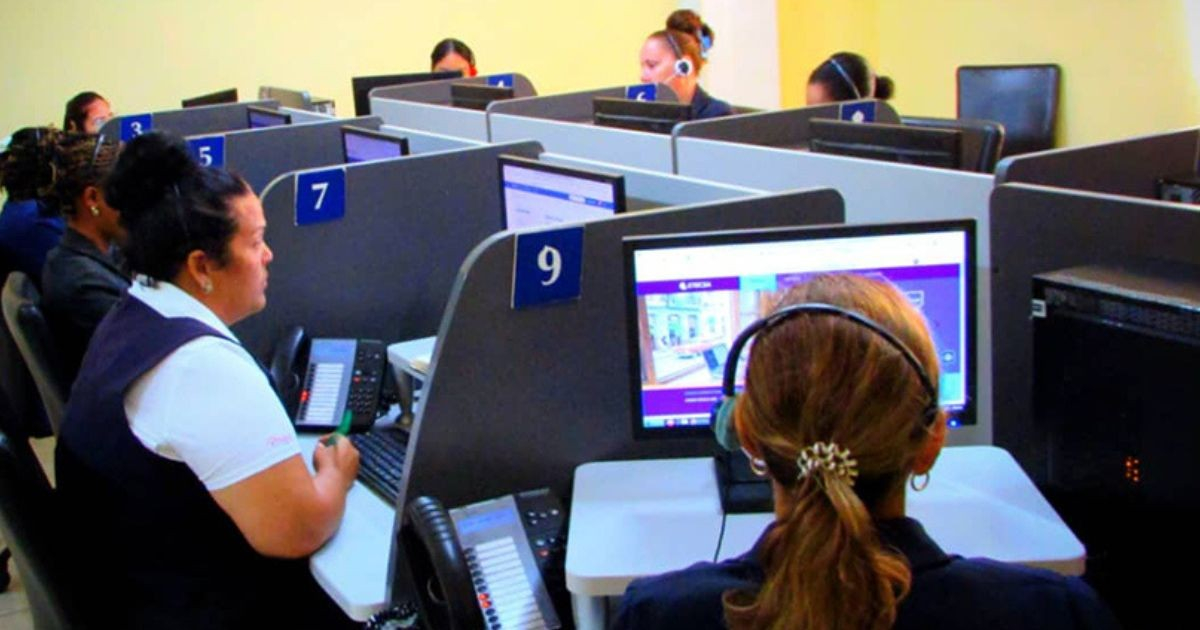
Three generations of women uphold the first line of contact between ETECSA and its clients in Ciego de Ávila, where the Telephone Service Center (CAT) of the company's Territorial Division operates under strict protocols, minute-by-minute metrics, and faces the challenging task of maintaining composure in the face of public criticism regarding the company's inefficiency.
This is depicted in a report by the state-run newspaper Invasor, published on Monday by journalist Alain Martínez Pol.
The telematic operators of CAT cannot use colloquial expressions. Their mandatory greeting is "Etecsa is at your service, how can we assist you?", and the system records how many calls each one has handled, the duration of each conversation, and whether they exceeded the break time for going to the bathroom.
Alicia María Consuegra Fernández entered the profession in 1994, when the center was called Telephonic Traffic and she operated a switchboard with ten simultaneous positions, during the Special Period, earning a minimum wage and facing inadequate food supplies.
"I come from the plugs of time immemorial," recalls the woman who is now a supervisor and has been unwilling to leave for over thirty years.
At that time, public phone calls with coins required distinguishing the sound of the medium and the peseta.
"If a cigar was lit, you had to respond. And always with your ear finely tuned, because in public calls with coins you had to distinguish the sound of the medium from the peseta, and notify the client when the three minutes were up," Alicia explains.
Then came the beepers, with between 600 and 700 messages per operator, with good spelling and no pause.
Then Movitel, text messages, and finally, the era of Nauta Hogar and data packages. "Now it's more complex because there's mobile, Nauta Hogar, all those services. You have to study and read non-stop," he admits.
Yanira Cedré Castilla, with five years of experience in the field, starred in one of the most intense nights of her career when an ambulance driver called her in desperation: his vehicle had broken down while transporting a patient from Sancti Spíritus to Ciego de Ávila and he was unable to reach his dispatch center.
Yanira found the connection she needed. "That feeling when a client thanks you after calling you upset is priceless," she says.
The youngest member of the team is Anella de la Caridad Montalvo Pérez, who is twenty years old. She enrolled in the training course shortly after turning 18, was the first in her group to do so, and graduated before she turned 19.
"I feel really happy. I have a wonderful job. The goal is to always meet the needs of the clients, to assist them with any concerns they may have," she confesses.
Anella acknowledges that the most challenging aspect is not the difficult calls, but the volume of information they must master.
"The most stressful part is the amount of information you have to gather, process, and read, as we are required to be well-prepared. Sometimes it’s hard to help clients understand the new modalities," she noted.
The work of the CAT takes on a specific dimension in the current context of ETECSA.
Since May 2025, the company has restricted top-ups in Cuban pesos to a limit of 360 CUP every 30 days and promoted data plans in dollars, which triggered a wave of public criticism. It is precisely those calls filled with frustration that the staff of the CAT receive daily.
Yanira advocates for the usefulness of telephone services in light of digitalization: “The internet is complicated for many people. Through the phone, we can help set up a hotspot, purchase a data package, and even assist students with access to educational sites.”
ETECSA plans to transform the old telephone service model into a digital contact center where employees will actively sell and promote services in the international market.
What all three agree will not change is the essence of the profession: "We always help someone, that makes you feel useful," Anella summarizes.
Filed under: