
Related videos:
There are photographs that document an event. And there are photographs that end up telling something more.
The one taken Tuesday night in Centro Habana belongs to the second category.
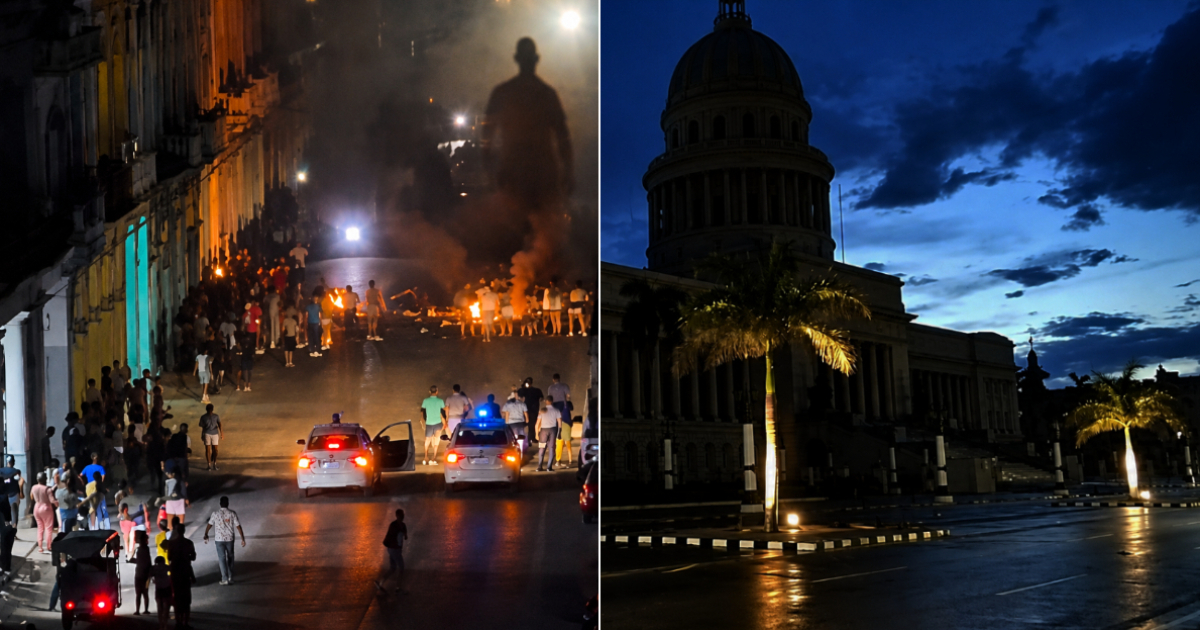
On a dark street, illuminated by the flames of a protest against blackouts, a gigantic human shadow seems to move through the smoke.
The image (still from a video) was captured at the intersection of Manrique and Reina, just a few blocks from the National Capitol, as dozens of residents took to the streets to demand the restoration of electric service after enduring long hours without power.
The figure does not exist. It is merely the result of an accidental combination of light, smoke, and perspective. However, it is hard to look away and not feel that it conveys something: the real pulse of a country descending into chaos, a hellish reality, the truth.
Because the image seems to capture something that has been growing in Cuba for months, or rather years.
The protests reported in Centro Habana are not an isolated incident. In recent weeks, cacerolazos have taken place in Santos Suárez, El Vedado, Cayo Hueso, Luyanó, Regla, Guanabacoa, and other neighborhoods of Havana.
Power outages, which in some areas exceed 30 continuous hours and in other provinces have extended for more than two days, have turned discomfort into a shared experience for millions of Cubans.
The figures reflect this trend. The Cuban Conflict Observatory recorded 1,245 protests in March 2026 and another 1,133 in April, the highest levels since the demonstrations of July 11, 2021. Cubalex has also documented arrests linked to protests over blackouts in the capital in recent months.
What happened in Manrique and Reina also has a symbolic value that is hard to ignore. It did not occur in a remote location or in a rural area. It happened practically at the gates of the Cuban political power.
While the Central Committee of the Communist Party was preparing to convene in an Extraordinary Plenary aimed at assessing the economic reforms announced by Miguel Díaz-Canel, the sound of the pots and pans echoed throughout the capital.
It is impossible to overlook that coincidence, just as it is the fact that the protest occurred just a few blocks from the Capitol, the headquarters of the National Assembly of People's Power, which was convened to meet this Thursday, June 18, and "discuss" the same issue
While the institutions of the regime were getting ready to applaud, cheer, and unanimously endorse what was decided by the top echelon of Cuban totalitarian power with that "revolutionary spirit" that is awakened in air-conditioned halls, the crisis was already speaking on the streets.
The temporal coincidence is inevitably revealing.
On one hand, the authorities are trying to present a package of reforms that includes greater autonomy for municipalities and state enterprises, changes in the subsidy policy, agricultural incentives, and a limited opening to investment from Cubans residing abroad.
On the other hand, a growing part of the population seems to be sending a much more immediate message: before plans and promises, they demand answers to a crisis that manifests every night when the lights go out.
The shadow captured in the photograph vanished seconds after it was recorded. The smoke dissipated. The lights changed. But the image remained.
Because its magnetic strength and steadfastness come precisely from what it symbolizes.
It does not represent a specific person. It represents a state of mind.
The fatigue accumulated from years of economic crisis, inflation, shortages, and blackouts is increasingly becoming more visible.
What for a long time remained locked away in dark homes, private conversations, or individual complaints is starting to be expressed in the streets, in neighborhoods, and in public spaces increasingly close to the centers of power.
Perhaps that's why the photograph is so unsettling.
Because the enormous figure that seems to advance through the smoke is not an individual. It is the involuntary representation of a reality that has become impossible to hide.
As if the discontent accumulated over the years had, for a moment, found a visible form, the shadow rises over the street with a disproportionate presence, born like a golem from the darkness and fire that surround it.
A six blocks from the Capitol, discontent took shape. And for a moment, it cast its shadow over power.
Filed under: